Resampling, Nonparametric, and Robust Methods
Fall 2026 · UA Little Rock
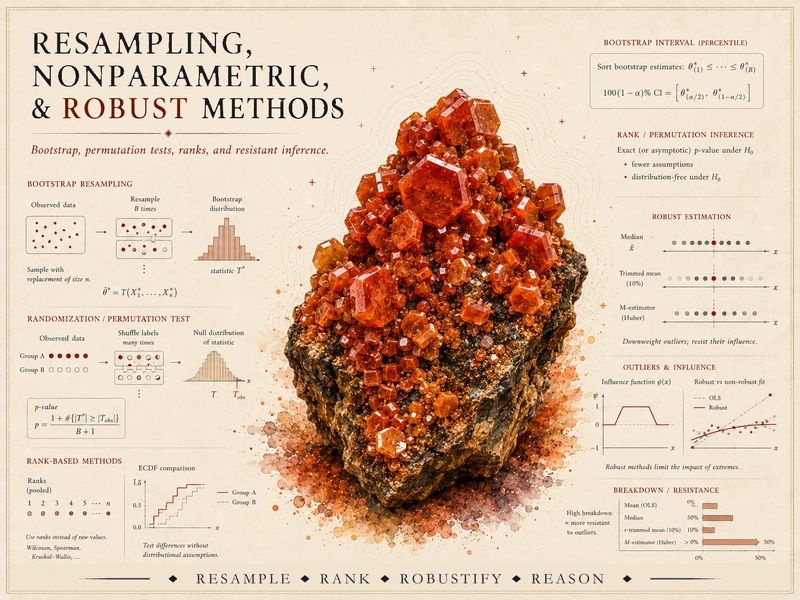
Source basis. Original instructor-authored notes; all data on this site is synthetic and instructor-generated. Open textbooks are used as conceptual companions by section title only (map-don’t-mine) — no prose, figures, examples, or exercises are copied. See Open readings & attribution. Public notes are ungraded; Blackboard is authoritative for graded work, due dates, and grades.
What this course is about
Most statistics courses begin with a comfortable set of models — normal distributions, equal variances, straight-line regression, the t-test, ANOVA, large-sample formulas. Those tools are genuinely useful. But real data are often skewed, heavy-tailed, ordinal, small-sample, contaminated by outliers, or shaped by a design where randomization matters more than a distributional formula.
This course asks a different opening question:
What can we responsibly infer from data when the usual assumptions are shaky, hard to justify, or beside the point?
We treat resampling, ranks, robustness, and simulation not as a box of backup tests to reach for after a normality test fails, but as core statistical ideas. You will see how methods behave, name what each one still assumes, choose a method for a purpose, and report results without overselling them.
How the site is organized
- Notes — one page per week. Each leads with a picture and a worked example, develops the idea in plain language with live-text math, and ends by connecting the method to a data-structure decision. Fifteen weeks, Week 1 → Week 15.
- Labs — short, self-contained resampling/robustness activities you can run in R or Posit Cloud. Public, ungraded exemplars that connect method logic to computation.
- Resources — software setup, a cross-cutting method-comparison guide, a notation glossary, applied-project guidance, and the open-reading list.
The habit the course builds
Every topic runs the same loop, on purpose:
formula → simulation → output → interpretation → method choice.
You will run simulations, build resampling procedures by hand and in code, compare a parametric and a nonparametric conclusion on the same data, explain a robustness tradeoff, and write a short report that ties the method you chose to the structure of the data in front of you.
A note on using AI
AI assistants are allowed as study aids, but resampling and nonparametric methods are unusually easy to explain wrong — by permuting the wrong thing, resampling rows when a dependence structure should be preserved, treating a bootstrap interval as assumption-free, or claiming a rank method has “no assumptions.” The syllabus asks for a short AI Use Note (Tool · Purpose · Verification) on graded work, and verification is the load-bearing line. These public notes are written to give you something concrete to verify against.
This is the public course site: notes, labs-as-material, and resources. Graded prompts, rubrics, point values, answer keys, and due dates live in Blackboard Ultra, which governs.