Course Library
Every public course-material site I maintain, together with the courses whose materials are still being built. Undergraduate and graduate records sit in one catalog rather than in separate destinations, ordered by curriculum rather than alphabetically.
Records that link out have a public course site. Some of those sites are still being assembled, and say so: an In development site is published while its dates, policies, assessments, and readings remain provisional. A course with no site at all, and a planning-stage curriculum direction, are shown as plain text with nothing to click.
These are shortcuts, not combinable filters: each one narrows the catalog on its own. The Filter box below searches every part of a record — title, code, level, status, summary, and curriculum grouping — so a status without a shortcut here, such as Maintained public reference, is still one search away.
Undergraduate course sites
Public course-material sites, each a self-contained collection of notes, labs, and references.
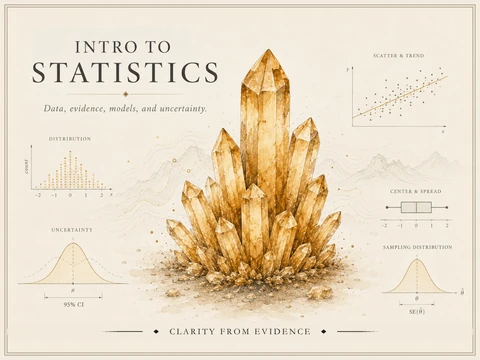
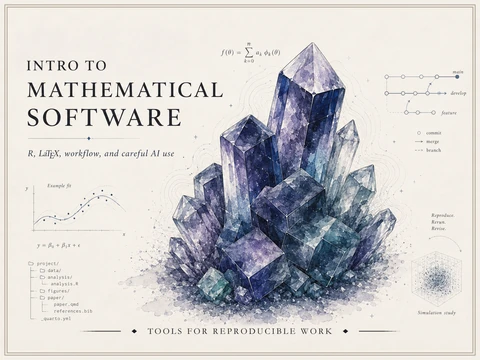
Intro to Mathematical Software
LaTeX, R, Quarto, reproducible workflow, and careful AI-assisted work.
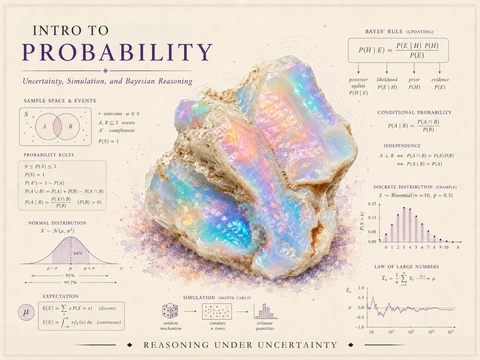
Sample spaces, conditioning and Bayes' rule, random variables, the standard distributions, and simulation.
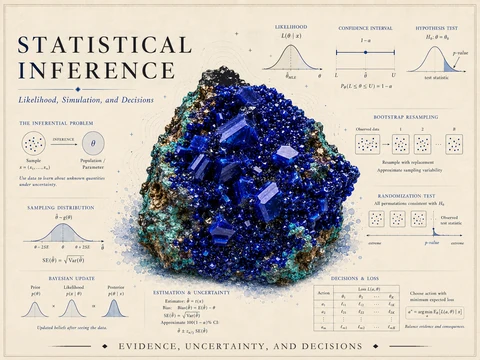
Sampling distributions, likelihood, confidence intervals, hypothesis tests, the bootstrap, and Bayesian inference.
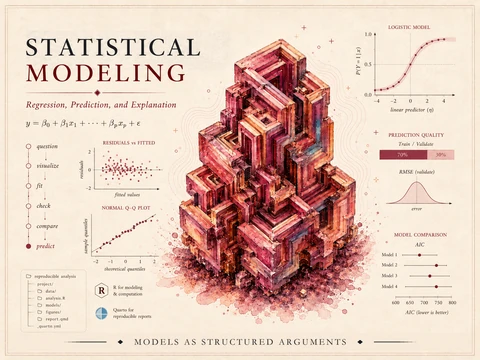
Regression, diagnostics, adjustment and interactions, prediction and validation, and logistic regression.
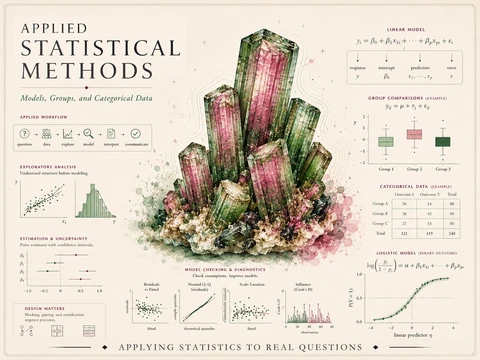
Group comparisons and ANOVA, regression and ANCOVA, contingency tables, and logistic regression.
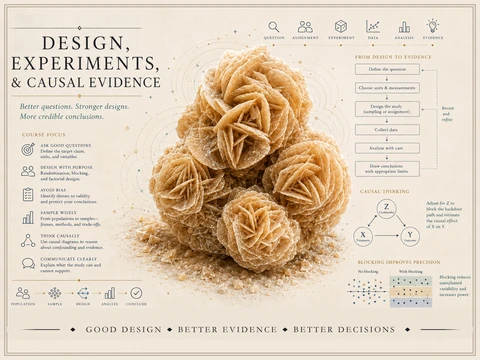
Design, Experiments & Causal Evidence
Sampling versus assignment, bias and confounding, blocked and factorial experiments, causal diagrams, and study critique.
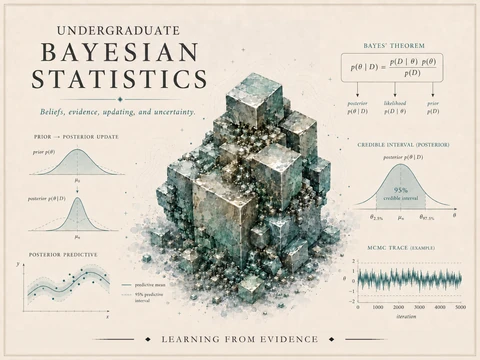
Priors, likelihoods, and posteriors; Bayesian regression, model checking, and hierarchical models.
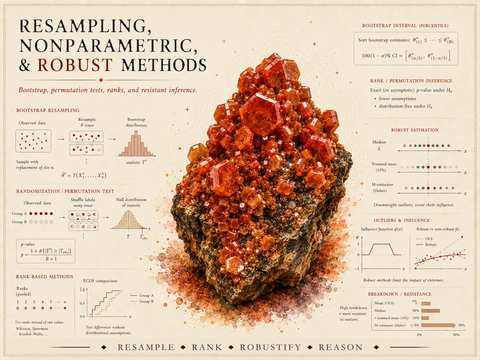
Resampling, Nonparametric & Robust Methods
Permutation and randomization tests, the bootstrap, rank-based methods, and robust estimation.
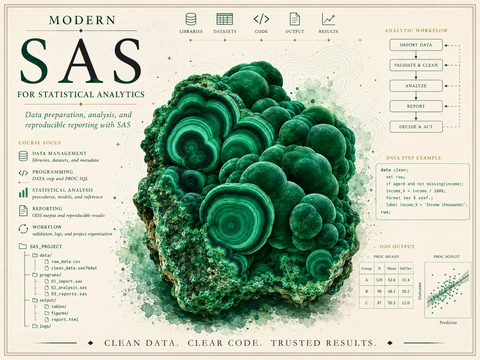
Modern SAS for Statistical Analytics
DATA steps, PROC SQL, cleaning and validation, the core procedures, ODS output, and reproducible reporting.
Graduate statistics curriculum
The mathematical-statistics sequence. These are established catalog courses; what is still being assembled is their public material.

Probability, likelihood, and estimation: sampling distributions, convergence, sufficiency, and information. Public materials are still being assembled, so dates, policies, and assessments remain provisional.

The established second course in the sequence: hypothesis testing, interval procedures, decision theory, asymptotics, and resampling. Public materials are still being assembled, so dates, policies, and assessments remain provisional.
Graduate curriculum directions
Planning-stage areas of the curriculum. Not scheduled courses, not adopted requirements, and not in-development course sites.
Regression and Generalized Linear Models
Graduate regression resting on the estimation and likelihood theory of the mathematical-statistics sequence. A planning-stage direction, not a scheduled course.
Not a scheduled course

Computational Statistics
Computation as a tool for statistical reasoning, with reproducible analysis as the working standard. A planning-stage direction, not a scheduled course.
Not a scheduled course

Bayesian Modeling
Graduate Bayesian modeling and workflow, following the conditional-probability and likelihood foundations of the mathematical-statistics sequence. A planning-stage direction, not a scheduled course.
Not a scheduled course

Causal Inference
Estimands, identification, and causal reasoning at the graduate level. A planning-stage direction, not a scheduled course.
Not a scheduled course
About course statuses
Status describes the public materials, not whether a course exists.
- Current offering — tied to a presently scheduled section.
- Maintained public reference — a durable, public resource collection that is not currently representing a scheduled section. Dates, weights, and final policies are not set here.
- In development — materials are still being assembled, so dates, policies, assessments, and readings remain provisional.
- No public materials yet — the course is real and established, but nothing public exists for it.
- Curriculum direction — a planning-stage area of the curriculum. Not a scheduled course, not an adopted requirement, and not an in-development course site.
Anything operational for a live section — meetings, dates, assessments, grades, and announcements — belongs in the LMS, not here.
How these materials are built
The sites above are the current public demonstration layer for Course Builder, a developing course-design harness I build and use. A Course Builder run does not improvise a course from a prompt; it extends a course as an explicit analytic object under stated controls — course context, source boundaries, pedagogy references, durable state, diagnostic gates, and human review. It is not autonomous course design: instructor judgment and release authority stay central, and graded, answer-key, and roster-specific material stays in the LMS, not on these public sites. See the research page for more.
See the Teaching overview for current courses, the teaching approach, and the Math Assistance Center.