Teaching
I teach mathematics and statistics at the University of Arkansas at Little Rock and direct the Math Assistance Center. My teaching emphasizes conceptual understanding, durable public course materials, reproducible work, and the careful use of computational and AI tools.
This page covers what I am teaching now and how I teach it. The complete collection of public course materials, undergraduate and graduate, lives in the Course Library.
Current courses
Public, durable resource sites for two of my current courses. Roster- and section-specific material lives in the LMS, not here.
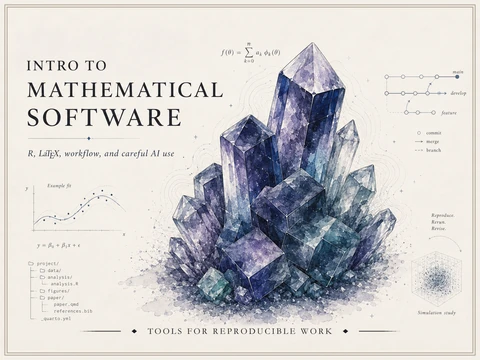
Intro to Mathematical Software
LaTeX, R, Quarto, reproducible workflow, and careful AI-assisted work.

Data, evidence, models, uncertainty, and simulation.
Each public course site also carries its own notes, labs, and examples alongside curated resource collections — see the Math Software resources and the Intro Stats resources.
Teaching approach
- Concepts before procedures. Students should understand why a method works before reaching for it, so the procedure becomes a tool rather than a ritual.
- Explain, verify, revise, communicate. I ask students to justify their reasoning, check their results, revise their work, and communicate it clearly — the habits that outlast any single course.
- Reproducible artifacts matter. Rendered documents, organized projects, executable code, and transparent AI-use notes (when AI is used) make student work durable, checkable, and honest.
Math Assistance Center
As Director of the Math Assistance Center (MAC) at UA Little Rock, I lead the university’s drop-in support center for lower-division mathematics and statistics. The role is part academic service, part leadership:
- Peer support at scale — coordinating drop-in tutoring that meets students where they are, across many courses and sections.
- Tutor mentoring and development — hiring, training, and developing peer tutors so they grow as explainers, not just answer-checkers.
- Instructional coordination — aligning support with what courses actually ask of students, in conversation with the instructors who teach them.
- Sustainable support workflows — building durable, low-overhead systems so the center keeps running smoothly from term to term.