Week 5 — Inner products, norms, and the geometry they impose
Where this week starts
Four weeks have gone by with no geometry in them. Week 1 built vector spaces over a field \(F\); Week 2 measured them with dimension; Week 3 mapped one space to another; Week 4 chose bases and produced \([T]_{\mathcal{C} \leftarrow \mathcal{B}}\). Now look back at the eight axioms and notice what is missing. Nothing in them lets you say that one vector is longer than another, that two vectors point in nearly the same direction, or that a third is perpendicular to both. Those are not facts you failed to prove. They are not available. A vector space over \(F\) has an algebra and no shape.
This week supplies the shape with one extra piece of data: a function that eats two vectors and returns a scalar, written \(\langle u, v \rangle\) and subject to three short axioms. What should surprise you is how much falls out — length, distance, angle, perpendicularity, the two inequalities most of analysis stands on, and a theorem identifying which notions of length arise this way. None of it needs the space to be finite-dimensional, which is worth saying twice, since finite-dimensionality has been load-bearing in nearly everything since Week 2.
There is a price, paid in the field. Positive-definiteness — the axiom making \(\langle v, v \rangle\) a plausible squared length — is an order statement, and most fields have no order to state it in, so from here until Week 9 the field is \(\mathbb{R}\) or \(\mathbb{C}\) and nothing else. Week 4 also left something unfinished: no ordered basis is canonical, since every \(n\)-dimensional space over \(F\) is isomorphic to \(F^n\) only after a choice. An inner product does not single out one basis, but it does single out a class of them, the orthonormal ones, in which computation is far cheaper. Building those is Week 6’s job; this week builds the structure that makes the word mean anything.
Why this matters beyond the definition
Here is a mistake that costs real time. Two vectors in \(\mathbb{R}^2\), \(u = (5, 2)\) and \(v = (1, -1)\), get declared non-orthogonal because \(u \cdot v = 5 - 2 = 3 \ne 0\), and the verdict is filed as a fact about \(u\) and \(v\). But suppose the problem came with the weighted inner product \(\langle u, v \rangle_w = 2u_1v_1 + 5u_2v_2\), a perfectly good inner product on \(\mathbb{R}^2\). Then \(\langle u, v \rangle_w = 10 - 10 = 0\) and the vectors are orthogonal after all. Orthogonality relates three things — two vectors and an inner product — and dropping the third is how weighted least squares and estimation under a covariance get misread.
The second stake concerns norms with no inner product behind them. It is tempting to think any sensible notion of length carries a notion of angle, so that a right angle and a Pythagorean identity are always in reach. Give \(\mathbb{R}^2\) the max-norm \(\lVert (a,b) \rVert_{\infty} = \max(|a|, |b|)\), which satisfies every axiom a norm is asked to satisfy, and take \(u = (1,0)\), \(v = (0,1)\). Then \(\lVert u \rVert_{\infty} = \lVert v \rVert_{\infty} = 1\) and \(\lVert u + v \rVert_{\infty} = 1\) as well: the hypotenuse matches each leg. That alone is no contradiction — unit vectors at 120 degrees do the same in the euclidean plane, where all three lengths are one — but here \(\lVert u - v \rVert_{\infty} = 1\) too, and the second worked example turns those four numbers into a proof that no inner product induces this norm.
What you will be able to do
- State the real and complex inner product axioms, including conjugate symmetry, and say which slot this course conjugates and why both slots cannot be linear at once.
- Verify that a proposed formula is or is not an inner product on a named space, including the integral form on \(C[0,1]\), where positive-definiteness genuinely uses continuity.
- Prove Cauchy-Schwarz over \(\mathbb{R}\) and over \(\mathbb{C}\), identify its equality case, and derive the triangle inequality from it.
- Compute inner products, norms, and angles for concrete pairs in \(C[0,1]\) and in \(\mathbb{C}^2\) with exact arithmetic.
- Exhibit a counterexample showing a norm need not come from an inner product, by breaking the parallelogram law for the max-norm.
- Decide whether a geometric conclusion is a fact about the vectors or about the vectors together with a chosen inner product.
Terms and notation worth fixing
| Symbol or term | What it means in this course |
|---|---|
| \(\langle u, v \rangle\) | the inner product of \(u\) and \(v\); linear in the first slot, conjugate-linear in the second |
| \(\overline{a}\) | the complex conjugate of \(a\); \(\overline{a} = a\) exactly when \(a \in \mathbb{R}\) |
| conjugate symmetry | \(\langle v, u \rangle = \overline{\langle u, v \rangle}\), which over \(\mathbb{R}\) is plain symmetry |
| sesquilinear | additive in each slot, homogeneous in the first, conjugate-homogeneous in the second |
| \(\lVert v \rVert\) | the induced norm \(\sqrt{\langle v, v \rangle}\), always a non-negative real number |
| \(u \perp v\) | \(\langle u, v \rangle = 0\); always read as “with respect to this inner product” |
| \(C[0,1]\) | continuous real functions on \([0,1]\), with \(\langle f, g \rangle = \int_0^1 f g\) |
| \(\lVert x \rVert_1\), \(\lVert x \rVert_2\), \(\lVert x \rVert_{\infty}\) | on \(F^n\): sum of moduli; the euclidean norm; the largest modulus |
| unit ball | \(\{ v \in V : \lVert v \rVert \le 1 \}\), which determines the norm completely |
One convention, fixed once. The form is linear in the first slot and conjugate-linear in the second for the rest of this course; much of the literature chooses the opposite, so check the second slot before trusting a formula you read elsewhere.
Inner products and the norm they induce
An inner product is structure laid on top of a vector space, not a consequence of it. The same space carries many, and each gives a different geometry to an identical set of vectors. What follows fixes the axioms, checks them on four spaces, and reads a notion of length off them.
The axioms, over the reals and over the complex numbers
Definition (real case). Let \(V\) be a vector space over \(\mathbb{R}\). An inner product on \(V\) is a function \(\langle \cdot, \cdot \rangle \colon V \times V \to \mathbb{R}\) such that for all \(u, v, w \in V\) and all \(a \in \mathbb{R}\):
\[\begin{aligned} &\text{(i) symmetry} && \langle u, v \rangle = \langle v, u \rangle, \\ &\text{(ii) linearity in the first slot} && \langle u + a w, v \rangle = \langle u, v \rangle + a \langle w, v \rangle, \\ &\text{(iii) positive-definiteness} && \langle v, v \rangle \ge 0, \text{ with } \langle v, v \rangle = 0 \text{ only for } v = 0 . \end{aligned}\]
Symmetry and (ii) give linearity in the second slot as well, so a real inner product is bilinear.
Definition (complex case). Let \(V\) be a vector space over \(\mathbb{C}\). An inner product satisfies (ii) and (iii) with \(a \in \mathbb{C}\), and replaces symmetry by conjugate symmetry, \(\langle v, u \rangle = \overline{\langle u, v \rangle}\). Axiom (iii) still parses: conjugate symmetry with \(u = v\) gives \(\langle v, v \rangle = \overline{\langle v, v \rangle}\), so \(\langle v, v \rangle\) is real even though the form is complex-valued, and demanding it be non-negative is legitimate.
Why not ask instead for a bilinear positive-definite form over \(\mathbb{C}\)? Because on a nonzero complex space there is none: if the form were linear in both slots and \(v \ne 0\), then \(\langle iv, iv \rangle = i \cdot i \, \langle v, v \rangle = -\langle v, v \rangle\), so positivity for \(v\) would force negativity for \(iv\). The conjugate is the one modification letting positivity survive. Combining conjugate symmetry with (ii) yields the second-slot rules
\[\langle u, v + w \rangle = \langle u, v \rangle + \langle u, w \rangle, \qquad \langle u, a v \rangle = \overline{a} \, \langle u, v \rangle,\]
each got by conjugating its first-slot counterpart. A form with these properties is sesquilinear — one-and-a-half-times linear — and the fraction is exactly that conjugate. One consequence used constantly: if \(\langle u, w \rangle = \langle v, w \rangle\) for every \(w\), then taking \(w = u - v\) gives \(\langle u-v, u-v \rangle = 0\), so \(u = v\) by positive-definiteness.
Field discipline, as promised. Over \(\mathbb{Q}\) the axioms are meaningful, since \(\mathbb{Q}\) is ordered, and the dot product on \(\mathbb{Q}^2\) satisfies all three; what breaks is the norm, because \(\lVert (1,1) \rVert = \sqrt{2}\) is irrational, so lengths escape the field. Over \(\mathbb{F}_2\) the failure is total: for the dot product on \(\mathbb{F}_2^2\) and \(v = (1,1)\), \(\langle v, v \rangle = 1 + 1 = 0\) with \(v \ne 0\). There is no ordering to state positivity in, and even the weak demand that \(\langle v,v \rangle = 0\) force \(v = 0\) fails. Nonzero vectors orthogonal to themselves are isotropic, and Week 9 is the theory that lives with them.
Three inner products, and a fourth that weights the plane
The dot product on \(\mathbb{R}^n\), \(\langle u, v \rangle = \sum_{j=1}^{n} u_j v_j\), is the model: symmetry and bilinearity are visible, and \(\langle v, v \rangle = \sum_j v_j^2\) is a sum of real squares, zero only when every \(v_j\) is. The standard Hermitian form on \(\mathbb{C}^n\), \(\langle u, v \rangle = \sum_{j=1}^{n} u_j \overline{v_j}\), conjugates in the second slot by our convention, so \(\langle v, v \rangle = \sum_j |v_j|^2 \ge 0\) with equality only at \(v = 0\); in matrix form it is \(\langle u, v \rangle = v^{*} u\), with \(v^{*}\) the conjugate transpose of the column \(v\).
The integral form on \(C[0,1]\), the real continuous functions on the closed unit interval, is \(\langle f, g \rangle = \int_0^1 f(x)g(x)\,dx\). Symmetry and bilinearity come from linearity of the integral, and positive-definiteness is where a hypothesis earns its keep. Certainly \(\langle f, f \rangle \ge 0\). Conversely, suppose \(f\) is continuous with \(f(x_0) \ne 0\). Continuity supplies \(\delta > 0\) and an interval \(I \subseteq [0,1]\) of length \(\delta\) containing \(x_0\) on which \(|f| \ge |f(x_0)|/2\); then \(\int_0^1 f^2 \ge \int_I f^2 \ge \delta f(x_0)^2/4 > 0\), so \(\langle f, f \rangle = 0\) forces \(f \equiv 0\). Drop continuity and the argument dies: the function equal to \(1\) at \(x = 1/2\) and \(0\) elsewhere is Riemann integrable, nonzero, and has \(\int_0^1 f^2 = 0\). On merely integrable functions the form is positive semi-definite, which is why the standard repair identifies functions agreeing off a negligible set. Note too that \(C[0,1]\) is infinite-dimensional, since \(1, x, x^2, \dots\) are independent, so every theorem below applies to it and none may assume \(\dim V\) is finite.
Finally the weighted inner product on \(\mathbb{R}^2\), \(\langle u, v \rangle_w = 2u_1v_1 + 5u_2v_2\): bilinear and symmetric by inspection, with \(\langle v, v \rangle_w = 2v_1^2 + 5v_2^2\) vanishing only when both coordinates do. More generally \(\langle u, v \rangle_A = v^{\mathsf{T}} A u\) is an inner product on \(\mathbb{R}^n\) whenever \(A\) is symmetric with \(x^{\mathsf{T}} A x > 0\) for every nonzero \(x\). Off-diagonal entries are allowed: for \(A = \begin{pmatrix} 2 & 1 \\ 1 & 1 \end{pmatrix}\), \(\langle v, v \rangle_A = 2v_1^2 + 2v_1v_2 + v_2^2 = v_1^2 + (v_1+v_2)^2\), which vanishes only at \(v = 0\). Deciding which symmetric \(A\) pass this test is the business of Week 9.
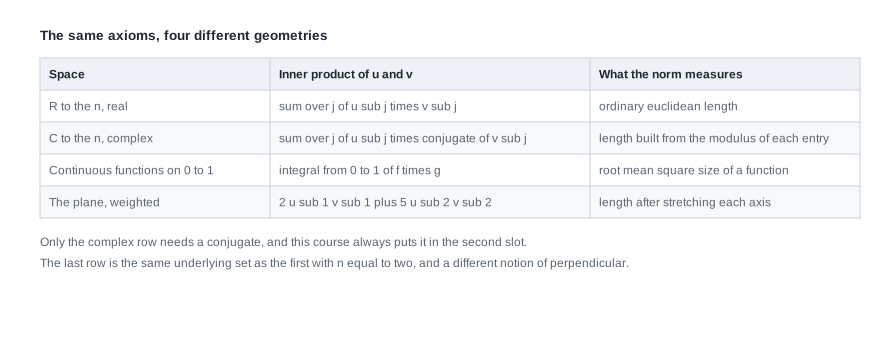
Read the table as one claim repeated four times: the axioms are fixed and the geometry is not. Its last row and its first row sit on the same set \(\mathbb{R}^2\), differ only in two positive weights, and disagree about which pairs are perpendicular.
The norm, and what positive-definiteness buys
Definition. For \(v\) in an inner product space the induced norm is \(\lVert v \rVert = \sqrt{\langle v, v \rangle}\), the non-negative square root of a non-negative real, and the distance from \(u\) to \(v\) is \(\lVert u - v \rVert\).
Two properties are immediate. That \(\lVert v \rVert = 0\) exactly when \(v = 0\) restates positive-definiteness, and it is why that axiom was demanded: without it a nonzero vector could have length zero, distance would not separate vectors, and every geometric argument here would collapse. Absolute homogeneity, \(\lVert a v \rVert = |a| \lVert v \rVert\), follows from \(\langle av, av \rangle = a\overline{a}\langle v, v \rangle = |a|^2 \lVert v \rVert^2\); the modulus emerges rather than the scalar, so over \(\mathbb{C}\) multiplying by any number of modulus one preserves length. The third property, the triangle inequality, is not obvious and needs Cauchy-Schwarz.
A norm on a real or complex vector space is any function \(V \to \mathbb{R}\) with those three properties, induced or not. Two on \(F^n\), for \(n \ge 2\), that are not induced are \(\lVert x \rVert_1 = \sum_j |x_j|\) and \(\lVert x \rVert_{\infty} = \max_j |x_j|\). Both really are norms: for the max-norm, \(\max_j |x_j + y_j| \le \max_j(|x_j| + |y_j|) \le \max_j |x_j| + \max_j |y_j|\), with homogeneity and positivity a line each. The second worked example shows no inner product whatsoever induces either, which is far stronger than saying no obvious one does.
Cauchy-Schwarz and the geometry it unlocks
Everything geometric here is a corollary of one inequality, and the inequality rests on one idea: a squared length arranged as a quadratic in a real variable cannot dip below zero, which constrains its coefficients. Those coefficients are inner products, so the constraint is a statement about inner products.
The inequality, with its proof
Theorem (Cauchy-Schwarz). Let \(V\) be a vector space over \(\mathbb{R}\) or over \(\mathbb{C}\) carrying an inner product. Then \(|\langle u, v \rangle| \le \lVert u \rVert \lVert v \rVert\) for all \(u, v \in V\), with equality if and only if \(u\) and \(v\) are linearly dependent. No assumption on \(\dim V\) is made or needed.
Argument, real case. If \(v = 0\) both sides vanish and the pair is dependent, so assume \(v \ne 0\), whence \(\lVert v \rVert^2 > 0\) by positive-definiteness. For \(t \in \mathbb{R}\), \[q(t) = \lVert u - t v \rVert^2 = \lVert u \rVert^2 - 2t \langle u, v \rangle + t^2 \lVert v \rVert^2 ,\] a real quadratic in \(t\) with positive leading coefficient which, being a squared norm, is non-negative for every real \(t\). A real quadratic \(\alpha t^2 + \beta t + \gamma\) with \(\alpha > 0\) that is never negative has \(\beta^2 - 4\alpha\gamma \le 0\), so \(4\langle u, v \rangle^2 - 4\lVert v \rVert^2 \lVert u \rVert^2 \le 0\), which rearranges to the claim.
Argument, complex case. The discriminant needs a real variable, so substitute the minimising value instead. Assume \(v \ne 0\), put \(t = \langle u, v \rangle / \lVert v \rVert^2\), so \(\overline{t} = \langle v, u \rangle / \lVert v \rVert^2\). Then \[\begin{aligned} 0 \le \lVert u - tv \rVert^2 &= \langle u, u \rangle - \overline{t}\,\langle u, v \rangle - t\,\langle v, u \rangle + t \overline{t} \, \langle v, v \rangle \\ &= \lVert u \rVert^2 - \frac{|\langle u, v \rangle|^2}{\lVert v \rVert^2} - \frac{|\langle u, v \rangle|^2}{\lVert v \rVert^2} + \frac{|\langle u, v \rangle|^2}{\lVert v \rVert^2} = \lVert u \rVert^2 - \frac{|\langle u, v \rangle|^2}{\lVert v \rVert^2}, \end{aligned}\] using \(\langle u, v \rangle \langle v, u \rangle = |\langle u, v \rangle|^2\) three times. Multiplying by \(\lVert v \rVert^2 > 0\) finishes it. Every step but the first is an identity, so equality holds exactly when \(\lVert u - tv \rVert = 0\), which positive-definiteness turns into \(u = tv\); conversely \(u = cv\) gives \(|\langle u, v \rangle| = |c| \lVert v \rVert^2 = \lVert u \rVert \lVert v \rVert\). The real equality case is the same: the discriminant vanishes exactly when \(q\) has a real root, and a root of \(q\) is a \(t\) with \(u = tv\).
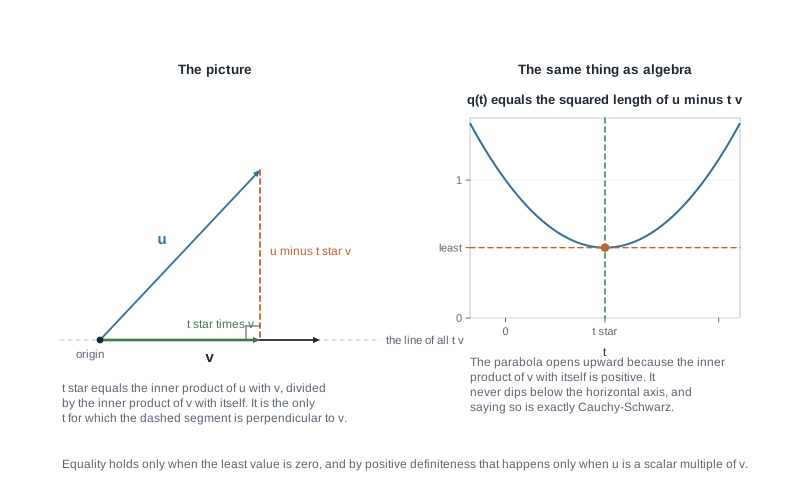
The figure carries the proof twice. On the left \(t^{*}v\) is the spot on the line \(\{tv\}\) closest to the tip of \(u\), and the dashed segment joining it to \(u\) meets \(v\) at a right angle; on the right the same quantity is the least value of \(q\). Multiplying \(q(t^{*}) = \lVert u \rVert^2 - |\langle u,v\rangle|^2 / \lVert v \rVert^2\) by \(\lVert v \rVert^2\) gives the deficit a meaning: \[\lVert u \rVert^2 \lVert v \rVert^2 - |\langle u, v \rangle|^2 = \lVert v \rVert^2 \, \lVert u - t^{*} v \rVert^2 ,\] so the gap measures how far \(u\) sits off the line through \(v\), and the inequality is strict exactly when \(u\) is off it. Week 7 calls \(t^{*}v\) the orthogonal projection of \(u\) onto \(\operatorname{span}(v)\).
Angle, orthogonality, and the triangle inequality
Definition (angle, real case). For nonzero \(u, v\) in a real inner product space, Cauchy-Schwarz puts \(\langle u, v \rangle / (\lVert u \rVert \lVert v \rVert)\) in \([-1,1]\), so exactly one \(\theta \in [0, \pi]\) has \(\cos\theta\) equal to it, and that \(\theta\) is the angle between \(u\) and \(v\). The definition is legitimate only because of the theorem; without it the arccosine would be undefined. Over \(\mathbb{C}\) the ratio need not be real and the sentence does not parse; the standard repair takes the modulus, so that \(|\langle u, v \rangle| / (\lVert u \rVert \lVert v \rVert) \in [0,1]\) determines a unique \(\theta \in [0, \pi/2]\). Complex angles are never obtuse, a sign the notion carries less information there.
Definition (orthogonality). \(u \perp v\) means \(\langle u, v \rangle = 0\). Conjugate symmetry makes this symmetric even over \(\mathbb{C}\), since \(\langle u,v \rangle = 0\) if and only if \(\langle v, u \rangle = \overline{0} = 0\). The zero vector is orthogonal to everything, and it is the only vector orthogonal to itself — positive-definiteness once more. Over \(\mathbb{F}_2\), where that axiom is unavailable, \((1,1)\) is orthogonal to itself, which is precisely the difference between this theory and Week 9’s.
Theorem (triangle inequality). In any real or complex inner product space, \(\lVert u + v \rVert \le \lVert u \rVert + \lVert v \rVert\).
Argument. Expanding, \(\lVert u + v \rVert^2 = \langle u,u\rangle + \langle u,v\rangle + \langle v,u\rangle + \langle v,v\rangle\), and the middle terms are conjugates, so their sum is \(2\operatorname{Re}\langle u, v\rangle\), where \(\operatorname{Re}\) denotes the real part of a complex number. A real part never exceeds a modulus, and Cauchy-Schwarz bounds the modulus, so \[\lVert u + v \rVert^2 = \lVert u \rVert^2 + 2\operatorname{Re}\langle u, v \rangle + \lVert v \rVert^2 \le \lVert u \rVert^2 + 2\lVert u \rVert \lVert v \rVert + \lVert v \rVert^2 = \big(\lVert u \rVert + \lVert v \rVert\big)^2 ,\] and taking non-negative square roots preserves it. Equality needs both estimates tight, that is \(\operatorname{Re}\langle u,v\rangle = |\langle u,v\rangle| = \lVert u \rVert \lVert v \rVert\), which together say one vector is a non-negative real multiple of the other, so the inequality is strict unless the two point the same way.
Pythagoras, the parallelogram law, and which norms are induced
Theorem (Pythagorean identity). If \(u \perp v\) in a real or complex inner product space then \(\lVert u + v \rVert^2 = \lVert u \rVert^2 + \lVert v \rVert^2\), since \(\langle u, v \rangle = 0\) kills the middle term of the expansion above.
Notice how much the proof used: only that \(\operatorname{Re}\langle u, v \rangle = 0\). Over \(\mathbb{R}\) that is orthogonality, so the converse holds and the identity characterises perpendicularity. Over \(\mathbb{C}\) it is strictly weaker and the converse fails: take \(u = (1,0)\) and \(v = (i,0)\) in \(\mathbb{C}^2\), where \(\langle u, v \rangle = 1 \cdot \overline{i} = -i \ne 0\), so the pair is not orthogonal — not even independent, since \(v = iu\) — yet \(\lVert u+v \rVert^2 = |1+i|^2 = 2 = 1 + 1\). Anyone proving a converse “by Pythagoras” over \(\mathbb{C}\) has proved something about real parts and nothing about orthogonality.
Theorem (parallelogram law). In any real or complex inner product space, \(\lVert u + v \rVert^2 + \lVert u - v \rVert^2 = 2\lVert u \rVert^2 + 2\lVert v \rVert^2\).
Argument. Expand both squared norms, the second using \(\lVert u - v \rVert^2 = \lVert u \rVert^2 - 2\operatorname{Re}\langle u,v\rangle + \lVert v \rVert^2\). The cross terms are equal in size and opposite in sign, so they cancel and twice each squared norm remains.
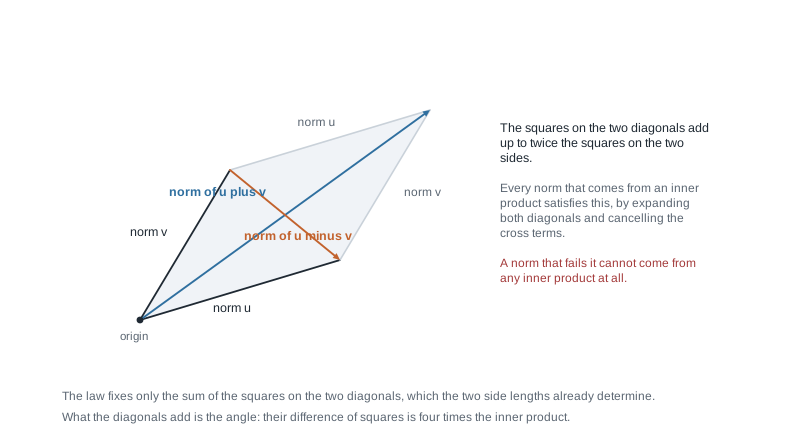
The figure shows why the identity earns a name. A parallelogram is determined by its two sides, and the law says the squares on its two diagonals always add up to a number the two side lengths already fix. The individual diagonals are not fixed: over \(\mathbb{R}\) the difference of their squares is exactly \(4\langle u, v \rangle\), which is why the polarisation identity below recovers the whole inner product, and with it the angle, from those same two diagonals. Nothing about the law is obvious, and nothing about it holds for a general norm.
Theorem (Jordan and von Neumann). Let \(\lVert \cdot \rVert\) be a norm on a real or complex vector space \(V\). Some inner product on \(V\) induces it if and only if the parallelogram law holds for all \(u, v \in V\). When it does, the inner product is recovered by polarisation: over \(\mathbb{R}\), \(\langle u, v \rangle = \tfrac{1}{4}\big(\lVert u+v \rVert^2 - \lVert u-v \rVert^2\big)\), and over \(\mathbb{C}\), with this course’s slot convention, \(\langle u, v \rangle = \tfrac{1}{4}\sum_{k=0}^{3} i^{k} \lVert u + i^{k} v \rVert^2\).
The forward direction is the theorem just proved, and both polarisation identities are short. Over \(\mathbb{R}\), subtracting the two expansions leaves \(4\langle u, v\rangle\). Over \(\mathbb{C}\), expanding \(\lVert u + i^k v \rVert^2 = \lVert u \rVert^2 + \overline{i^k}\langle u,v\rangle + i^k \langle v,u\rangle + \lVert v \rVert^2\) and summing against the weights \(i^k\) uses \(\sum_k i^k = 0\), \(\sum_k i^k \overline{i^k} = 4\) and \(\sum_k i^{2k} = 0\), again leaving \(4\langle u, v\rangle\). The converse — that a formula built from a norm obeying only the parallelogram law really is additive in its first slot — is the substantial half and the step this page compresses; it establishes additivity, then rational homogeneity, then real homogeneity by continuity of the norm. What matters here is the shape of the statement: the law is not merely necessary but a complete test, so ruling out every inner product at once takes one pair of vectors.
Worked example — the constant function and the identity on the unit interval
Work in \(V = C[0,1]\) over \(\mathbb{R}\) with \(\langle f, g \rangle = \int_0^1 fg\), and take \(f(x) = 1\), \(g(x) = x\), both continuous and so both in \(V\). Compute the inner product, both norms and the angle, confirm Cauchy-Schwarz exactly, and locate the deficit.
Step 1. The inner product. \(\langle f, g \rangle = \int_0^1 x \, dx = \left[ \tfrac{x^2}{2} \right]_0^1 = \tfrac{1}{2}\).
Step 2. The two norms. \(\langle f, f \rangle = \int_0^1 1 \, dx = 1\), so \(\lVert f \rVert = 1\); and \(\langle g, g \rangle = \int_0^1 x^2 dx = \tfrac{1}{3}\), so \(\lVert g \rVert = 1/\sqrt{3} = \sqrt{3}/3\).
Step 3. Cauchy-Schwarz, checked exactly. Compare squares to stay in the rationals: \(|\langle f, g\rangle|^2 = \tfrac14\) against \(\lVert f \rVert^2 \lVert g \rVert^2 = 1 \cdot \tfrac13 = \tfrac13\). Since \(\tfrac14 < \tfrac13\) the inequality holds and is strict, with deficit \(\tfrac13 - \tfrac14 = \tfrac{1}{12}\). Strictness was predictable from the equality case, which would need \(g\) to be a scalar multiple of \(f\), that is \(x\) to be a constant function.
Step 4. The angle. \(\cos\theta = \dfrac{\langle f, g\rangle}{\lVert f \rVert \lVert g \rVert} = \dfrac{1/2}{1/\sqrt{3}} = \dfrac{\sqrt{3}}{2}\), so \(\theta = \pi/6\): a thirty-degree angle between the constant function and the identity function, exact rather than decimal.
Step 5. Where the deficit lives. By the identity proved with the figure, the deficit should equal \(\lVert f \rVert^2 \lVert g - t^{*}f \rVert^2\) with \(t^{*} = \langle g, f \rangle / \lVert f \rVert^2 = \tfrac12\). The residual \(g - \tfrac12 f\) is the function \(x - \tfrac12\), and \(\big\lVert x - \tfrac12 \big\rVert^2 = \int_0^1 \big(x - \tfrac12\big)^2 dx = \left[\tfrac13\big(x-\tfrac12\big)^3\right]_0^1 = \tfrac13\big(\tfrac18 + \tfrac18\big) = \tfrac{1}{12}\). With \(\lVert f \rVert^2 = 1\) the predicted deficit is \(\tfrac{1}{12}\), matching Step 3.
Step 6. Two checks that must succeed. The residual is orthogonal to \(f\): \(\big\langle x - \tfrac12, 1 \big\rangle = \tfrac12 - \tfrac12 = 0\). So \(g = \tfrac12 f + \big(g - \tfrac12 f\big)\) splits \(g\) into orthogonal pieces, and Pythagoras must account for \(\lVert g \rVert^2\): indeed \(\big\lVert \tfrac12 f \big\rVert^2 + \big\lVert x - \tfrac12 \big\rVert^2 = \tfrac14 + \tfrac1{12} = \tfrac{3}{12} + \tfrac{1}{12} = \tfrac13 = \lVert g \rVert^2\). Every number above has now been recovered a second way.
What this establishes: two continuous functions have a well-defined angle, computable in closed form, and the geometric vocabulary of the plane transfers verbatim to an infinite-dimensional function space. What it does not establish: anything pointwise. The two functions agree at \(x = 1\) and differ sharply near \(x = 0\), and the inner product reports one averaged number that sees none of that. Nor is thirty degrees a fact about \(f\) and \(g\) alone — switch to \(\int_0^1 fgw\) for a positive continuous weight \(w\) and in general every number above moves, the angle included. A constant weight is the one exception: it rescales the whole form, and a rescaled inner product leaves every angle where it was, \(\pi/6\) here included.
The same reasoning, transferred
Run the same steps in \(\mathbb{C}^2\) with the standard Hermitian form, \(u = (1, i)\) and \(v = (1,1)\). Step 1: \(\langle u, v \rangle = 1 \cdot \overline{1} + i \cdot \overline{1} = 1 + i\), while \(\langle v, u \rangle = 1 \cdot \overline{1} + 1 \cdot \overline{i} = 1 - i\); the two differ and are conjugates, exactly as conjugate symmetry requires, so where the real case produced one number this produces two. Step 2: \(\lVert u \rVert^2 = 1 \cdot \overline{1} + i \cdot \overline{i} = 1 + 1 = 2\) and \(\lVert v \rVert^2 = 2\), so both norms are \(\sqrt{2}\) — and it is the conjugate that makes \(i \overline{i} = 1\) rather than \(i^2 = -1\), which is the whole reason the axioms were rewritten. Step 3: \(|\langle u, v \rangle|^2 = |1+i|^2 = 2\) against \(\lVert u \rVert^2 \lVert v \rVert^2 = 4\), so the inequality is strict with deficit \(2\); strictness follows from independence, since \(u = cv\) would force \(c = 1\) from the first coordinate and \(c = i\) from the second. Step 4: \(|\langle u,v\rangle|/(\lVert u \rVert \lVert v \rVert) = \sqrt{2}/2\), so \(\theta = \pi/4\). Step 5: with \(t^{*} = \langle u,v\rangle/\lVert v \rVert^2 = (1+i)/2\), the residual is \(u - t^{*}v = \big(\tfrac{1-i}{2}, \tfrac{-1+i}{2}\big)\), of squared norm \(\tfrac24 + \tfrac24 = 1\); multiplying by \(\lVert v \rVert^2 = 2\) recovers the deficit \(2\).
What stayed the same: the steps and their order, the role of Cauchy-Schwarz in making the angle well defined, and the deficit as distance off a line. What changed: the second slot conjugates, so \(\langle u,v\rangle \ne \langle v,u\rangle\) and the order of the arguments is part of the question; the inner product is not real, so the angle is built from its modulus and can never be obtuse; and \(t^{*}\) is complex. One check the real case could not offer: \(\langle iu, v\rangle\) should be \(i\langle u,v\rangle = i - 1\), and directly \(iu = (i,-1)\) gives \(i \cdot 1 + (-1)\cdot 1 = i-1\); while \(\langle u, iv\rangle\) should be \(\overline{i}\langle u,v\rangle = -i(1+i) = 1 - i\), and directly \(iv = (i,i)\) gives \(1 \cdot \overline{i} + i \cdot \overline{i} = -i + 1\). Both match and they differ, which is sesquilinearity made arithmetic.
Second worked example — a norm with no inner product behind it
The claim is negative and needs care: not that the max-norm on \(\mathbb{R}^2\) fails to arise from some obvious inner product, but that it arises from none. The Jordan and von Neumann theorem converts that into a finite check, since one pair of vectors breaking the parallelogram law rules out every inner product at once.
Step 1. It really is a norm. For \(\lVert (a,b) \rVert_{\infty} = \max(|a|,|b|)\), positivity is clear, homogeneity follows from \(\max(|ca|,|cb|) = |c|\max(|a|,|b|)\), and the triangle inequality was proved above. Nothing is wrong with it as a measure of length; whatever fails, fails for geometric reasons.
Step 2. The two vectors. Take \(u = (1,0)\) and \(v = (0,1)\), so \(u+v = (1,1)\) and \(u-v = (1,-1)\), and \[\lVert u \rVert_{\infty} = 1, \quad \lVert v \rVert_{\infty} = 1, \quad \lVert u + v \rVert_{\infty} = 1, \quad \lVert u - v \rVert_{\infty} = 1 .\]
Step 3. Both sides of the law. The left side is \(\lVert u+v \rVert_{\infty}^2 + \lVert u-v \rVert_{\infty}^2 = 1 + 1 = 2\); the right side is \(2\lVert u \rVert_{\infty}^2 + 2\lVert v \rVert_{\infty}^2 = 2 + 2 = 4\). Since \(2 \ne 4\) the law fails, and by the theorem no inner product on \(\mathbb{R}^2\) induces \(\lVert \cdot \rVert_{\infty}\).
Step 4. The same pair breaks the \(1\)-norm. Here \(\lVert u \rVert_1 = \lVert v \rVert_1 = 1\) while \(\lVert u+v \rVert_1 = \lVert u-v \rVert_1 = 2\), so the left side is \(8\) and the right side is \(4\). One norm makes the diagonals too short and the other too long, and the same two vectors rule out both. The euclidean norm passes, as it must: \(2+2 = 4\) on both sides.
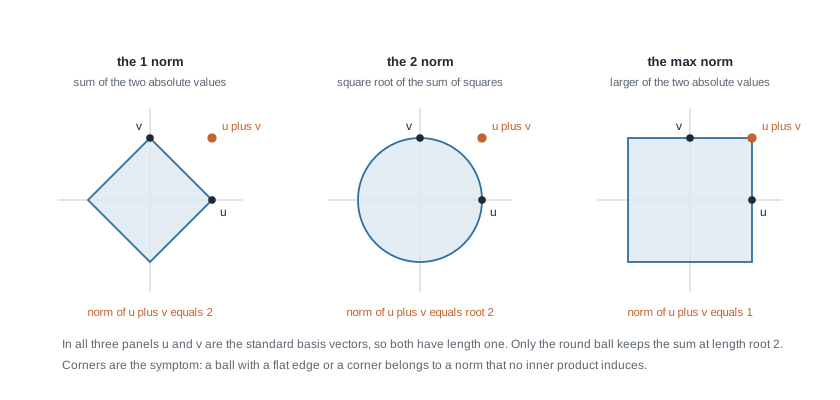
The picture explains the arithmetic. In every panel \(u\) and \(v\) sit on the boundary, so both have length one; what differs is where \(u+v\) lands. For the max-norm it lands on a corner of the square, still at length one, so a sum of two unit vectors is again a unit vector — Step 3 in one sentence. For the \(1\)-norm it lands twice as far out as the diamond’s boundary. Only the disc puts it at \(\sqrt{2}\). A unit ball with flat faces or corners belongs to a norm no inner product induces, because induced geometry forces the ball to be a genuinely round ellipsoid.
Step 5. What is actually lost. All three norms on \(\mathbb{R}^2\) are equivalent in the analyst’s sense, since \(\lVert x \rVert_{\infty} \le \lVert x \rVert_2 \le \lVert x \rVert_1 \le 2\lVert x \rVert_{\infty}\), so they agree about which sequences converge. That is a topological statement and says nothing about geometry. What the max-norm lacks is angle, orthogonality, projection, and uniqueness of nearest vectors — and the last is concrete. Let \(X\) be the vertical axis of \(\mathbb{R}^2\) and take \((2,0)\). Its max-distance to \((0,t) \in X\) is \(\max(2,|t|)\), which equals \(2\) for every \(t\) with \(|t| \le 2\), so a whole segment of vectors in \(X\) is nearest and none is preferable. Under the euclidean norm the nearest vector is \((0,0)\) and it is unique — the uniqueness Week 7’s best-approximation theorem delivers.
The misreading to avoid
The misreading: orthogonality is a property of the two vectors. It sounds harmless because in the only inner product most people have met, the dot product on \(\mathbb{R}^n\), it is true by default. But the sentence is incomplete in the way “the matrix of \(T\)” was incomplete in Week 4 — there it needed two bases, here an inner product. In \(\mathbb{R}^2\) let \(u = (5,2)\) and \(v = (1,-1)\). Under the dot product \(\langle u,v\rangle = 5 - 2 = 3 \ne 0\), so they are not orthogonal; under the weighted form \(\langle u,v\rangle_w = 2\cdot 5\cdot 1 + 5\cdot 2\cdot(-1) = 10 - 10 = 0\), so they are. The reverse direction is as easy: \(u' = (1,1)\) and \(v' = (1,-1)\) have \(u' \cdot v' = 0\) but \(\langle u', v'\rangle_w = 2 - 5 = -3 \ne 0\). Two pairs, two forms, every combination of verdicts realised.
The diagnostic is Week 4’s in a new costume. If a claim can be stated without naming an inner product — that a set is independent, that a map is injective, that \(\dim U = 2\) — then it is a claim about the space, and choosing an inner product to prove it is legitimate technique. If it mentions length, angle, perpendicularity, projection, distance, or “shortest”, then the inner product is part of the statement and must travel with it.
A second misreading is that Cauchy-Schwarz needs finite dimensions, or coordinates, or a sum. Look back at the proof: it used the axioms, the non-negativity of a squared norm, and nothing else, which is why Step 3 of the worked example could apply it to two functions in an infinite-dimensional space without a word of justification. Finite-dimensionality becomes a real hypothesis next week, though not quite where you would guess: Gram-Schmidt itself asks only for an ordered independent list, and next week runs it inside \(C[-1,1]\), which is infinite-dimensional. What needs \(\dim V\) finite is the corollary drawn from it, that every such space has an orthonormal basis. The hypothesis bites again in Week 7, where best approximation needs the subspace finite-dimensional. It is a hypothesis of nothing on this page, and pretending otherwise hides where it genuinely bites.
Practice on your own
These are for your own checking rather than for submission, and each is within reach of Weeks 1 through 5.
- A form that is not an inner product. On \(\mathbb{R}^2\) define \(B(u,v) = u_1v_1 - u_2v_2\). Show it is bilinear and symmetric, then find a nonzero \(v\) with \(B(v,v) = 0\) and another with \(B(v,v) < 0\). Which axiom fails, and which of Cauchy-Schwarz, the triangle inequality and Pythagoras survive its loss?
- Weights and perpendicularity. For which pairs of positive weights \((w_1, w_2)\) is \((3,1)\) orthogonal to \((1,-2)\) under \(\langle u,v\rangle = w_1u_1v_1 + w_2u_2v_2\)? Solve the condition, exhibit one such inner product, and verify positive-definiteness for your choice.
- The equality case, tested. In \(C[0,1]\) compute \(\langle f,g\rangle\), \(\lVert f \rVert\) and \(\lVert g \rVert\) for \(f(x) = x\) and \(g(x) = 3x\), and confirm Cauchy-Schwarz holds with equality. Then explain from the proof, not from the arithmetic, why equality was forced here and strict in the worked example.
- Breaking the law elsewhere. The \(1\)-norm on \(\mathbb{R}^3\) also fails the parallelogram law. Find an explicit pair that breaks it, compute all four norms, and confirm both sides. Then decide whether your pair breaks the max-norm on \(\mathbb{R}^3\) too, and say why the two verdicts need not agree.
- Polarisation as a computation. Take the dot product on \(\mathbb{R}^2\) with \(u = (3,1)\) and \(v = (1,2)\). Compute \(\lVert u+v \rVert_2^2\) and \(\lVert u-v \rVert_2^2\), apply the real polarisation identity, and check that \(u \cdot v\) comes out. Then apply the same identity to the max-norm on that pair and show what it produces is not bilinear, by testing additivity against a third vector.
Where to read more
This page stands on its own, but a second treatment in a different voice is often what makes an inequality settle. The three addresses below are offered online at no cost by their providers; availability and licence terms are as those providers state them, and neither is confirmed here.
- MIT OpenCourseWare 18.700 Linear Algebra — a proof-based course whose inner product spaces, Cauchy-Schwarz and orthogonality run parallel to this week and on into Weeks 6 and 7.
- Linear Algebra Done Wrong by Sergei Treil — an abstract-first text whose chapter on inner product spaces sets up the complex case with the same care about which slot conjugates.
- MIT OpenCourseWare 18.06 Linear Algebra — the computational complement, for dot products, lengths and projections on explicit numerical vectors.
- The optional Roman alignment for this week is the chapter on inner product spaces, in the sections on inner products and on norms. That text is an optional reference: a borrowed or library copy suffices, and nothing from it is reproduced or adapted here.
- Course pages: the notes overview, the syllabus, the schedule, and the resources page. The learning management system remains authoritative for section logistics and graded details.
Where this goes next
You now have a geometry: length from the inner product, distance from the norm, angle from Cauchy-Schwarz, perpendicularity from the vanishing of one scalar. You also have a sharp test for when a notion of length is of this kind, and two familiar norms that fail it. What you do not have is a way to use orthogonality efficiently. Every computation here handled two vectors at a time, and an arbitrary ordered basis makes \([v]_{\mathcal{B}}\) easy to define and \(\lVert v \rVert\) awkward to read off.
Week 6, on orthogonal sets, orthonormal bases, and Gram-Schmidt, repairs that. It proves an orthogonal set of nonzero vectors is automatically independent — three lines, and the reason the whole block works — then gives an algorithm turning any independent list into an orthonormal one spanning the same subspaces at every stage. Against such a basis, coordinates stop being a linear system to solve and become inner products to compute, \(v = \sum_i \langle v, e_i\rangle e_i\). Weeks 7 through 9 spend that on projection and least squares, on orthogonal complements and adjoints, and finally on bilinear and quadratic forms over a general field, where positive-definiteness is dropped and the isotropic vectors named above return to be classified. To look back: Week 4 carries the coordinate machinery this geometry attaches to, and the notes index and course home page list what is here.