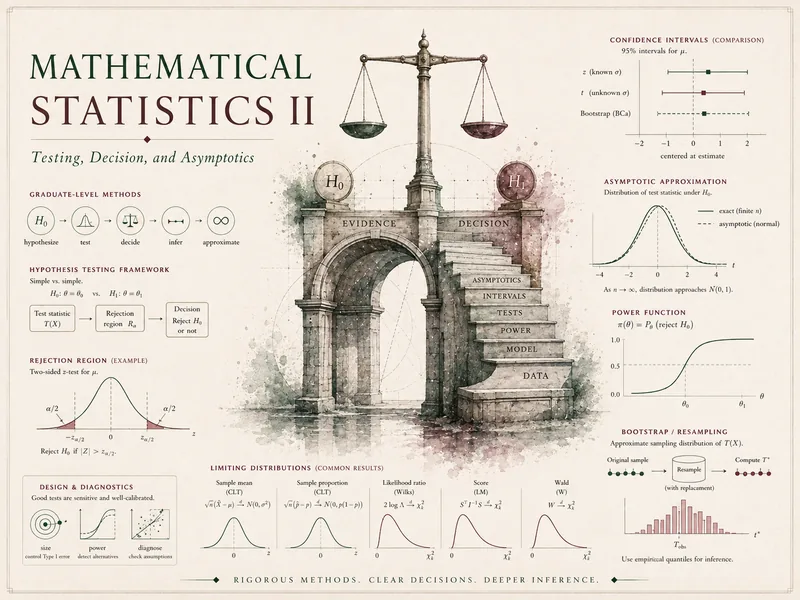
Mathematical Statistics II
Treat a statistical procedure as a decision rule with assumptions and operating characteristics rather than a mechanical route to a p-value: derive how a procedure is built, calibrate what it actually does, stress it where its assumptions fail, and compare exact, asymptotic, resampling, robust, and Bayesian answers to the same question.
3 credits · in person · Fall 2027
These public materials are still being assembled. The course itself is an established graduate catalog course (MATH 75163); what is provisional here is the public collection. Dates, policies, assessments, and readings on this site are provisional and may change, and the term shown above is a planning assumption rather than a scheduled section. The learning management system is authoritative for section logistics and graded details.
What you will learn
- Formulate statistical inference as a decision problem with an estimand, action space, loss function, procedure, and risk.
- Define and calculate size, level, power, type I error, type II error, and power functions, and explain what each quantity does and does not establish.
- Apply the Neyman-Pearson lemma and monotone likelihood-ratio arguments to construct most powerful and uniformly most powerful tests.
- Use the duality between tests and confidence sets to derive and interpret exact and approximate procedures.
- Derive and compare likelihood-ratio, score, and Wald tests, including their regularity assumptions and finite-sample limitations.
- Handle nuisance parameters using conditioning, profiling, invariance, or asymptotic approximation when appropriate.
- Derive central results for normal linear models using projections and quadratic forms, including t, F, regression, and analysis-of-variance procedures.
- Explain and evaluate family-wise error control, false-discovery-rate control, multiple comparisons, and introductory selective-inference concerns.
- Construct and justify randomization, permutation, and exact conditional procedures from the assignment or sampling mechanism.
- Use bootstrap and jackknife methods, and assess their calibration through theory and simulation.
- Apply foundational nonparametric rank procedures and compare their assumptions, targets, and efficiency with parametric alternatives.
- Evaluate robustness using influence, contamination, breakdown, M-estimation, and sandwich-style variance ideas.
- Derive and compare Bayes rules, minimax rules, admissible procedures, shrinkage estimators, and predictive decisions in foundational settings.
- Distinguish evidence against a null model, posterior model probability, predictive performance, and scientific importance.
- Use R to estimate operating characteristics, compare procedures, diagnose approximation failure, and reproduce inferential results.
- Audit AI-generated mathematical and computational work by checking assumptions, theorem conditions, edge cases, code execution, and independent derivations.
- Communicate a defensible inferential conclusion with explicit assumptions, calibration claims, sensitivity results, and limitations.
How the course runs
Mathematical Statistics II meets as three contact hours a week on days still to be assigned through Fall 2027, 2027-08-23 to 2027-12-10, across 16 units. Zero student cost, with the course site as the primary source of truth and every required reading openly available online. The reference text is optional and never required to be purchased, no paid homework platform is used, and the software the course depends on is free. The learning management system stays authoritative for section logistics and graded details.
Start here
Begin with Week 0 — Readiness review from Mathematical Statistics I, then follow the unit list in the sidebar.
How to use this site
Everything you need is on this site, at no cost: unit notes, the syllabus summary, the schedule, and supporting resources. The LMS remains authoritative for section logistics and graded details.