set.seed(35003)
n_sim <- 100000
# count "correct" answers in 10 independent fair guesses, repeated many times
scores <- rbinom(n_sim, size = 10, prob = 0.5)
mean(scores)        # close to 5
var(scores)         # close to 2.5
mean(scores >= 8) # close to 0.0547Week 9 — Common discrete models
Bernoulli, binomial, geometric, Poisson
The week question
Up to now you have built a random variable by hand: you listed the values it could take, attached a probability to each, and read off the expectation and variance from that table. That works, but it is a lot of bookkeeping, and it hides a useful fact — most of the discrete random variables you meet in practice are not all different. They fall into a small number of recurring shapes, each with a name, a one-line story, and a formula for its pmf, mean, and variance. Once you recognize the shape, you can skip the table entirely.
So this week’s question is: which named discrete model fits a given situation, and how do you read off its probabilities once you have chosen it? The skill is half modeling (matching a story to a model) and half calculation (plugging into the model’s pmf). We will work through four models that cover an enormous share of first-course problems — Bernoulli, binomial, geometric, and Poisson — and we will keep checking the match rather than reaching for a formula on autopilot.
Why this matters
Naming a distribution is not vocabulary for its own sake. The payoff is that a name carries everything with it. When you say “this is Binomial(10, 0.5),” you have committed to a specific pmf, a specific mean, a specific variance, and a specific set of modeling assumptions — all at once, and all reusable. You no longer re-derive the wheel for every quiz, every batch of parts, every hour of arrivals.
The matching itself is where the real reasoning lives. Each model is the answer to a kind of question:
- How many successes in a fixed number of independent tries? That is the binomial’s question.
- How long until the first success? That is the geometric’s question.
- How many rare events land in a fixed window of time or space? That is the Poisson’s question.
Choosing the wrong model is the most common way a probability calculation goes wrong, and it never shows up as an arithmetic error — the numbers will look perfectly reasonable. So the habit worth building this week is to say the assumptions out loud before you compute. For Maya’s commuter world, that means asking whether her quiz guesses really are independent identical trials, and whether shuttle arrivals really do scatter at a steady rate. When those assumptions hold, the named model is a gift; when they do not, the name is a trap.
Learning goals
By the end of this week you should be able to:
- State the one-sentence story behind the Bernoulli, binomial, geometric, and Poisson models, and say what each one’s parameter(s) mean.
- Decide which of these models fits a described situation, and name the assumption that would break the match.
- Write down the pmf for each model and evaluate a probability such as \(P(X = k)\) or \(P(X \ge k)\) from it.
- Read off the mean and variance of each model from its parameters without rebuilding a probability table.
- Recognize the Poisson as a model for counts of rare events in a fixed window — typos on a page, calls to a help desk, shuttles in an hour — and explain why mean equals variance there.
Core vocabulary
- Bernoulli trial — a single trial with exactly two outcomes, “success” (probability \(p\)) and “failure” (probability \(1-p\)). The atom out of which the binomial and geometric are built.
- Binomial model — the count of successes in a fixed number \(n\) of independent Bernoulli trials, each with the same success probability \(p\). Written \(X \sim \text{Binomial}(n, p)\).
- Geometric model — the number of trials up to and including the first success, in a sequence of independent Bernoulli(\(p\)) trials. Written \(X \sim \text{Geometric}(p)\), support \(\{1, 2, 3, \dots\}\).
- Poisson model — the count of events in a fixed window of time, length, or area, when events occur at a steady average rate \(\lambda\) and independently of one another. Written \(N \sim \text{Poisson}(\lambda)\).
- Rate / parameter \(\lambda\) — for the Poisson, the mean number of events per window; it is both the mean and the variance.
- Support — the set of values a random variable can actually take. It differs by model: \(\{0, 1\}\) for Bernoulli, \(\{0, 1, \dots, n\}\) for binomial, \(\{1, 2, \dots\}\) for geometric, \(\{0, 1, 2, \dots\}\) for Poisson.
A convention note you will need all term: this course defines the geometric as trials-until-success, so its smallest value is \(1\), not \(0\). (R’s rgeom counts failures before the first success, so its smallest value is \(0\). Same idea, shifted by one — we flag this again in the lab and the distribution reference.)
Concept development
Bernoulli — the single yes/no trial
The simplest discrete model has just one trial and two outcomes. Code success as \(1\) and failure as \(0\), with
\[ p(1) = p, \qquad p(0) = 1 - p, \qquad 0 \le p \le 1. \]
Its mean is \(E[X] = p\) and its variance is \(\text{Var}(X) = p(1-p)\), which you can confirm directly from the two-row table. The Bernoulli is rarely the final answer to an interesting question, but it is the building block: a single coin flip, a single quiz guess being right or wrong, a single shuttle being on time or late. Everything else this week is built by stacking or timing Bernoulli trials. One on-time-or-late shuttle in Maya’s morning, taken in isolation, is a Bernoulli trial with \(p = 0.81\) for “on time.”
Binomial — counting successes in a fixed number of tries
Now run \(n\) independent Bernoulli(\(p\)) trials and count the successes. The count \(X\) ranges over \(\{0, 1, \dots, n\}\), and its pmf combines two ideas you have already met: the number of ways to place \(x\) successes among \(n\) trials, and the probability of any one such arrangement:
\[ p(x) = \binom{n}{x}\, p^{x}\, (1-p)^{\,n-x}, \qquad x = 0, 1, \dots, n. \]
The \(\binom{n}{x}\) counts arrangements (the same combinations you built in Week 6); the \(p^{x}(1-p)^{n-x}\) gives each arrangement its probability because the trials are independent. The mean and variance follow from adding up \(n\) independent Bernoulli pieces:
\[ E[X] = n p, \qquad \text{Var}(X) = n p (1-p). \]
The binomial fits when four things hold: a fixed number of trials, only two outcomes per trial, a constant success probability, and independence across trials. Drop any one of these and the binomial stops being the right model. If the number of trials is not fixed but you keep going until something happens, you want the geometric instead.
Geometric — waiting for the first success
Keep running independent Bernoulli(\(p\)) trials, but now do not fix the count — stop the moment you get your first success, and let \(X\) be the trial number on which that success arrives. To land the first success exactly on trial \(x\), the first \(x-1\) trials must all be failures and trial \(x\) a success:
\[ p(x) = (1-p)^{\,x-1}\, p, \qquad x = 1, 2, 3, \dots \]
The support starts at \(1\) because at least one trial must occur. The mean has a clean and intuitive form,
\[ E[X] = \frac{1}{p}, \]
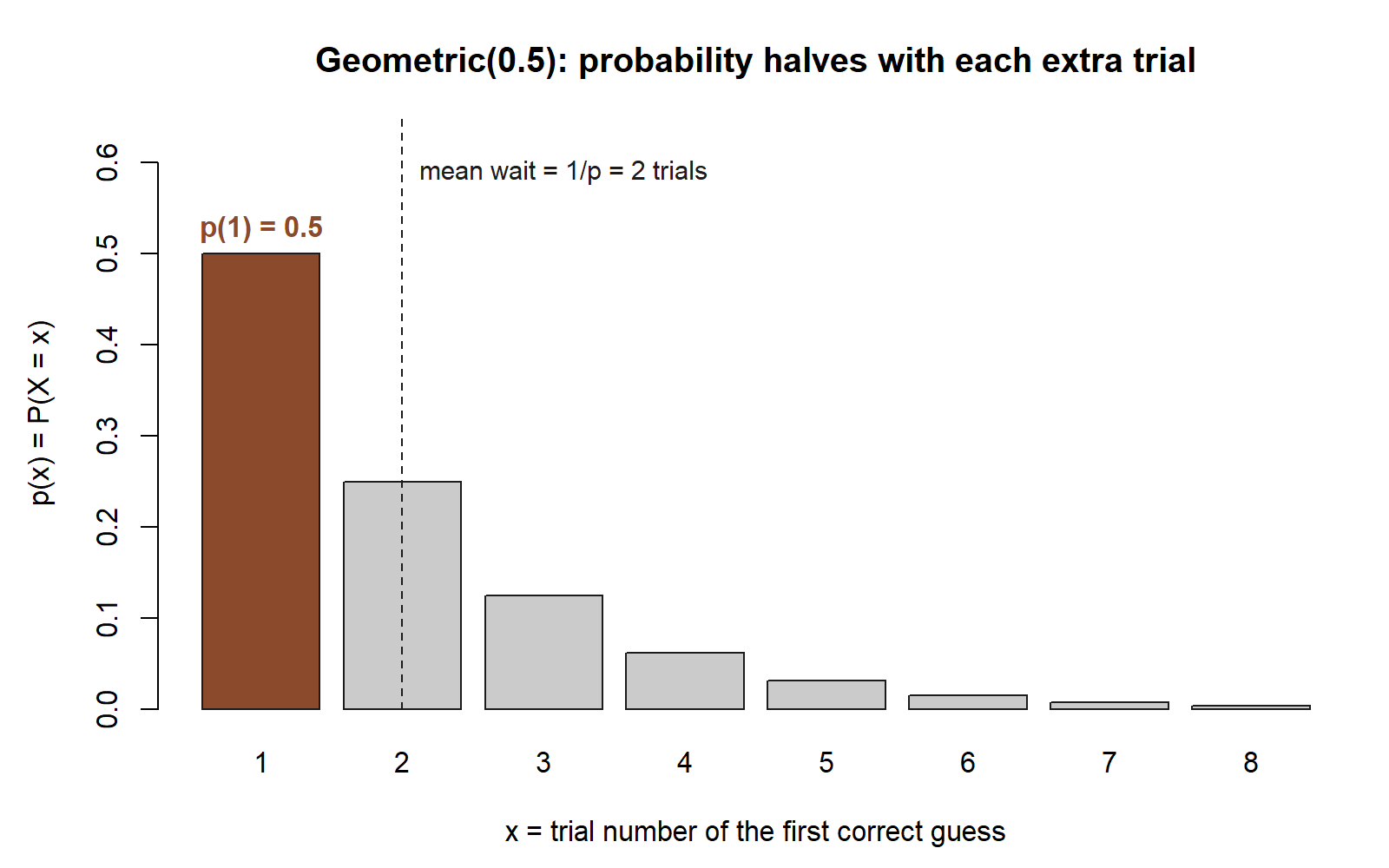
which says exactly what you would hope: if success has probability \(p\), you wait on average \(1/p\) trials for it. Rare successes (small \(p\)) mean long waits. The geometric answers “how many tries until it works?”, where the binomial answers “how many of a fixed batch worked?” — same Bernoulli atoms, different question.
Picture this with Maya’s own quiz-guessing probability \(p = 0.5\), reframed as a waiting question instead of a counting question: suppose she kept guessing, one question after another, until her first correct guess. That reframing is exactly \(\text{Geometric}(0.5)\).
Poisson — counts of rare events in a fixed window
The Poisson model is different in flavor: there are no obvious individual “trials” to count. Instead you have a continuous window — an hour, a page, a stretch of road — within which events happen at a steady average rate, independently, and rarely on any tiny sub-interval. Let \(N\) be the number of events in that window and \(\lambda\) the average count per window. Then
\[ p(x) = \frac{e^{-\lambda}\,\lambda^{x}}{x!}, \qquad x = 0, 1, 2, \dots \]
The signature property is that the mean and the variance are equal:
\[ E[N] = \lambda, \qquad \text{Var}(N) = \lambda. \]
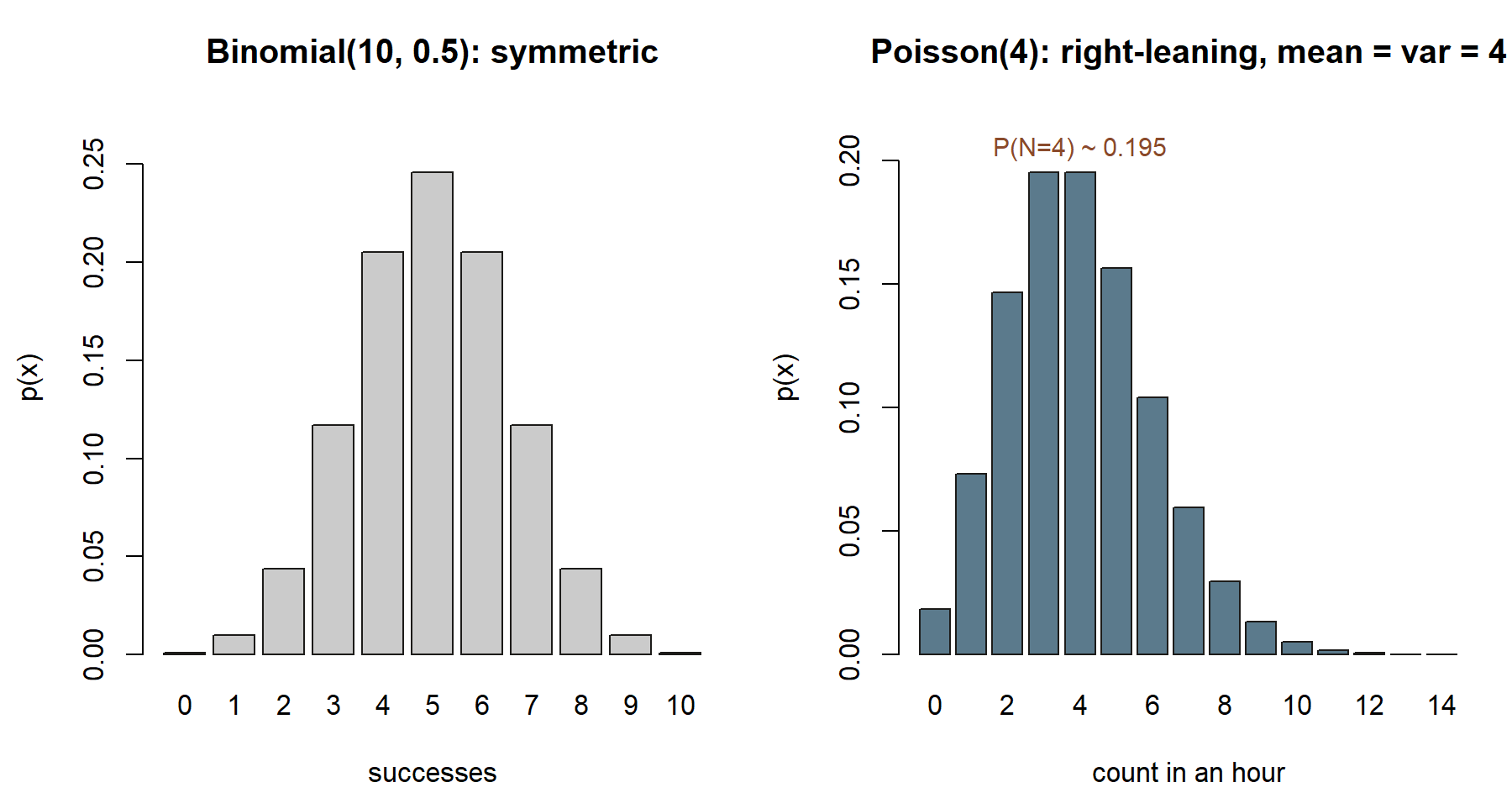
That equality is a quick diagnostic. If you have count data whose spread is much larger than its average, the Poisson assumption of independent, steady-rate events is probably violated (events may cluster). The Poisson is the natural model for shuttle arrivals in an hour, typos on a page, calls reaching a help desk, or particles registering on a counter — any setting where many opportunities each carry a small chance and you care about the total. (Conceptually, it is the limit of a Binomial(\(n\), \(p\)) where \(n\) grows large, \(p\) shrinks, and the product \(np = \lambda\) stays put. You can keep that picture in mind without proving it here.)
Choosing among them
Before the words, here is the same decision path as a picture — the question to ask, and the three places it can land:
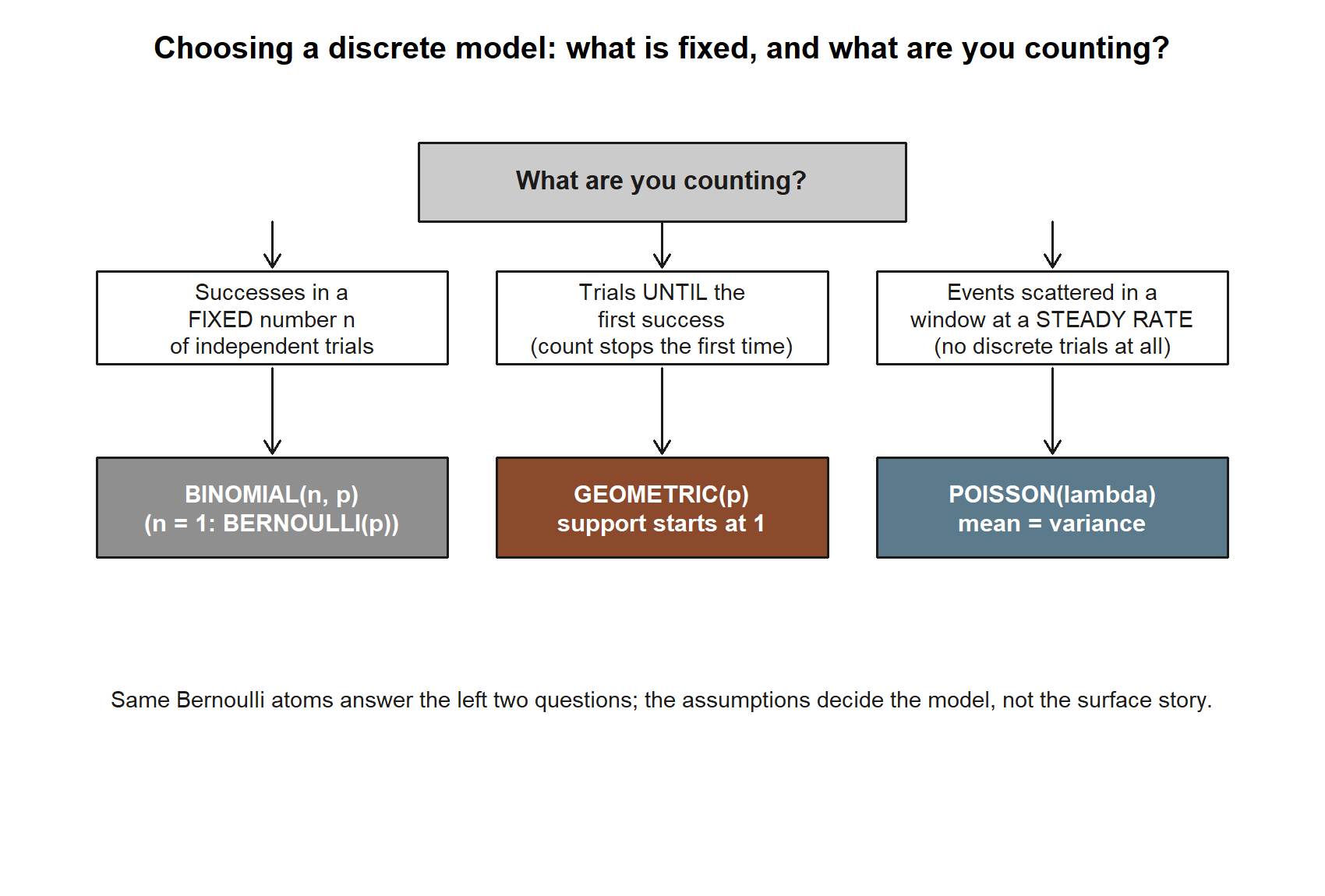
A short decision path covers most cases. Ask first whether the number of trials is fixed. If yes and you are counting successes, reach for the binomial; the single-trial case \(n = 1\) is just the Bernoulli. If instead you keep trying until the first success and count the trial number, that is the geometric. If there are no discrete trials at all — just events scattered through a window at a steady rate — that is the Poisson. The same data sometimes admits more than one framing, so the assumptions, not the surface story, decide the model.
Worked examples
All numbers below are synthetic; seed 35003 is set for any simulation. We re-use Maya’s commuter world for the recurring slice and then transfer the Poisson idea to a fresh context.
Worked example — the quiz score as a binomial (recurring slice)
Maya faces a 10-question true/false quiz and guesses purely at random, so each answer is right with probability \(p = 0.5\), independently of the others. Let \(X\) be the number she gets correct.
Symbolic. Ten independent two-outcome trials with constant success probability is exactly the binomial setting, so
\[ X \sim \text{Binomial}(10,\, 0.5), \qquad p(x) = \binom{10}{x}(0.5)^{x}(0.5)^{10-x} = \binom{10}{x}(0.5)^{10}. \]
Because \(p = 0.5\), every arrangement carries the same factor \((0.5)^{10} = 1/1024\), so a probability is just “(number of favorable arrangements) \(/\, 1024\).” The mean and variance come straight from the parameters:
\[ E[X] = n p = 10(0.5) = 5, \qquad \text{Var}(X) = n p (1-p) = 10(0.5)(0.5) = 2.5, \qquad \sigma = \sqrt{2.5} \approx 1.58. \]
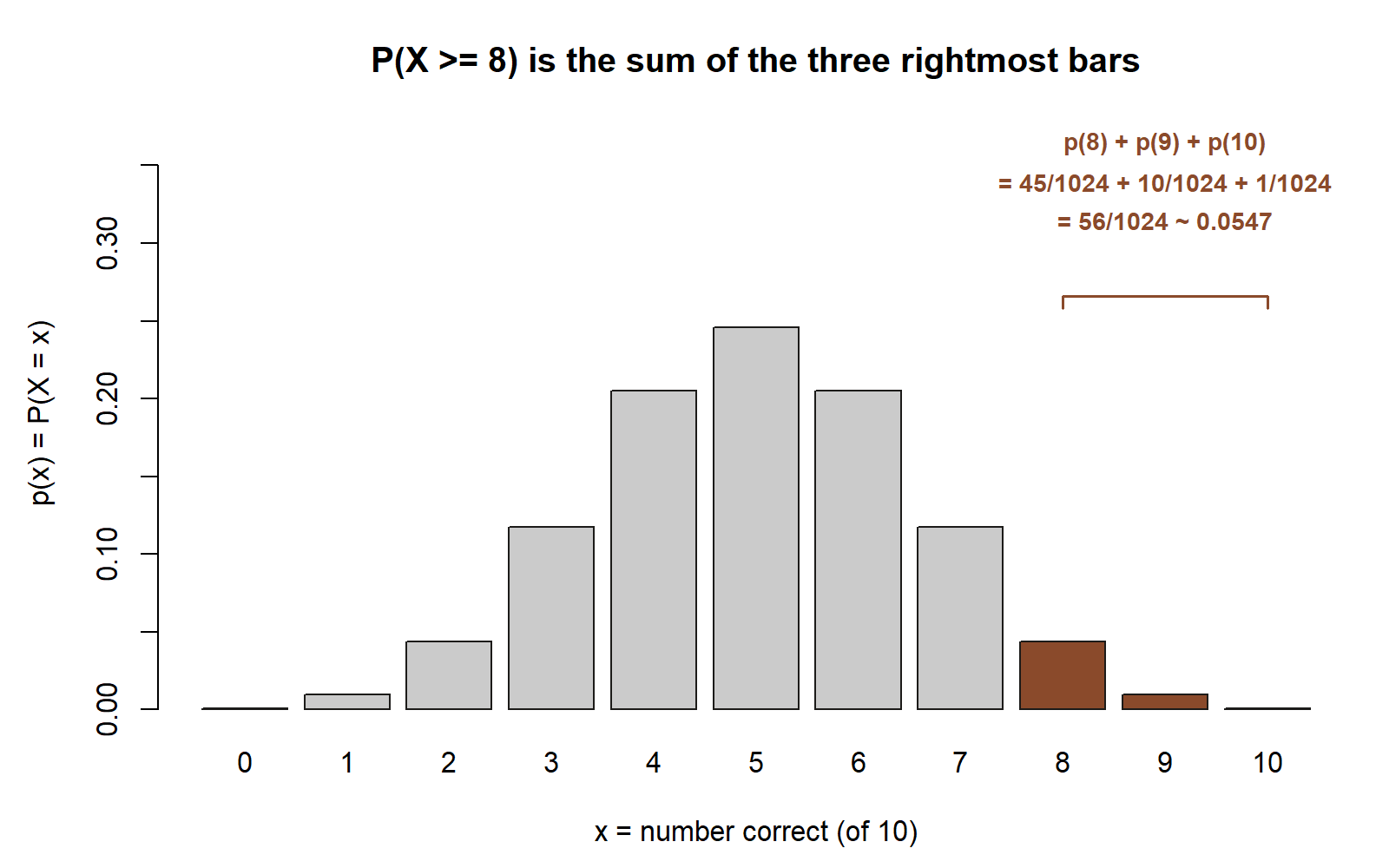
Numeric. Suppose we want the probability she scores at least \(8\) out of \(10\) by luck alone — that is, \(P(X \ge 8)\). Sum the top three terms:
\[ P(X \ge 8) = p(8) + p(9) + p(10) = \frac{\binom{10}{8} + \binom{10}{9} + \binom{10}{10}}{1024} = \frac{45 + 10 + 1}{1024} = \frac{56}{1024} \approx 0.0547. \]
So a pure guesser clears an 8-out-of-10 bar only about \(5.5\%\) of the time. The mean of \(5\) and standard deviation of about \(1.58\) say a score of \(8\) sits roughly two standard deviations above what guessing produces — unusual, but not astronomically so. This is the same quiz thread you saw build across Weeks 6–8; the named model just lets you read mean, variance, and tail probabilities off the parameters directly.
You can confirm the tail by simulation (shown as teaching; not executed in this build):
Worked example — shuttle arrivals as a Poisson count (recurring slice)
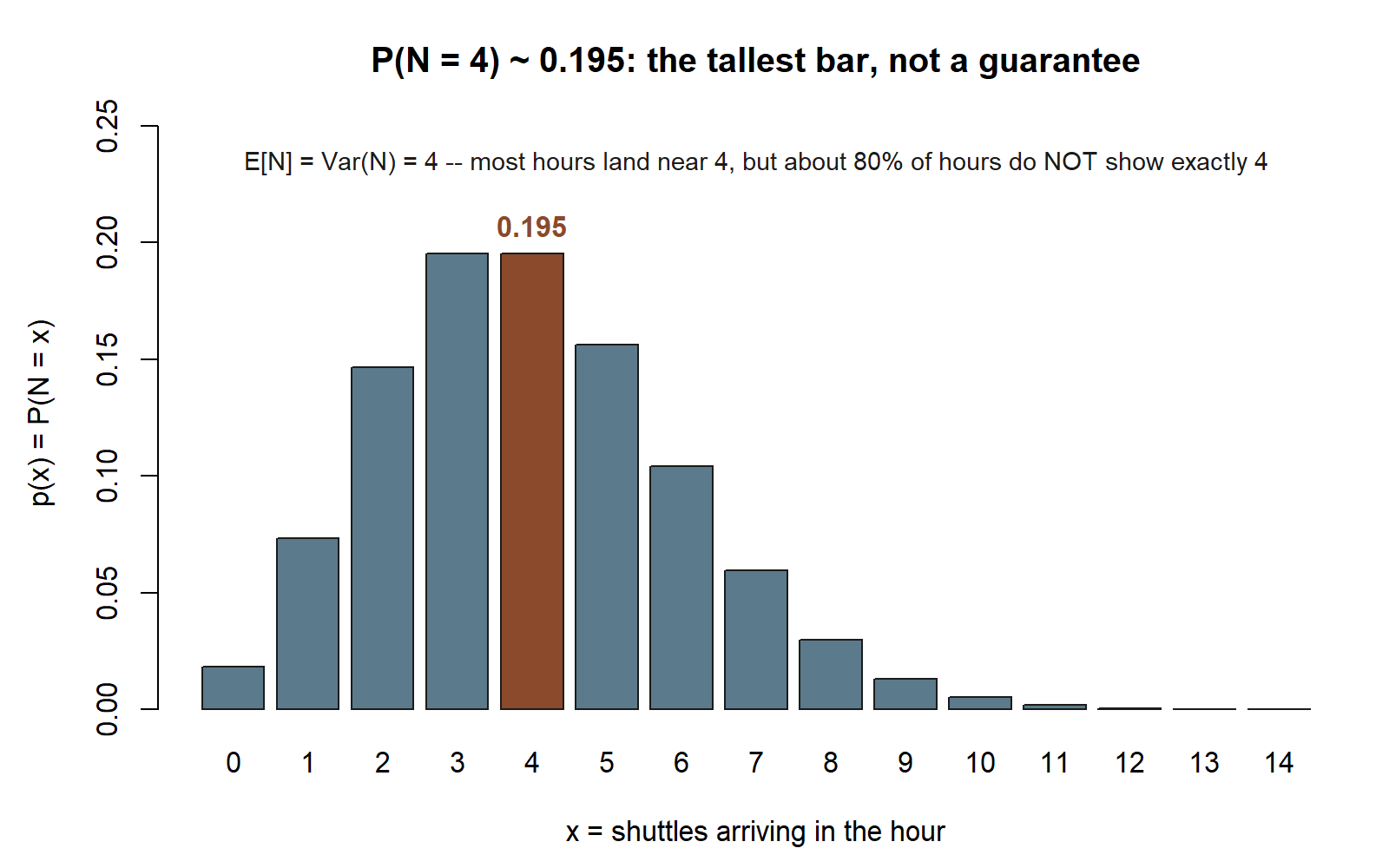
Shuttles serving Maya’s stop arrive at a steady average rate of one every 15 minutes, which is four per hour, and arrivals do not coordinate with one another. Let \(N\) be the number that arrive in a given hour.
Symbolic. A count of independent, steady-rate events in a fixed window is the Poisson setting, with rate \(\lambda = 4\) per hour:
\[ N \sim \text{Poisson}(4), \qquad p(x) = \frac{e^{-4}\, 4^{x}}{x!}, \qquad x = 0, 1, 2, \dots \]
Because mean equals variance for a Poisson,
\[ E[N] = \lambda = 4, \qquad \text{Var}(N) = \lambda = 4, \qquad \sigma = 2. \]
Numeric. The probability that exactly four shuttles arrive in the hour is
\[ P(N = 4) = \frac{e^{-4}\, 4^{4}}{4!} = \frac{e^{-4}\,(256)}{24} \approx 0.195. \]
So even though four per hour is the average, getting exactly four in any particular hour happens only about \(19.5\%\) of the time — the rest of the probability spreads over three, five, two, six, and so on. That spread is the variance of \(4\) at work, and it is why “on average four” does not mean “four every hour.” (As a quick sanity check on the model choice: if you logged arrivals for many hours and found the variance was, say, \(10\) while the mean stayed near \(4\), the steady-independent-rate assumption would be suspect and the Poisson would be the wrong model.)
Worked example — typos on a page (transfer)
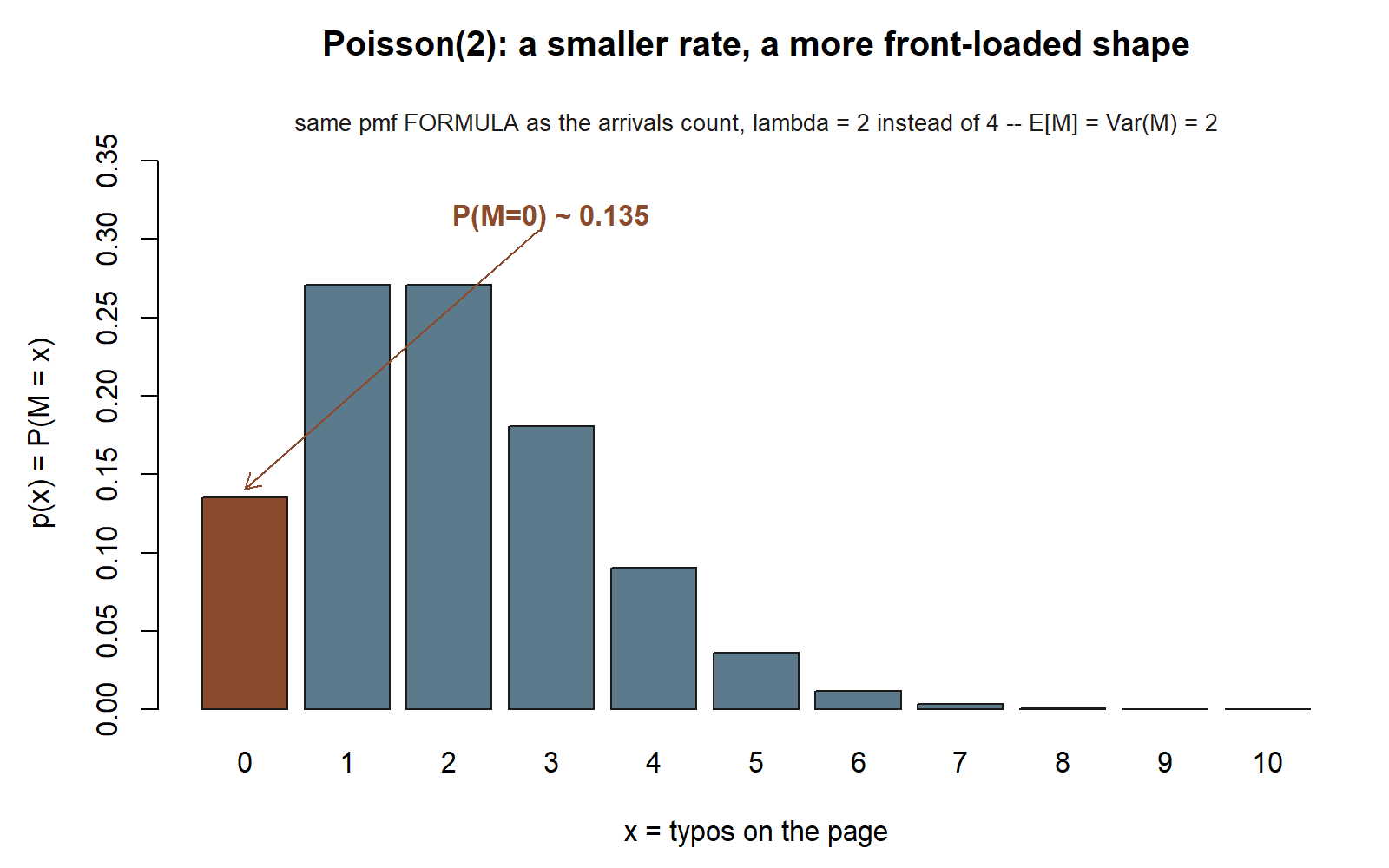
Now move the Poisson idea to a brand-new setting to show it is about the structure of the problem, not about shuttles. A careful copy editor finds that a particular manuscript averages \(\lambda = 2\) typos per page, with typos scattered independently and at a steady rate down the page. Let \(M\) be the number of typos on a randomly chosen page.
Symbolic. Counts of rare, independent, steady-rate events in a fixed window (here the window is one page) give
\[ M \sim \text{Poisson}(2), \qquad p(x) = \frac{e^{-2}\, 2^{x}}{x!}, \qquad E[M] = \text{Var}(M) = 2. \]
Numeric. The probability a page is clean — zero typos — is
\[ P(M = 0) = \frac{e^{-2}\, 2^{0}}{0!} = e^{-2} \approx 0.135, \]
so only about \(13.5\%\) of pages come out perfectly, even though the typical page has just two typos. The same template fits the number of calls reaching a help desk in an hour, or emails in an inbox over a lunch break: identify the window, estimate the average count \(\lambda\) in that window, check the steady-independent-rate story, and the whole pmf follows. Synthetic; seed set.
A common mistake
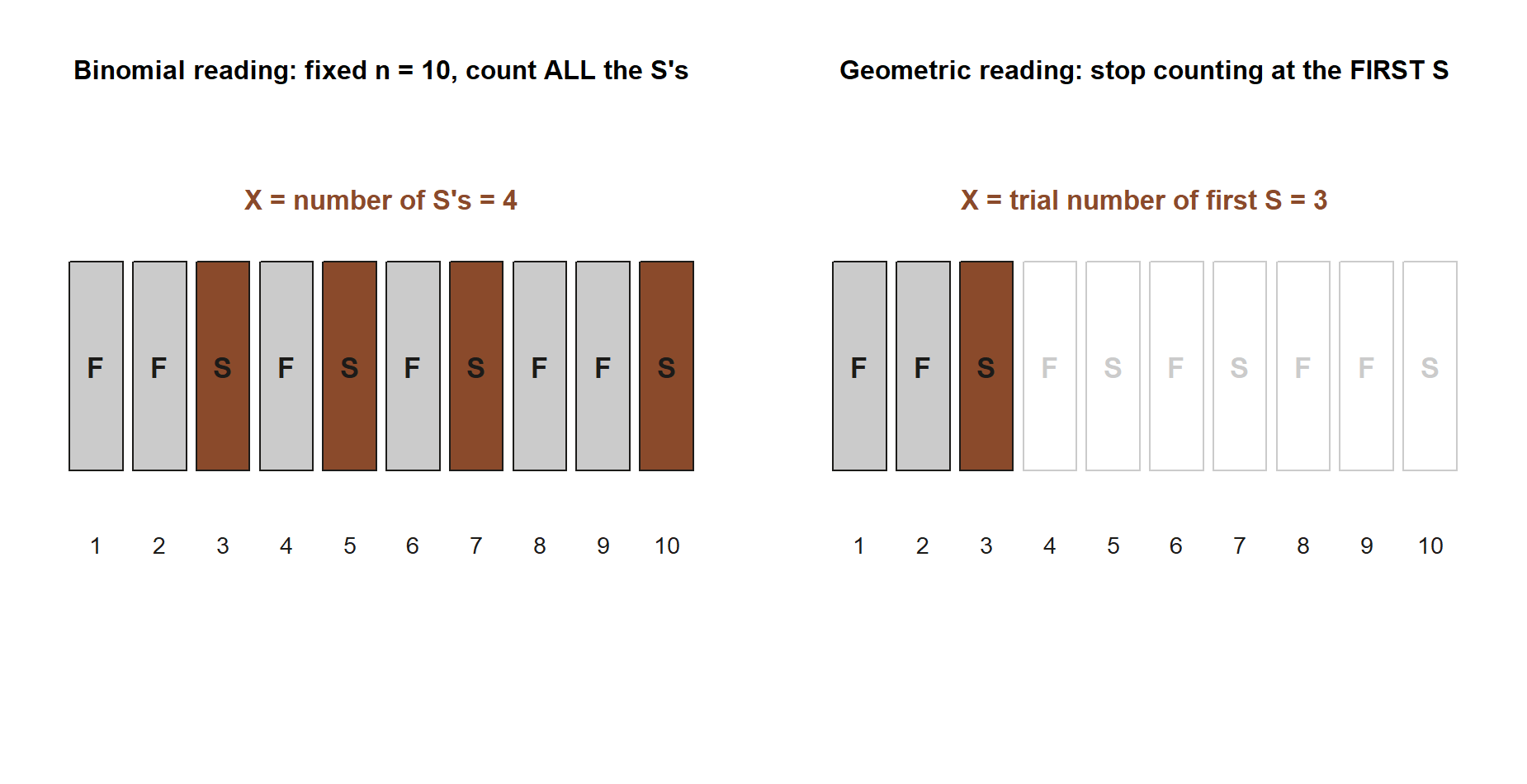
The classic Week-9 error is matching the model to the surface story instead of the assumptions, and the binomial-versus-geometric mix-up is the usual form. Both are built from independent Bernoulli(\(p\)) trials, so a problem about “coin flips” or “quiz guesses” feels like it could be either. The deciding question is what is fixed and what is random:
- If the number of trials is fixed (\(n = 10\) quiz questions) and you count successes, it is binomial.
- If you stop at the first success and count the trial number, the count itself is random and it is geometric.
The same sequence of trial outcomes can be read either way, which is exactly why the mix-up happens:
A second, related slip is forgetting that this course’s geometric starts its support at \(1\), not \(0\), because at least one trial must happen before you can have a first success. If you reach for software and use R’s rgeom, remember it counts failures before the first success and so starts at \(0\) — its values are exactly one less than ours. Add one to line them up. The third slip is treating a Poisson’s \(\lambda\) as if it were tied to a number of trials: there are no trials to count in a Poisson, only a rate and a window, and the giveaway that you have a genuine Poisson (rather than a binomial in disguise) is that mean and variance come out equal. When you find yourself about to plug numbers in, pause and name the model’s assumptions first; the arithmetic is almost never the part that goes wrong.
Low-stakes self-checks (ungraded)
These are for your own practice — nothing here is collected or graded.
- A multiple-choice section has \(5\) questions, each guessed independently with success probability \(0.25\). Which model fits the number correct, and what are its mean and variance? (Answer the model before you compute.)
- For Maya’s quiz, \(X \sim \text{Binomial}(10, 0.5)\), explain in one sentence why \(P(X \ge 8)\) uses only the three terms \(x = 8, 9, 10\), and confirm the numerator \(45 + 10 + 1 = 56\) from the combinations.
- You keep rolling a fair die until the first six appears. Name the model for the roll number of that first six, give its parameter \(p\), and state its mean number of rolls.
- Help-desk calls arrive at a steady \(\lambda = 3\) per hour, independently. What are the mean and variance of the hourly count, and what is \(P(\text{exactly } 0 \text{ calls in an hour}) = e^{-3}\) to three decimals?
- Without computing, decide which model fits each: (a) number of defective items in a shipment of \(20\), each defective with probability \(0.05\); (b) number of pages you read before hitting the first dog-eared page; (c) number of meteors you see in a one-hour sky watch. Justify each by naming the assumption that makes it fit.
Reading and source pointer
For the discrete-model definitions and their pmfs, read Grinstead & Snell, Chapter 5 — Important Distributions (discrete part), which develops the binomial, geometric, and Poisson families and their basic properties: https://www.dartmouth.edu/~chance/teaching_aids/books_articles/probability_book/book.html.
This week also draws on the secondary course text. See MIT OpenCourseWare 18.05 for its treatment of discrete random variables, the probability mass function, and expectation — useful for a second pass on how a named model’s pmf gives you its mean and tail probabilities: https://ocw.mit.edu/courses/18-05-introduction-to-probability-and-statistics-spring-2022/.
These notes are the course’s own synthesis, grounded in but not copied from the sources.
Public vs. graded
These notes, the examples, and the practice here are public and ungraded — study material only. No graded prompts, answer keys, rubrics, point values, or due dates appear on this site. Graded checkpoints, quizzes, homework, labs, the midterm, the project, and the final live in Blackboard (the LMS), which is authoritative for due dates, submissions, and grades. If this page and Blackboard ever disagree, follow Blackboard.
Looking ahead
Every model this week was discrete: the support was a list of separate values you could in principle enumerate, and a single value could carry positive probability. Next week we cross into continuous random variables, where a variable can land anywhere in an interval, no single point carries probability, and probability becomes area under a density. Maya’s thread carries us there naturally: instead of counting how many shuttles arrive in an hour, we will ask how long she waits for the next one — a continuous quantity. The Poisson count and the continuous waiting time turn out to be two sides of the same arrival process, which is exactly what Weeks 10 and 11 will make precise.
See also
- Companion lab — Lab 9: Simulating discrete models — generate binomial, geometric, and Poisson draws and check the means, variances, and tail probabilities above by simulation.
- Notation glossary — the binding symbols and the model parameterizations (\(\text{Geometric}(p)\) as trials-until-success, \(\text{Poisson}(\lambda)\) with mean \(=\) variance).
- Distribution reference — a one-stop table of each model’s pmf, mean, variance, support, and the R
*binom/*geom/*poisfunctions (including the geometric support shift). - Week 7 — Discrete random variables — where the pmf and the quiz random variable were first built by hand.
- Week 8 — Expectation and variance — where \(E[X] = 5\) and \(\text{Var}(X) = 2.5\) for the quiz were derived from the definition.
- Week 10 — Continuous random variables — the next step, where probability becomes area under a density.
- Course syllabus — overall structure, schedule, and where graded work lives.