# Shown as teaching, not executed in this build. Count the union directly
# from the 52-card deck, then check it against inclusion-exclusion.
set.seed(35003)

suits <- c("hearts", "diamonds", "clubs", "spades")
ranks <- c("A", "2", "3", "4", "5", "6", "7", "8", "9", "10", "J", "Q", "K")
deck  <- expand.grid(rank = ranks, suit = suits, stringsAsFactors = FALSE)

is_red  <- deck$suit %in% c("hearts", "diamonds")
is_face <- deck$rank %in% c("J", "Q", "K")

p_red       <- mean(is_red)              # 26/52
p_face      <- mean(is_face)             # 12/52
p_red_face  <- mean(is_red & is_face)    # 6/52  (the overlap)
p_red_or_face <- mean(is_red | is_face)  # 32/52, computed directly

# Inclusion-exclusion should reproduce the direct union:
p_red + p_face - p_red_face # equals p_red_or_faceWeek 2 — Sample spaces, events & rules
Listing outcomes and combining events with the complement and addition rules
The week question
Last week we said the number \(0.81\) — the probability that Maya’s morning shuttle is on time — means something about the long run. This week we ask the next question: once we have a list of everything that could happen, how do we build new probabilities from old ones without re-counting from scratch?
If you know that the shuttle is on time \(81\%\) of mornings, you should not have to do any new bookkeeping to say how often it is late. And if you want the chance of “rain or a late shuttle,” you should be able to assemble it from pieces you already have. The machinery for this is small but exact: write down the sample space, name the outcomes you care about as events, and then combine events with two rules — the complement rule and the addition rule. Get the list right and the rest is arithmetic.
Why this matters
Almost every probability you will ever compute is really a statement about a set of outcomes. “The shuttle is late,” “I draw a red card,” “at least one of two emails is spam” — each names a collection of possible results, and the probability is how much of the whole that collection covers. Once you see events as sets, two facts become unavoidable. First, every outcome either is or is not in your event, so the chance of “not \(A\)” is just whatever is left over: that is the complement rule, and it turns hard questions (“at least one”) into easy ones (“none”). Second, when you glue two events together with “or,” you must not double-count the overlap — that single correction, inclusion–exclusion, is the source of more right answers than almost any other rule in the course.
These are also the rules that make later weeks possible. Conditional probability (Week 3), independence (Week 4), and Bayes’ rule (Week 5) are all built on unions, intersections, and complements. If the set picture is solid now, the rest of the term is mostly careful application of it.
Learning goals
By the end of this week you should be able to:
- Write down the sample space \(\Omega\) for a small experiment and list its outcomes explicitly.
- Express an event as a subset of \(\Omega\) and read its probability as the total of the outcomes it contains.
- Apply the complement rule \(P(A^{c}) = 1 - P(A)\) and explain why it must hold.
- Use the addition rule for disjoint events, and the general inclusion–exclusion rule \(P(A \cup B) = P(A) + P(B) - P(A \cap B)\) when events overlap.
- Decide, from the wording of a problem, whether two events are disjoint (so the overlap term is zero) or overlapping (so it is not).
- Tie a coarse model (on-time vs. late) back to a finer one (rain vs. no-rain crossed with on-time vs. late) and check that the two agree.
Core vocabulary
- Sample space (\(\Omega\)). The set of all outcomes of an experiment that we treat as possible, listed so that exactly one of them occurs on any single run.
- Outcome (\(\omega\)). A single element of \(\Omega\) — one complete result of the experiment.
- Event (\(A\), \(B\), \(E\)). A subset of \(\Omega\). The event “happens” exactly when the outcome that occurs is one of its members. Its probability is the total probability of the outcomes it contains.
- Complement (\(A^{c}\)). The event “\(A\) does not happen” — every outcome of \(\Omega\) that is not in \(A\). We write \(A^{c}\) throughout this course (not \(A'\) and not \(\bar A\)).
- Union (\(A \cup B\)). The event “\(A\) or \(B\) (or both).” Our “or” is always inclusive: outcomes in both events still count.
- Intersection (\(A \cap B\)). The event “\(A\) and \(B\)” — the outcomes that belong to both events at once.
- Disjoint (mutually exclusive) events. Two events with no outcome in common: \(A \cap B = \varnothing\). They cannot both occur on the same run.
A note that will matter in Week 4: “disjoint” is not the same as “independent.” Disjoint events are about sharing no outcomes; independence is about one event carrying no information about the other. Keep them apart.
Concept development
From an experiment to a sample space
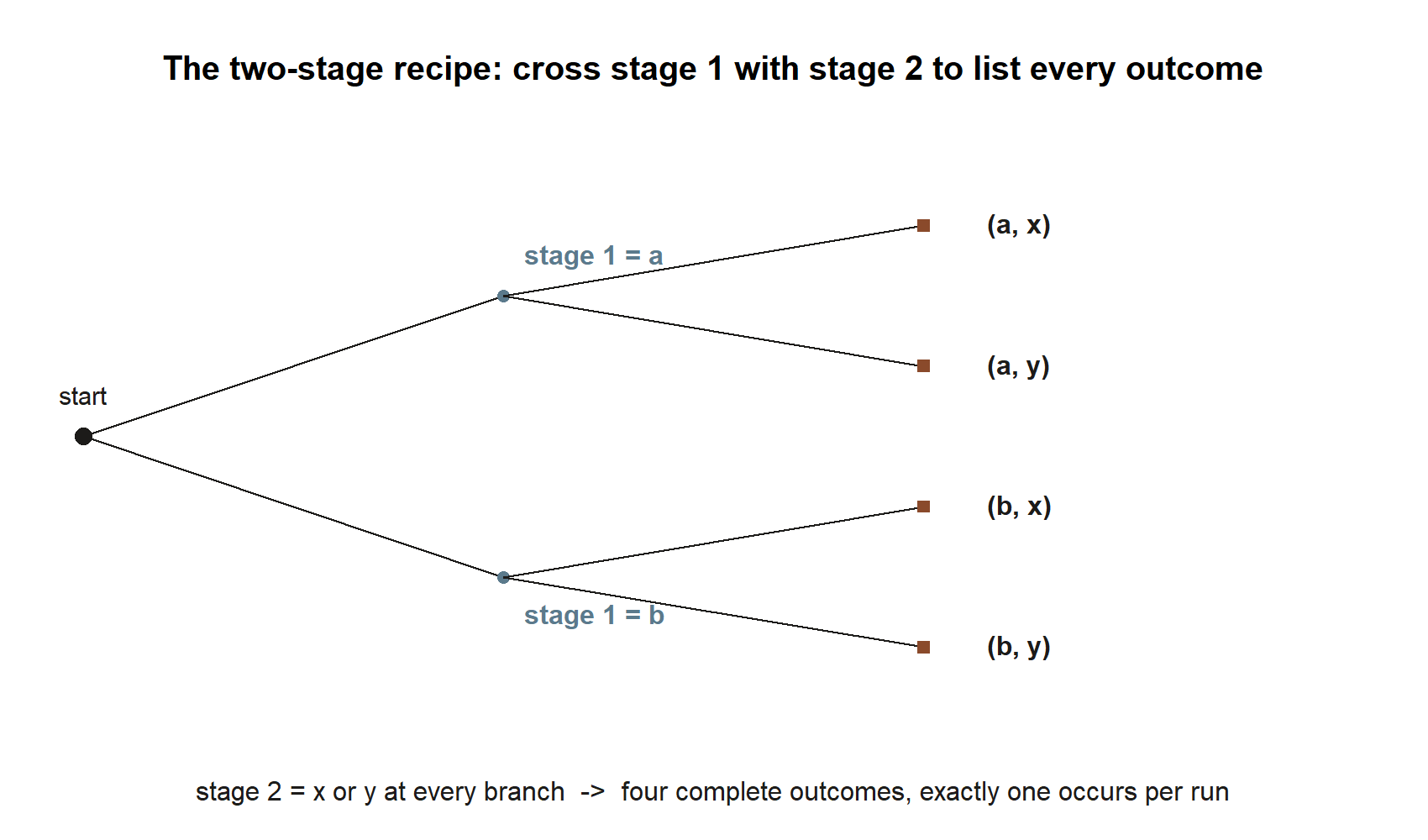
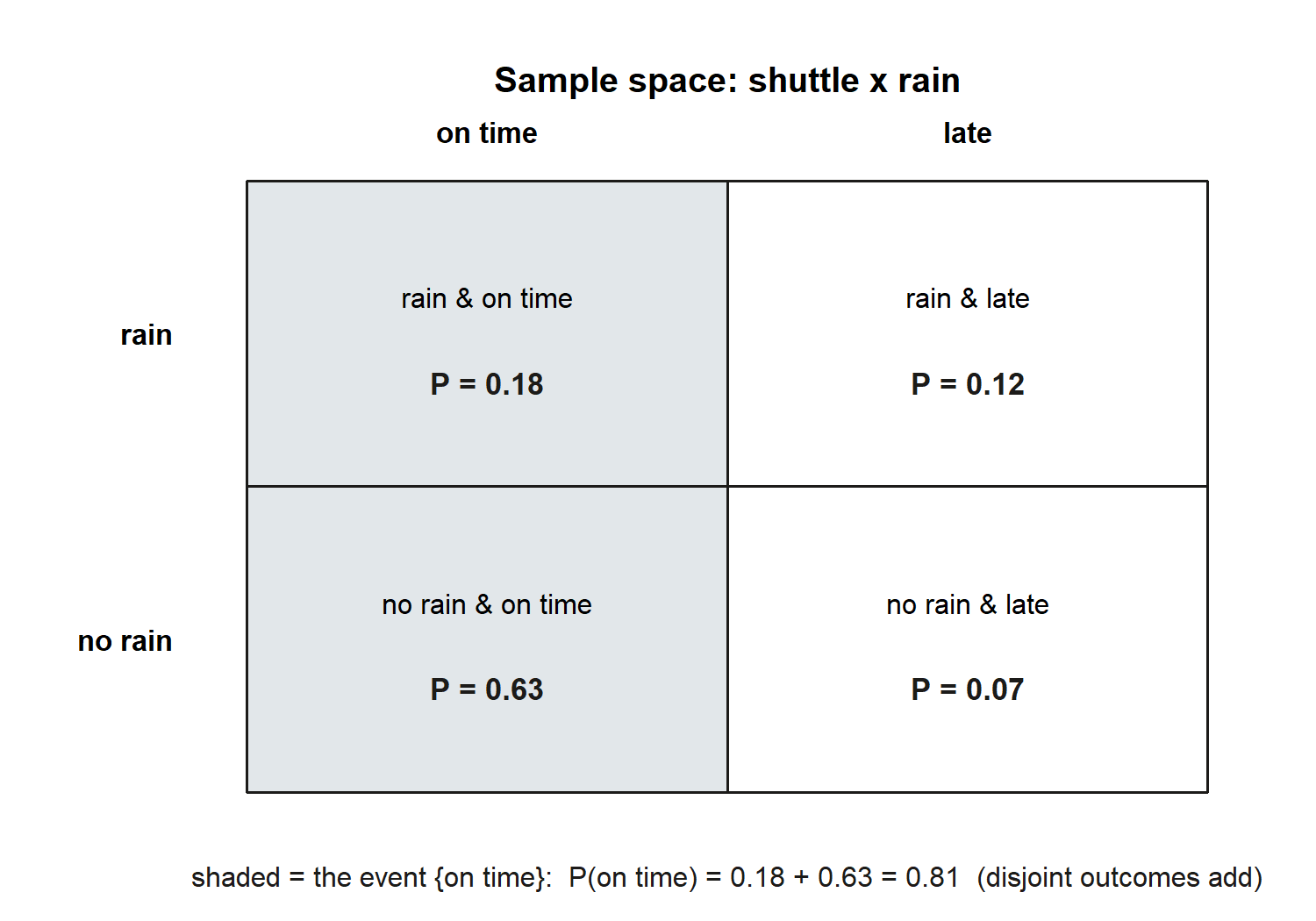
A probability model starts with a clean list of what could happen. Consider Maya’s morning as a small two-part experiment: first the weather is either rain or no rain, and then the shuttle is either on time or late. Crossing the two parts gives four complete outcomes, and that set is the sample space:
\[ \Omega = \{\,(\text{rain},\,\text{on time}),\ (\text{rain},\,\text{late}),\ (\text{no rain},\,\text{on time}),\ (\text{no rain},\,\text{late})\,\}. \]
Each \(\omega \in \Omega\) is one full description of the morning. Exactly one of the four occurs on any given day, and together they exhaust the possibilities — that is what makes this a legitimate sample space. The four outcomes are not equally likely (rainy mornings are rarer, and the shuttle behaves differently in the rain), so we attach a probability to each rather than counting \(1/4\) apiece.
The recipe behind that crossing step is general, not specific to weather and shuttles: whenever an experiment runs in two stages, you cross every outcome of stage 1 with every outcome of stage 2, and the sample space is the full set of pairs.
Events are subsets you can name in plain language
Any phrase that describes “what happened” picks out a subset of \(\Omega\). Three useful ones for this week:
- Let \(R\) = “it rains” \(= \{(\text{rain},\,\text{on time}),\ (\text{rain},\,\text{late})\}\).
- Let \(T\) = “the shuttle is on time” \(= \{(\text{rain},\,\text{on time}),\ (\text{no rain},\,\text{on time})\}\).
- Let \(L\) = “the shuttle is late” \(= \{(\text{rain},\,\text{late}),\ (\text{no rain},\,\text{late})\}\).
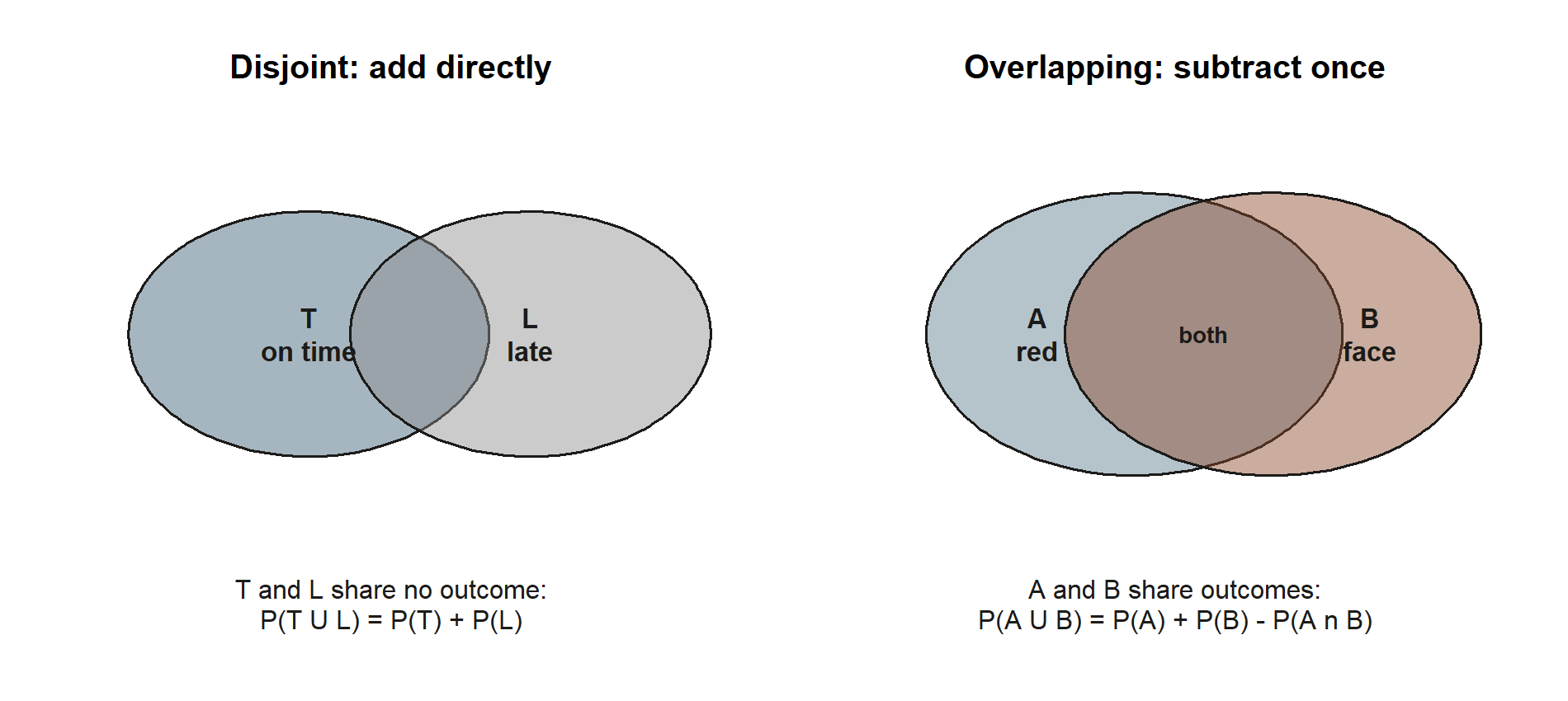
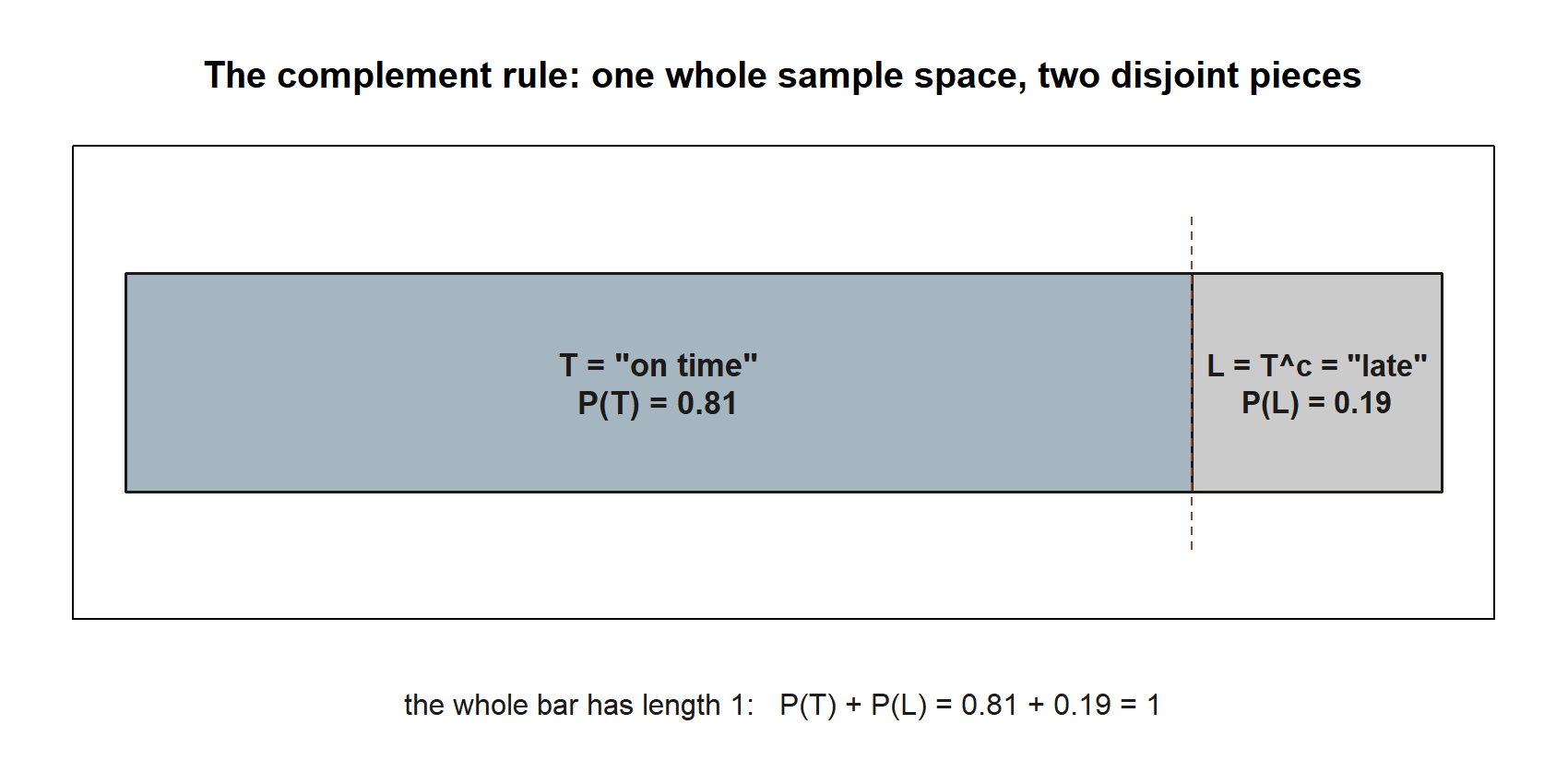
Notice that \(T\) and \(L\) share no outcomes: \(T \cap L = \varnothing\). They are disjoint — the shuttle cannot be both on time and late on the same morning. Notice also that \(L\) is exactly “everything in \(\Omega\) that is not in \(T\),” which is the set-language way of saying \(L = T^{c}\). That single observation is the whole point of the complement rule, coming next.
The complement rule
Because every outcome is either in \(A\) or in \(A^{c}\) and never in both, the probabilities of an event and its complement must account for the entire sample space. The probability of all of \(\Omega\) is \(1\), so
\[ P(A) + P(A^{c}) = 1 \qquad\Longrightarrow\qquad P(A^{c}) = 1 - P(A). \]
This is the most quietly useful rule in the course. Many questions are awkward head-on but easy through the back door: “at least one” is the complement of “none,” and “late” is the complement of “on time.” When the direct count is messy, ask whether the opposite is simpler, compute that, and subtract from \(1\).
The addition rule and inclusion–exclusion
To find the probability of “\(A\) or \(B\),” you might be tempted to add \(P(A)\) and \(P(B)\). That is correct only when the two events are disjoint — when they share no outcome, nothing gets counted twice:
\[ P(A \cup B) = P(A) + P(B) \qquad\text{if } A \cap B = \varnothing. \]
When the events do overlap, adding \(P(A)\) and \(P(B)\) counts every shared outcome once in \(P(A)\) and again in \(P(B)\). To correct the double count, subtract the overlap exactly once. This is the general addition rule, or inclusion–exclusion:
\[ P(A \cup B) = P(A) + P(B) - P(A \cap B). \]
The disjoint version is just the special case where \(P(A \cap B) = 0\), so you can keep only the general rule in mind and let the overlap term vanish when there is no overlap. The discipline is simple to state and easy to forget under time pressure: whenever you see “or,” check for the overlap before you add.
Worked examples
Worked example — the shuttle’s complement, and tying \(0.81\) to a finer model
Symbolic. We want \(P(L)\), the probability the shuttle is late. We saw that “late” is the complement of “on time,” \(L = T^{c}\), so the complement rule applies directly:
\[ P(L) = P(T^{c}) = 1 - P(T). \]
Numeric. From the running model, the marginal probability the shuttle is on time is \(P(T) = 0.81\). Therefore
\[ P(L) = 1 - 0.81 = 0.19. \]
So Maya’s shuttle is late on about \(19\%\) of mornings. We did no new counting — the \(0.19\) fell straight out of the \(0.81\) we already had.
It is worth seeing where the coarse number \(0.81\) comes from, because it ties the two-outcome picture (on time / late) back to the four-outcome sample space (rain \(\times\) on-time). In the finer model, the shuttle’s reliability depends on the weather: it is on time on \(60\%\) of rainy mornings and \(90\%\) of dry ones, and it rains on \(30\%\) of mornings. Splitting “on time” across the two weather cases and adding the disjoint pieces gives
\[ P(T) = \underbrace{0.60 \times 0.30}_{\text{on time and rain}} + \underbrace{0.90 \times 0.70}_{\text{on time and no rain}} = 0.18 + 0.63 = 0.81. \]
The two slices “on time and rain” and “on time and no rain” are disjoint, so we added them with no overlap correction — the disjoint addition rule doing quiet work inside the finer model. The coarse \(0.81\) and the fine breakdown agree, and the complement rule then hands us \(P(L) = 0.19\) either way. (We return to the \(0.60 \times 0.30\) piece as a conditional probability in Week 3; for now read it as the share of all mornings that are both rainy and on time.) Synthetic data; seed 35003 set.
Worked example — drawing one card: \(P(\text{red or face card})\)
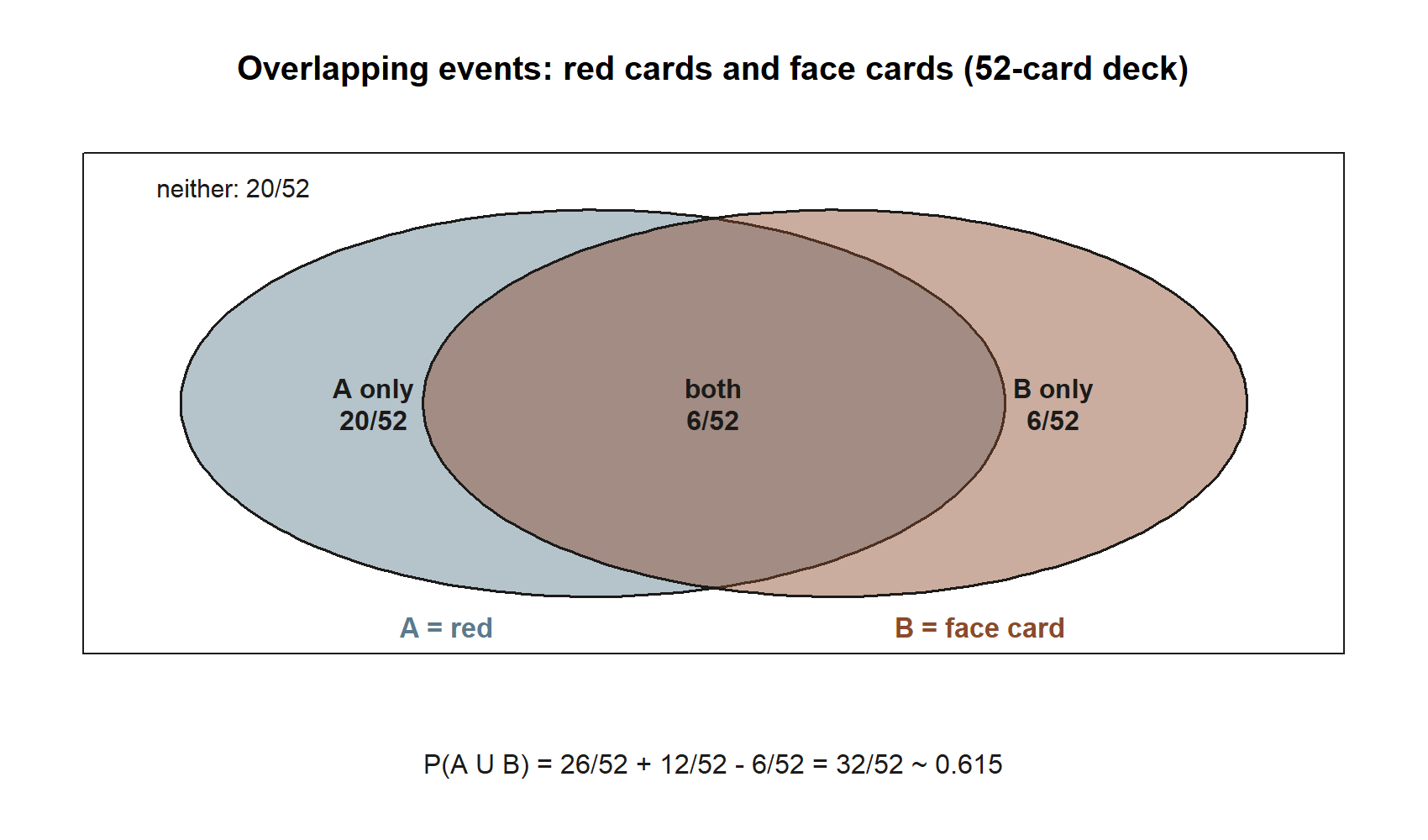
For a transfer to a new context, leave the shuttle behind and draw a single card from a standard \(52\)-card deck, every card equally likely. Let
- \(A\) = “the card is red” (hearts or diamonds), and
- \(B\) = “the card is a face card” (jack, queen, or king of any suit).
Symbolic. The events overlap — a card can be both red and a face card — so we need the full inclusion–exclusion rule:
\[ P(A \cup B) = P(A) + P(B) - P(A \cap B). \]
Numeric. Count outcomes out of \(52\):
- Red cards: \(26\) of the \(52\), so \(P(A) = \dfrac{26}{52} = \dfrac{1}{2}\).
- Face cards: \(3\) ranks \(\times\ 4\) suits \(= 12\), so \(P(B) = \dfrac{12}{52} = \dfrac{3}{13}\).
- Red and face: the red face cards are the jack, queen, and king of hearts and of diamonds — \(2\) suits \(\times\ 3\) ranks \(= 6\), so \(P(A \cap B) = \dfrac{6}{52} = \dfrac{3}{26}\).
Putting the pieces together,
\[ P(A \cup B) = \frac{26}{52} + \frac{12}{52} - \frac{6}{52} = \frac{32}{52} = \frac{8}{13} \approx 0.615. \]
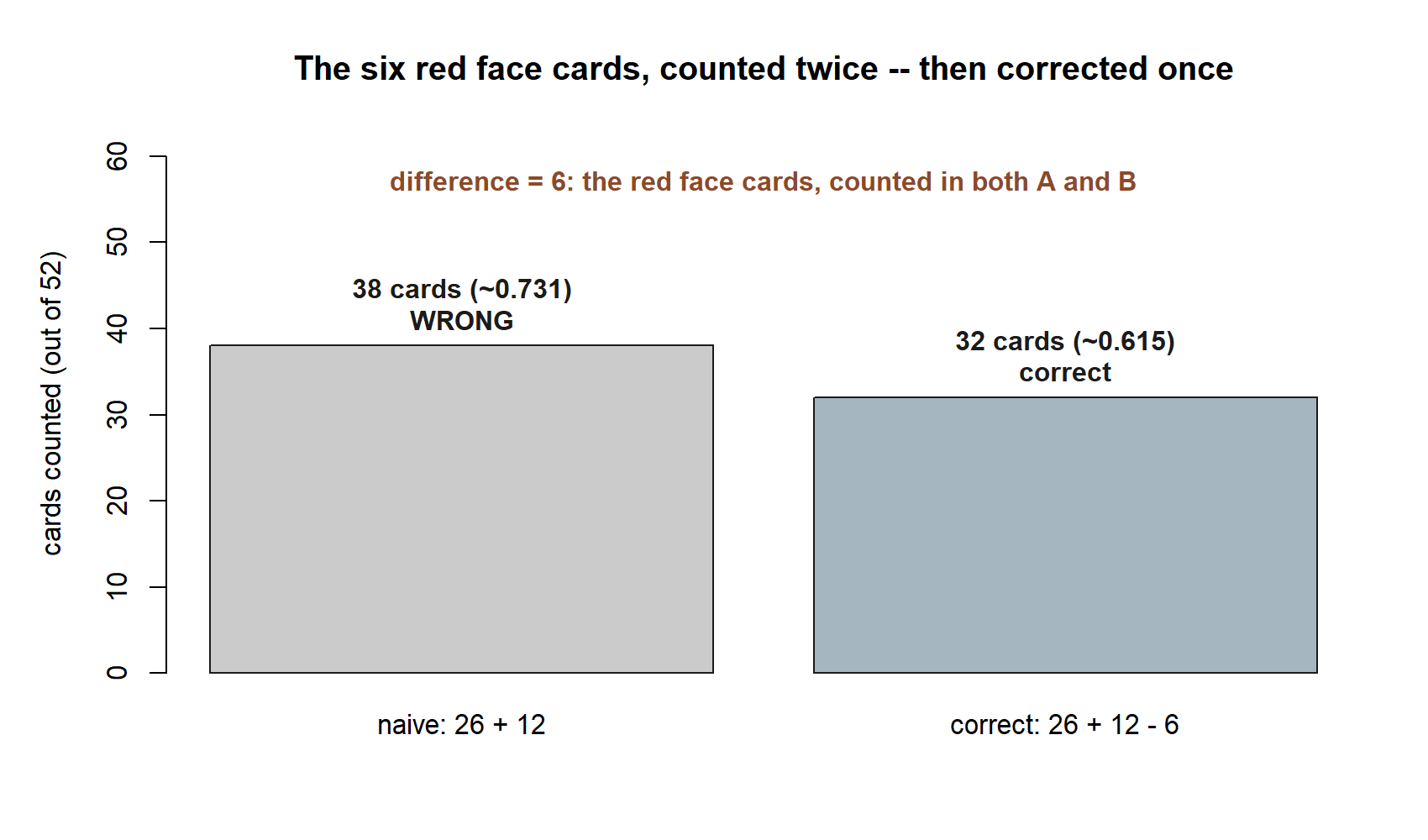
The overlap term is doing all the work: if you had carelessly added \(26 + 12 = 38\) favorable cards you would have reported \(\tfrac{38}{52} \approx 0.731\), counting the six red face cards twice. Subtracting the \(6\)-card overlap once brings the count down to the correct \(32\) cards. Whenever an “or” question has events that can both be true, the overlap is exactly what keeps the answer honest. Synthetic framing; seed 35003 set (the deck makes this exactly computable, no random draw needed).
You can see the same arithmetic by simulation; the companion lab does this with random draws.
A common mistake
The classic error this week is adding probabilities of overlapping events as if they were disjoint — forgetting the \(-\,P(A \cap B)\) term. It shows up the moment an “or” question involves two properties a single outcome can share. In the card example, “red or face” tempts you to write \(\tfrac{26}{52} + \tfrac{12}{52}\) and report \(\approx 0.73\), but that double-counts the six red face cards. The fix is a habit, not a formula: every time you see “or,” ask whether a single outcome can satisfy both events. If it can, find the overlap and subtract it once. If it genuinely cannot — as with “on time” versus “late,” which no single morning can both be — then the overlap is zero and plain addition is correct.
A smaller cousin of this mistake is applying the complement rule to the wrong whole. \(P(A^{c}) = 1 - P(A)\) only works when \(A\) and \(A^{c}\) together make up the entire sample space. “On time” and “late” qualify; “rain” and “on time” do not (they are neither complementary nor disjoint), so \(1 - P(\text{rain})\) is not the probability of being on time.
Low-stakes self-checks (ungraded)
Use these to test yourself; they are practice only, with no points and nothing to submit.
- Write the sample space for flipping a coin twice, listing all four outcomes. Then write the event “at least one head” as a subset, and find its probability using the complement rule (its complement is “no heads”).
- Using the shuttle model, you know \(P(T) = 0.81\). Without any new counting, state \(P(L)\) and explain in one sentence why the complement rule applies here but would not let you get \(P(\text{no rain})\) from \(P(T)\).
- Draw one card. Find \(P(\text{a club or a king})\) with inclusion–exclusion. (How many cards are both a club and a king? Subtract that overlap once.)
- Two events satisfy \(P(A) = 0.5\), \(P(B) = 0.4\), and \(P(A \cup B) = 0.7\). What is \(P(A \cap B)\)? Are \(A\) and \(B\) disjoint? How can you tell from the numbers alone?
- In the four-outcome shuttle sample space, identify the two disjoint slices whose probabilities add to \(0.81\), and confirm they sum correctly. Why was it legitimate to add them without an overlap term?
Reading and source pointer
This week’s spine reading is Grinstead & Snell, Introduction to Probability, Chapter 1 (Discrete Probability Distributions) — it develops sample spaces, events as subsets, and the basic rules for combining them, at exactly the level we use here. Read it for the set-theoretic picture of an event and for its treatment of equally-likely outcomes (which the card example leans on, even though the shuttle example deliberately does not). Free online: https://www.dartmouth.edu/~chance/teaching_aids/books_articles/probability_book/book.html.
There is no MIT 18.05 pointer this week; we will bring 18.05 in starting in Week 3, where conditional probability and base rates begin.
These notes are the course’s own synthesis, grounded in but not copied from the sources.
Public vs. graded
These notes, the examples, and the practice here are public and ungraded — study material only. No graded prompts, answer keys, rubrics, point values, or due dates appear on this site. Graded checkpoints, quizzes, homework, labs, the midterm, the project, and the final live in Blackboard (the LMS), which is authoritative for due dates, submissions, and grades. If this page and Blackboard ever disagree, follow Blackboard.
Looking ahead
We treated the \(0.60\) and \(0.90\) reliabilities as ingredients of the marginal \(0.81\) without quite saying what they are. They are conditional probabilities — the chance the shuttle is on time given the weather — and they are the engine of the next three weeks. Week 3 defines \(P(A \mid B)\) and shows why \(P(\text{on time} \mid \text{rain}) = 0.60\) is a different, more informative number than the overall \(0.81\). Week 4 asks whether knowing the weather changes the shuttle’s chances at all (independence), and Week 5 runs the logic backward with Bayes’ rule. Each is built on the unions, intersections, and complements you assembled today.
See also
- Companion lab: Lab 2 — Monte Carlo basics — estimate these same probabilities by simulating many repetitions and watching the long-run fractions settle.
- Notation glossary — the binding symbols for \(\Omega\), \(A^{c}\), \(A \cup B\), \(A \cap B\), and disjoint events.
- Distribution reference — for later weeks, once events grow into random variables and named distributions.
- Course syllabus — schedule, policies, and where graded work lives.
- Next: Week 3 — Conditional probability.