Week 15 — Final review

One pass over the whole assumption-light arc — which method each data shape calls for, and why

The week question

You have spent a semester learning a dozen ways to ask “what can I responsibly say about this data when the standard parametric model is in doubt?” — permutations, randomization, the bootstrap, the sign test, signed-rank, rank-sum, ordinal trend tests, robust summaries, robust regression, simulation. The final week’s question is the one that ties them together: given a particular data shape and a particular question, which assumption-light method does the shape call for, and what exactly does that method let you claim? This is not a new topic — it is the one picture the whole course was building toward. There is no new machinery here, only the discipline of choosing.

Why this matters

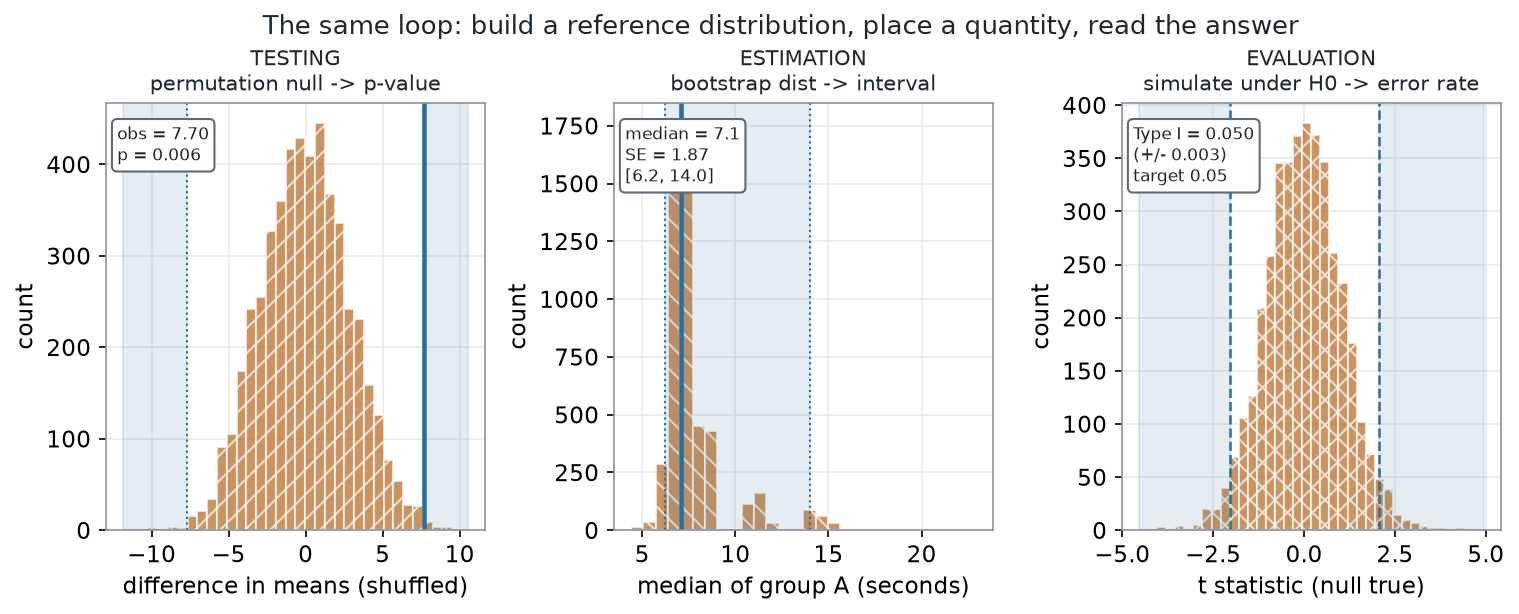
A course that ends as a list of named tests has failed at its real job. The point of this course was never “memorize the Wilcoxon” or “know how to call boot().” It was to make four ideas habitual: the empirical distribution is something you can compute with directly; exchangeability under a null lets you build a reference distribution by shuffling; resampling estimates how much a statistic would wobble; and resistance lets a summary survive contamination. Every method you met is one of those four ideas wearing a particular costume for a particular data shape.

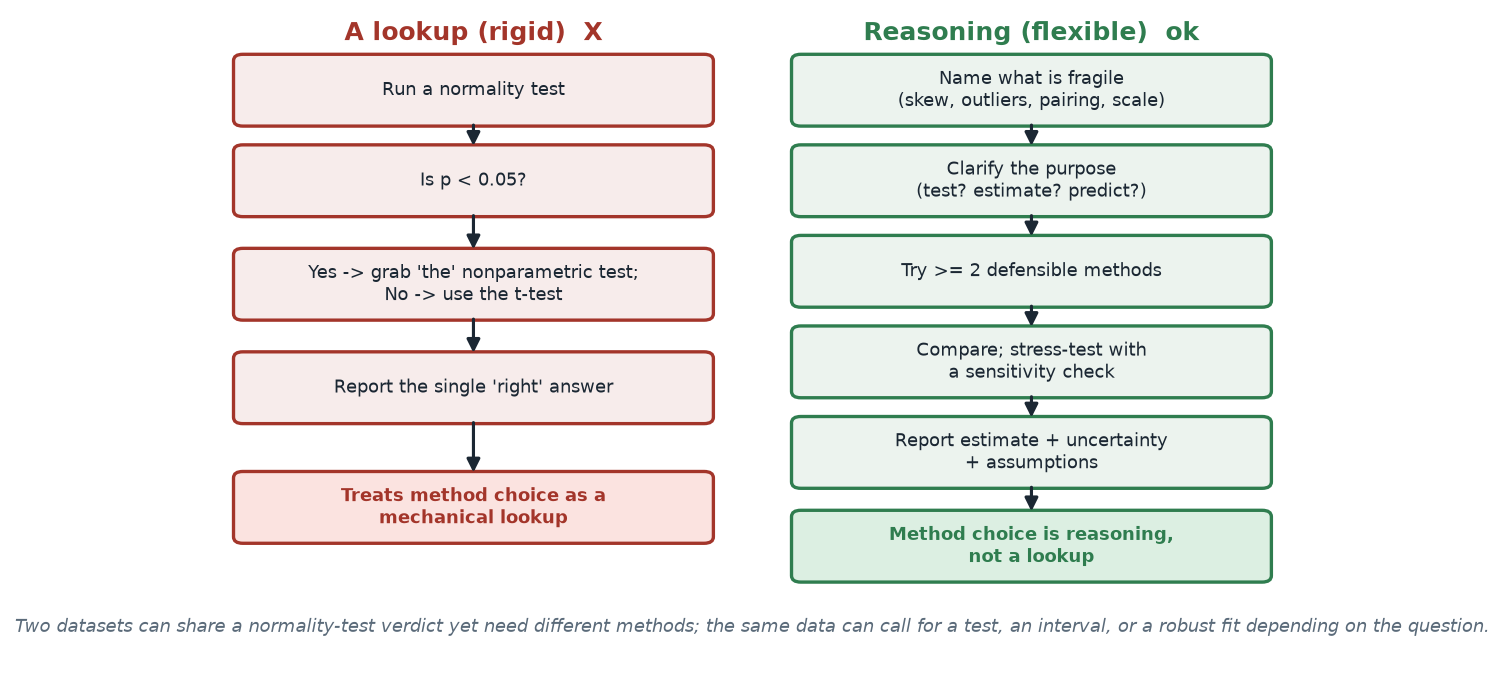
That matters because real data arrive shaped — skewed, paired, ordinal, contaminated — and the shape, not a normality test, is what should drive your method choice. The skill you are being asked to leave with is reading a data shape and a question, naming the candidate methods, and saying out loud what each one assumes, what it resamples or ranks or downweights, what it protects against, and what it still cannot prove. That last clause is the whole ethic of the course: assumption-light is never assumption-free. A bootstrap interval is not model-free truth; a rank test still assumes something; a robust slope trades efficiency for resistance. If you can name the trade every time, you have the course.

Learning goals

By the end of this week you should be able to:

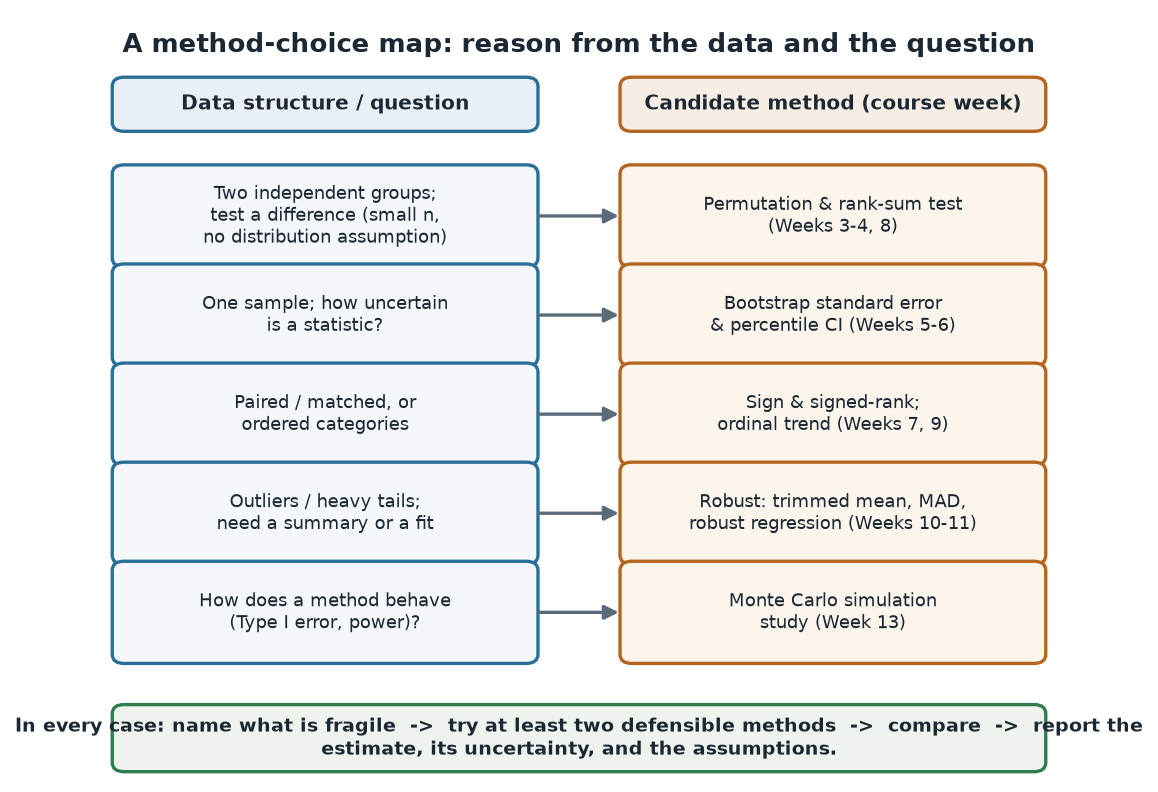
  • Map a data shape to a method. Given a description (right-skewed, paired and non-normal, ordinal, contaminated, or “I want to know how a method behaves”), name the assumption-light method the shape calls for and say why — without reaching for a normality test first.
  • State the assumption ladder for any method on the course. For a chosen method, name (1) what it assumes, (2) what it resamples / ranks / downweights, (3) what it protects against, and (4) what it still cannot prove.
  • Keep “shuffle to test” and “resample to estimate” straight. Explain why a permutation test holds labels’ meaning fixed and shuffles them under a null, while the bootstrap resamples the data itself to estimate sampling variability — and why each one can fail.
  • Read a rank or robust result in its own terms. Interpret a rank-sum result as a probability of superiority (not a mean difference), an ordinal trend test as respecting the scale, and a robust slope as resistance to contamination — and say what each does not establish.
  • Run the four anti-drift checklist on your own writing. Confirm an analysis is not generic intro stats, not a pure software exercise, not formula-only, and not a disconnected catalog of backup tests.

Core vocabulary

This week introduces no new terms; it consolidates the ones that recur. Hold these four organizing ideas in front of every method:

  • Empirical distribution / ECDF \(\hat F_n\) — the data’s own distribution, \(\hat F_n(x) = \frac{1}{n}\sum_i \mathbf{1}\{x_i \le x\}\). The single engine behind both ranks and the bootstrap: rank tests read its order, the bootstrap samples from it.
  • Exchangeability under a null — the assumption that, if the null is true, the group labels are interchangeable tags. It is what licenses a permutation / randomization reference distribution built by shuffling labels.
  • Resampling — drawing with replacement from the data (\(\hat F_n\)) to approximate a statistic’s sampling variability; reported as a bootstrap SE or bootstrap CI (percentile, basic, BCa).
  • Resistance / breakdown point — the fraction of contamination a summary tolerates before it is dragged away: \(0\) for the mean, \(\approx 0.5\) for the median. The basis of every robust summary and slope.
  • The assumption ladder — the four-part habit (assumes / resamples-ranks-downweights / protects / cannot prove) the course returns to on every page.
  • Probability of superiority \(P(X < Y)\) — the natural read of a rank-sum result: the chance a random value from one group falls below a random value from the other. A stochastic shift, not a difference in means.

Concept development

The semester ran through four data shapes from one synthetic world — the Riverside Wellness Program — plus a fifth concern, method behavior itself. The review is one pass over those shapes. For each, the move is the same: name the shape, name the method the shape calls for, then re-state the locked numeric instance you already saw, and climb the assumption ladder. No new numbers appear in this review; every figure below is one you met earlier in the course. All data are synthetic; seed set.

Shape 1 — skew (two independent groups): permutation, rank-sum, bootstrap

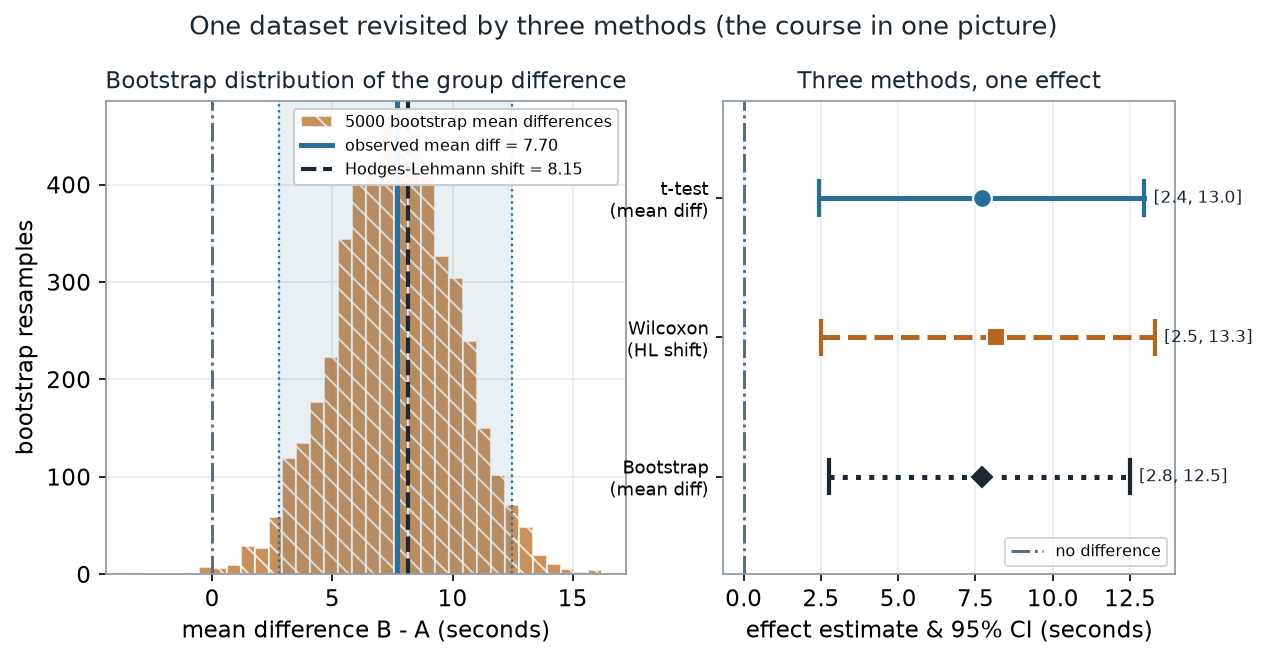
The idea. When two independent samples are right-skewed with long tails, the mean is the wrong center and its sampling distribution is the wrong reference. Three assumption-light moves respond. You can shuffle the group labels under a null of exchangeability and read the permutation tail (testing). You can rank the pooled values and read a stochastic shift (rank-sum). You can resample each group with replacement to see how a resistant statistic like the median wobbles (bootstrap). All three lean on the empirical distribution rather than on normality.

The locked instance (Dataset W — service wait times). Standard \(n_C = 25\), median \(18\) min, mean \(\approx 22\) (the right tail drags the mean up); Express \(n_T = 25\), median \(12\), mean \(\approx 15\). The observed difference in medians is \(12 - 18 = -6\) min (Express faster). Shuffling the \(50\) labels \(\approx 10{,}000\) times under exchangeability centers the permutation distribution at \(0\); the observed \(-6\) sits in the tail, two-sided permutation \(p \approx 0.02\). Pooling and ranking the \(50\) waits gives a probabilistic index \(\hat P(\text{Express} < \text{Standard}) \approx 0.72\) with rank-sum \(p \approx 0.01\). Resampling the Express median gives a bootstrap SE \(\approx 1.2\) min; the percentile \(95\%\) CI for the difference in medians is \(\approx (-10, -2)\) min, excluding \(0\).

The assumption ladder. The permutation test assumes exchangeability under the null; it resamples labels (shuffles); it protects against the skew that breaks a \(t\)-based reference; it cannot prove a causal direction unless the labels were randomly assigned (that is week 4’s separate move). The rank-sum assumes the two distributions differ by a shift (or at least that one stochastically dominates); it ranks the pooled data; it protects against outliers and skew because ranks cap a long wait at “largest,” not “\(88\)”; it cannot be read as a difference in means — \(0.72\) is a probability of superiority. The bootstrap assumes the sample mimics the population well enough to resample from; it protects against having no formula for the median’s SE; it cannot be trusted for extreme order statistics (see Shape 5 and the common mistake).

Shape 2 — paired and non-normal: sign and signed-rank

The idea. When the same units are measured twice, the two columns are not independent — the pairing is the structure, and you must analyze the within-pair differences, never the two columns as if they were two free-standing groups. If those differences are non-normal, two rank moves climb a ladder. The sign test uses only the signs of the differences (the fewest assumptions). The Wilcoxon signed-rank uses the signed magnitudes (a sharper test, one rung up), at the cost of assuming the differences are symmetric.

The locked instance (Dataset S — before/after wellbeing). On \(n = 15\) paired differences (after − before), the median difference is \(+4\) points; among the \(15\), \(11\) positive, \(3\) negative, \(1\) zero (the zero is dropped, leaving \(14\) nonzero). The mean difference \(+6\) is pulled up by one large \(+30\) improvement; the median \(+4\) is the resistant summary. The sign test: \(11\) of \(14\) positive, compared against Binomial\((14, 0.5)\), two-sided \(p \approx 0.057\) — borderline. The signed-rank, summing the positive ranks \(W^+\), gives \(p \approx 0.02\) — sharper, because it uses magnitude as well as sign.

The assumption ladder. The sign test assumes only that, under the null, a positive and a negative difference are equally likely; it resamples nothing — it reads signs against a binomial; it protects against any distributional shape of the differences; it cannot use the size of an improvement, so it is the least powerful rung. The signed-rank assumes symmetry of the differences about their median; it ranks the magnitudes; it protects against non-normality while recovering the power the sign test left on the table; it cannot survive a strongly skewed difference distribution, because then symmetry fails. The full ladder for paired data is sign test \(\subset\) signed-rank \(\subset\) paired \(t\)-test: each rung assumes more and, when its assumption holds, pays you back in power.

Shape 3 — ordinal: rank and ordinal methods, not averaged labels

The idea. When the outcome is an ordered category — a \(1\)\(5\) Likert rating — the numbers are labels with an order, not measured quantities. Averaging them silently asserts the step from \(1\) to \(2\) equals the step from \(4\) to \(5\), which you cannot know. The assumption-light move is to use the ordering through ranks (a Mann–Whitney / ordinal trend test), and to notice that a plain chi-square test throws the ordering away.

The locked instance (Dataset L — satisfaction by arm). Express arm (\(n = 50\)) counts \([1, 2, 7, 20, 20]\) across categories \(1\)\(5\); Standard arm (\(n = 50\)) counts \([3, 8, 16, 13, 10]\). The median category is Express \(4\), Standard \(3\). The mean of the numeric codes (Express \(\approx 4.12\), Standard \(\approx 3.38\)) looks clean but treats ordinal labels as equally spaced. A rank-based test gives \(p \approx 0.01\) with a probability of superiority \(\approx 0.66\). A nominal chi-square test of independence gives \(\chi^2 \approx 9.9\) on \(4\) df, \(p \approx 0.04\) — but it treats the five categories as unordered and throws the ordering away; the ordinal trend test, using the order, is more powerful here (\(p \approx 0.01\)).

The assumption ladder. The rank/ordinal test assumes the categories are ordered and exchangeable under the null; it ranks the ordinal scores (mid-ranks for ties); it protects against the false-precision of averaging labels; it cannot tell you the size of the shift in real units, because the scale has no real units. The chi-square assumes only independence and adequate expected counts; it protects against needing any ordering; but in discarding the order it leaves power on the table whenever the effect is a trend. Respect the scale: use ranks, do not average labels.

Shape 4 — contamination: robust summaries and robust regression

The idea. When a clean structure is spoiled by a few bad points — a data-entry error, a genuine extreme responder — least squares and the mean are dragged toward the contamination, because both minimize squared deviations and one far point dominates the sum. The assumption-light move is resistance: summarize with the median, a trimmed mean, the MAD; fit with a slope that downweights far residuals (Theil–Sen, Huber, L1). And the standing rule: investigate, do not auto-delete.

The locked instance (Dataset D — engagement vs wellbeing gain). Clean structure gain \(\approx 2 + 1.5 \cdot \text{sessions}\), residual SD \(\approx 4\), with two contaminating points: a high-leverage point at sessions \(= 20\), gain \(= 2\), and a vertical outlier at sessions \(= 5\), gain \(= 40\). On the gain outcome alone: mean \(11\) vs median \(8\) vs \(10\%\) trimmed mean \(8.3\); ordinary SD \(9\) (inflated by the \(+40\)) vs MAD-based SD \(\approx 5\) (resistant). In regression, OLS slope \(\approx 0.6\) (the leverage point flattens the line) vs the clean OLS slope \(\approx 1.5\); the robust fits recover the structure — Theil–Sen \(\approx 1.45\), Huber \(\approx 1.4\), L1 \(\approx 1.5\).

The assumption ladder. A robust summary assumes the bulk of the data is trustworthy and the contamination is a minority; it downweights (median) or trims the extremes; it protects against a single point with a high breakdown point (\(\approx 0.5\) for the median vs \(0\) for the mean); it cannot tell you whether the outlier is an error or a real signal — that is a substantive question, which is exactly why you investigate rather than delete. A robust slope assumes most points follow the linear trend; it downweights large residuals; it protects against leverage and vertical outliers; it cannot claim more precision than OLS when the data are clean (it trades efficiency for resistance — the trade you name every time).

Shape 5 — method behavior itself: simulation

The idea. The four shapes above tell you which method a given dataset calls for. Simulation answers a different question: across many datasets from a known data-generating process, how does a method behave — does it hold its nominal Type I error, how much power does it have, does its interval cover at the stated rate? You cannot read that off one dataset; you generate many and count.

The locked instance (the method-comparison simulation). Comparing the \(t\)-test, permutation, Wilcoxon, and trimmed-mean methods across data-generating processes (synthetic, set.seed(45203)): under a Normal DGP all hold Type I \(\approx 0.05\) with comparable power (\(t\) slightly best); under a right-skewed (lognormal) DGP the \(t\)-test CI under-covers (coverage \(\approx 0.91\)) while rank-sum holds level and gains power; under a heavy-tailed (\(t_3\)) DGP power is \(t \approx 0.55\) vs Wilcoxon \(\approx 0.70\) with permutation holding level; under contamination (\(5\%\) outliers) the mean-CI coverage is \(\approx 0.86\) vs trimmed-mean CI coverage \(\approx 0.94\). The lesson: no method wins everywhere; match the method to the data-generating reality.

The assumption ladder. A simulation assumes the DGP you coded is a fair stand-in for the kind of data you care about; it resamples nothing from real data — it generates fresh draws; it protects against believing a method’s advertised properties without checking them; it cannot tell you the truth about your dataset (its DGP is a model, not your data). That is the honest boundary even on the tool you use to study honesty.

Worked examples

Worked example — the whole arc on one Riverside slice (recurring)

What is assumed. Take the recurring Dataset W service-wait comparison and ask the synthesis question directly: the data are right-skewed with two very long Standard waits, and you want to know whether Express is faster. You assume only that, under the null of no difference, the \(50\) wait times are exchangeable across the two labels — no normality, no equal variances.

The computation. The static R below shows the three assumption-light reads on the same slice — a permutation test of the median difference, the rank-sum probability of superiority, and a bootstrap SE for the Express median — using the locked numbers as # comment output. It is teaching code, shown, not executed.

set.seed(45203)

# Dataset W -- service wait times (minutes), synthetic; seed set.
# Standard n_C = 25, median 18, mean ~22 (two long waits ~64, ~88).
# Express  n_T = 25, median 12, mean ~15.  Observed median diff = 12 - 18 = -6 min.

waits  <- c(standard, express)              # 50 pooled waits (locked slice)
labels <- rep(c("S", "E"), each = 25)
obs    <- median(express) - median(standard)   # observed diff in medians -> -6 min

# 1) Permutation test: shuffle the 50 labels under exchangeability.
perm <- replicate(10000, {
  lab <- sample(labels)                     # relabel, wait times fixed
  median(waits[lab == "E"]) - median(waits[lab == "S"])
})
perm_p <- mean(abs(perm) >= abs(obs))       # two-sided permutation p -> ~0.02

# 2) Rank-sum / Mann-Whitney: rank the pooled 50, read the shift.
#    P(Express wait < Standard wait) ~= 0.72 ;  rank-sum p ~= 0.01

# 3) Bootstrap the Express median: resample 25 with replacement, many times.
boot_med <- replicate(10000, median(sample(express, replace = TRUE)))
boot_se  <- sd(boot_med)                    # bootstrap SE of Express median -> ~1.2 min
# percentile 95% CI for the difference in medians ~= (-10, -2) min  (excludes 0)

# obs diff = -6   perm p = 0.02   P(E<S) = 0.72   rank-sum p = 0.01   boot SE = 1.2

The interpretation. All three reads agree that Express is faster, and each says it in its own currency. The permutation \(p \approx 0.02\) says a median gap of \(6\) minutes is unusual under exchangeability — it assumes exchangeability, shuffles labels, protects against the skew that would weaken a \(t\)-test, and cannot claim cause unless the workflow was randomly assigned. The rank-sum \(\hat P \approx 0.72\) says an Express wait is usually shorter than a Standard one — it ranks the pooled data, protects against the two long waits (a rank caps them), and cannot be reported as “\(6\) minutes faster on average” (that is a different statistic). The bootstrap SE \(\approx 1.2\) min says the Express median is known to about a minute — it resamples the data, protects against having no median-SE formula, and cannot be trusted for the maximum wait (the bootstrap can never resample beyond the observed largest value). Three methods, one shape, three honest claims — none of them “assumption-free.”

Worked example — transfer: delivery times for two courier routes (new context)

What is assumed. A logistics team compares delivery times in minutes on two courier routes, Route A (a new express lane) and Route B (the standard lane), to decide which to keep. The times are right-skewed — most deliveries are quick, a handful are stuck in traffic for an hour-plus. This is a brand-new context, distinct from the Riverside world. You assume only exchangeability of the route labels under the null of no route difference; you do not assume normal delivery times. These numbers are illustrative and are the same locked W-shape values, reused to show the method move transfers — no new figures are introduced.

The computation. The shape is identical to Dataset W — two independent, right-skewed samples — so the method choice is identical. You would compute the difference in medians as the resistant effect (Route A faster by the locked \(6\)-minute gap), shuffle the route labels \(\approx 10{,}000\) times for a permutation \(p \approx 0.02\), rank the pooled times for a probability of superiority \(\approx 0.72\) that a Route A delivery beats a Route B one, and bootstrap the Route A median for an SE \(\approx 1.2\) min. You would not compare the means, because the stuck-in-traffic tail inflates them.

The interpretation. Because the shape is what drove the choice, the analysis carries straight across: skew in two independent groups calls for permutation, rank-sum, and bootstrap, and each is read exactly as before. The permutation \(p \approx 0.02\) flags a real route difference under exchangeability; the \(\hat P \approx 0.72\) says a Route A delivery is usually faster (a stochastic shift, not “\(6\) minutes on average”); the bootstrap SE \(\approx 1.2\) pins the Route A median. What did not transfer is any license to read cause: unless the team randomly assigned parcels to routes, Route A’s advantage could be a confounder (easier neighborhoods). Same shape, same methods, same assumption ladder — only the context and the labels changed. That portability is the course.

A common mistake

The week’s “mistake” is the review-week check itself: re-state the assumption ladder, then confirm none of the four drifts has crept into your reasoning (this is the running review of Risks 1–15). The classic failure at the end of a course like this is to collapse a semester of reasoning back into a menu — “if normality fails, reach for the Wilcoxon” — which quietly violates every value the course held. Run the four-point checklist on any analysis you are about to call finished:

  • Not generic intro statistics. Did you actually use what an empirical distribution, a rank, a permutation, a bootstrap, or a robust estimator lets you claim — or did you just rerun a \(t\)-test and call it “nonparametric”? The subject is the assumption-light machinery, not descriptive summaries and the normal model, which are assumed background (Risks around treating the parametric model as the default).
  • Not a pure software exercise. Could you say what was permuted, resampled, ranked, or downweighted without pointing at the code? If your justification is “I called wilcox.test(),” you have described a keystroke, not a method. R carries out the logic; it is never the point.
  • Not formula-only inference. Did you build the reference distribution from the data (shuffle, resample) and read what it assumes — or did you look up a test statistic’s null table and stop? A permutation \(p\) is a tail of a distribution you generated, not a number from a formula sheet.
  • Not a disconnected catalog of backup tests. Can you say which of the four core ideas (empirical distribution, exchangeability under a null, resampling, resistance) each method expresses, and how the methods connect (sign \(\subset\) signed-rank \(\subset\) paired \(t\); rank-sum as a stochastic shift; bootstrap and ranks both reading \(\hat F_n\))? If your tools feel like an unordered list of “things to try when the t-test fails,” the catalog drift has won.

If, on a given analysis, you can climb the assumption ladder out loud — assumes / resamples-ranks- downweights / protects / cannot prove — and all four anti-drifts hold, you have done the course’s work. If any rung is missing, that is exactly where to look before you write the conclusion.

Low-stakes self-checks (ungraded)

These are for your own practice — ungraded, no submission.

  1. For each shape — right-skewed two-group, paired non-normal, ordinal, contaminated, “how does the method behave” — name in one phrase the assumption-light method it calls for, and the one thing that method cannot prove.
  2. A classmate reports the Dataset W rank-sum result as “Express is \(6\) minutes faster on average.” Name the error and restate the result correctly in terms of a probability of superiority.
  3. Write the three-rung paired ladder (sign test, signed-rank, paired \(t\)-test) and say, for each rung, one assumption it adds and one thing it buys you in return.
  4. Explain in your own words why averaging the Dataset L Likert codes (\(\approx 4.12\) vs \(\approx 3.38\)) is questionable, and what the rank-based read (\(\hat P \approx 0.66\)) reports instead.
  5. The OLS slope on Dataset D is \(\approx 0.6\) but Theil–Sen is \(\approx 1.45\). Say which one to trust and why, and state the standing rule about the two contaminating points.
  6. Run the four-anti-drift checklist on the W worked example above: for each drift, point to the sentence in that example that keeps the drift from happening.

Reading and source pointer

This synthesis is grounded in the instructor notes (the primary course materials) — the source for the whole-arc method-chooser logic and the assumption-ladder discipline — drawing the concepts and sequence of permutation, randomization, and the bootstrap from IMS (Çetinkaya-Rundel & Hardin) simulation-based-inference topics, the resampling workflow posture from ModernDive (Ismay, Kim & Valdivia), and the level and vocabulary of the classical rank-based and robust material from Hollander, Wolfe & Chicken, Nonparametric Statistical Methods (named only as an optional advanced reference; no content reproduced). These notes are the course’s own synthesis, grounded in but not copied from the sources. No prose, examples, exercises, figures, or solutions are reproduced from any source.

Evidence and verification status

verified: false. The synthesis logic and the method-chooser reasoning on this page are course-authored, but every numeric value here is drafted, synthetic, and not independently checked — and this review introduces no new numbers; it revisits the locked ones. The load-bearing synthetic figures on this page are: for Dataset W, the median difference \(-6\) min, permutation \(p \approx 0.02\), probability of superiority \(\approx 0.72\) with rank-sum \(p \approx 0.01\), bootstrap median SE \(\approx 1.2\) min, and percentile CI \(\approx (-10, -2)\) min; for Dataset S, the median paired difference \(+4\), the \(11\)/\(3\)/\(1\) sign split, sign-test \(p \approx 0.057\), and signed-rank \(p \approx 0.02\); for Dataset L, the counts \([1,2,7,20,20]\) and \([3,8,16,13,10]\), the numeric-code means \(\approx 4.12\) and \(\approx 3.38\), rank-based \(p \approx 0.01\) with \(\hat P \approx 0.66\), and \(\chi^2 \approx 9.9\) on \(4\) df, \(p \approx 0.04\); for Dataset D, median \(8\), trimmed mean \(8.3\), MAD-based SD \(\approx 5\), OLS slope \(\approx 0.6\) vs clean \(\approx 1.5\), Theil–Sen \(\approx 1.45\), Huber \(\approx 1.4\), L1 \(\approx 1.5\); and the simulation coverages/powers (\(t\)-CI \(\approx 0.91\) under skew, Wilcoxon power \(\approx 0.70\) under \(t_3\), mean-CI \(\approx 0.86\) vs trimmed-mean CI \(\approx 0.94\) under contamination). All study data are synthetic with set.seed(45203). These worked numbers are provisional and not independently verified — treat them as targets to reproduce, not as confirmed reference values.

Public vs. graded

These notes, the examples, and the practice here are public and ungraded — study material only. No graded prompts, answer keys, rubrics, point values, or due dates appear on this site. Graded method checkpoints, weekly quizzes, homework and method reports, resampling and robustness labs, the midterm, the applied robust-methods project, and the final exam live in Blackboard (the LMS), which is authoritative for due dates, submissions, and grades. If this page and Blackboard ever disagree, follow Blackboard.

Looking ahead

Next week there is no next week of new material — this is the last class meeting (Mon Dec 7), and the consultation day (Dec 8) and the final-exam window (Dec 9–15, exact block via Blackboard) follow. So “looking ahead” means looking into the final and beyond it: walk into the exam holding the one picture from this review — a data shape on the left, an assumption-light method on the right, and the assumption ladder running between them. Beyond the course, the habit is what lasts. The next time real data arrive skewed, paired, ordinal, or contaminated, you will not ask “did the normality test pass?” You will ask “what is the shape, what does it call for, and what can I honestly claim?” — and you will be able to name the trade every time.

See also