Resampling, Nonparametric & Robust Methods

What can we responsibly infer when the usual assumptions are in doubt?

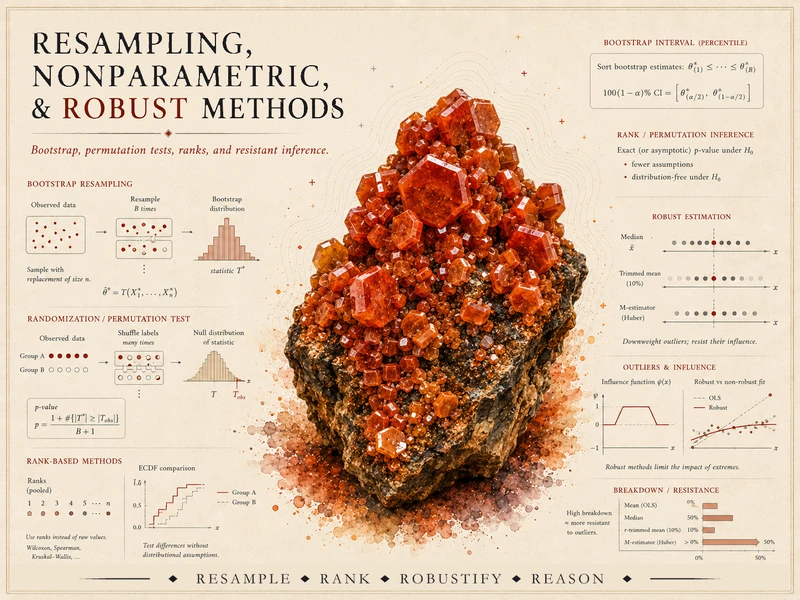
Course identity hero for Resampling, Nonparametric and Robust Methods — a red-orange vanadinite crystal cluster surrounded by assumption-light graphics including a bootstrap percentile interval, permutation and randomization tests, rank-based methods, robust estimators with a breakdown-point chart, and a method-comparison simulation, with the course title.

Real data are often skewed, heavy-tailed, ordinal, small-sample, or contaminated by outliers. This course studies the statistical methods that stay useful when the normal model, equal variances, and large-sample formulas are hard to justify — and it treats resampling, ranks, robustness, and simulation as core ideas, not as a box of backup tests to reach for only after a normality test fails.

What this course is

This is a course about assumption-light statistical reasoning. Many introductory and intermediate courses begin with familiar models — normal distributions, equal variances, the \(t\)-test, ANOVA, large-sample approximations. Those tools matter, but real data frequently break their assumptions. This course starts from a different question: what can we responsibly infer from the data with weaker assumptions?

We build the reasoning and the tools in order: empirical distributions, order statistics, and ranks; the logic of permutation and randomization tests; bootstrap distributions and confidence intervals; rank-based one-sample, paired, and two-sample methods; ordinal and categorical outcomes; robust summaries, outliers, and influence; robust regression ideas; the honest comparison of parametric and nonparametric conclusions; and simulation studies that show how methods actually behave.

The throughline is a single discipline we call the assumption ladder. For every method we ask four questions: what does it assume, what does it resample or rank or downweight, what does it protect against, and what can it still not prove? “Assumption-light” never means “assumption-free.” A bootstrap interval is a procedure with assumptions, not model-free truth; a rank test still assumes something; a robust estimator trades efficiency for resistance. We name the trade every time.

We use R and Quarto to shuffle labels, resample, rank, and fit robust models. But this is a methods-and-reasoning course, not a programming course and not a formula-only inference course: the code is the means, the method’s logic is the message.

What you will be able to do

By the end of the term, you should be able to:

  • Explain why assumption-light methods are useful, and distinguish parametric, nonparametric, resampling-based, randomization-based, and robust approaches.
  • Use empirical distributions, ranks, order statistics, and quantiles to summarize data.
  • Explain and carry out permutation and randomization tests, and read what each does and does not assume.
  • Use the bootstrap to approximate sampling variability, construct bootstrap confidence intervals, and explain when the bootstrap may fail.
  • Apply and interpret rank-based methods for one-sample, paired, and two-sample problems, and analyze ordinal outcomes with methods that respect the measurement scale.
  • Compare means, medians, trimmed means, and other robust summaries; identify outliers and influential points without treating every unusual value as an error.
  • Explain the idea of robust regression and why least squares is sensitive to unusual observations.
  • Use simulation studies to compare method behavior, and compare parametric and nonparametric conclusions without automatically treating one as more “correct.”

How the site is organized

This public site has three working areas, reachable from the sidebar:

  • Notes — the weekly instructional spine. Each week poses a question, develops the method, works it on a recurring dataset, names a common mistake, and offers ungraded self-checks. Start here.
  • Labs — the hands-on strand. Four short labs in R and Quarto let you build a randomization test, bootstrap a median, fit a robust regression against least squares, and run a method-comparison simulation. Code is shown for study; you run it in your own session.
  • Resources — a methods glossary, a method chooser that walks you from a data shape to a defensible method, a resampling guide that lays permutation and the bootstrap side by side, and a robustness-and-outliers guide. Keep these open while you read.

A recurring world

To keep the ideas concrete, the course returns to one synthetic world — the Riverside Wellness Program, a campus effort to shorten service waits and improve student wellbeing — studied through four datasets of different shapes: a skewed two-group comparison (service wait times), a paired before/after set (wellbeing scores), an ordinal set (satisfaction ratings), and a contaminated scatter (engagement vs gain). Each shape is exactly where a particular assumption-light method earns its keep. All data are synthetic, with the seed set; the same world seen through four lenses makes the method choice visible.

Software

We use R (via RStudio or Posit Cloud) together with Quarto. No prior coding experience is assumed — the work is scaffolded and the code is explained as it goes. On this draft course site, R chunks are shown as static teaching code and are not executed in place; you run them in your own session.

Source and attribution

These notes are the course’s own synthesis, grounded in but not copied from open and freely available sources:

  • Primary materials: instructor notes, examples, and method guides (the course’s own work).
  • Resampling & inference concepts: Introduction to Modern Statistics, 2nd ed. (Çetinkaya-Rundel & Hardin) — free at openintro-ims.netlify.app. License: CC BY-SA 3.0.
  • Resampling R workflow & reproducible reports: Statistical Inference via Data Science: A ModernDive into R and the Tidyverse, 2nd ed. (Ismay, Kim & Valdivia) — free at moderndive.com/v2. License: CC BY-NC-SA 4.0.
  • Optional advanced classical reference: Nonparametric Statistical Methods, 3rd ed. (Hollander, Wolfe & Chicken, Wiley) — a commercial text; named and cited only.

All example data are synthetic with the seed set; the prose here is original.

A note on what is public here

Everything on this site is public and ungraded — study material only. You will not find graded prompts, answer keys, rubrics, point values, or schedules here. The operational side of the course — graded method checkpoints, quizzes, homework and method reports, resampling and robustness labs, the midterm, the applied robust-methods project, and the final exam, along with all dates and submissions — lives in Blackboard (the LMS), which is authoritative. If this site and Blackboard ever disagree, follow Blackboard.

NoteDraft course site

This is a draft course site, not a finished release. Some pages are drafts, every numeric value in the example datasets is synthetic and provisional pending human review, and no accessibility-compliance claim is made. Treat it as a work in progress rather than the final word.