Week 13 — Cayley’s theorem and permutation representations
Where this week starts
Week 2 built the permutation groups as the course’s first concrete non-abelian example, and every week since has come back to them: \(S_3\) for cosets that differ on the two sides, \(A_4\) for the failure of Lagrange’s converse, \(A_n\) for a normal subgroup with a two-element quotient. They have been useful out of all proportion to their apparent status as one family among many.
This week explains that. Cayley’s theorem says every group is isomorphic to a subgroup of a permutation group. Not “resembles” and not “can be modelled by” — is isomorphic to. The permutation groups are not one family among many; they are, up to isomorphism, all of group theory.
The proof is short and worth anticipating, because it is the last major argument of the group-theory half of the course and it uses almost everything in it. Fix \(g \in G\) and consider the map \(\lambda_g \colon G \to G\) given by \(\lambda_g(x) = gx\). Cancellation makes it injective, and solvability of \(gx = y\) makes it surjective, so it is a bijection of the set \(G\) — that is, an element of the symmetric group on \(G\). Then \(g \mapsto \lambda_g\) is a homomorphism with trivial kernel, and Week 12’s criterion turns injectivity into an isomorphism onto the image.
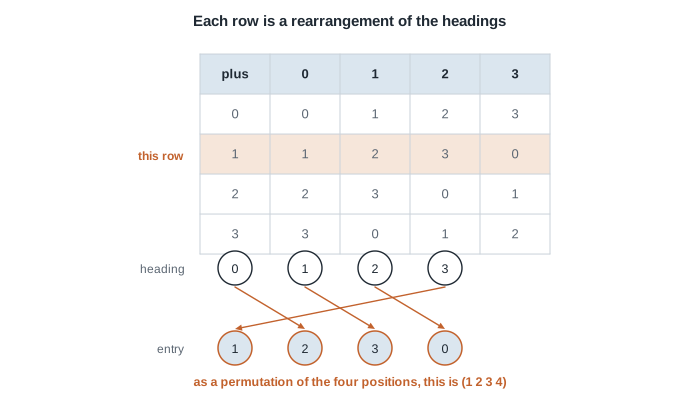
There is also something concrete to see. The permutation \(\lambda_g\) is not an abstraction: it is literally the row of \(g\) in the Cayley table, read as a rearrangement of the column headings. The theorem says that reading every row of a group table as a permutation produces a faithful copy of the group.
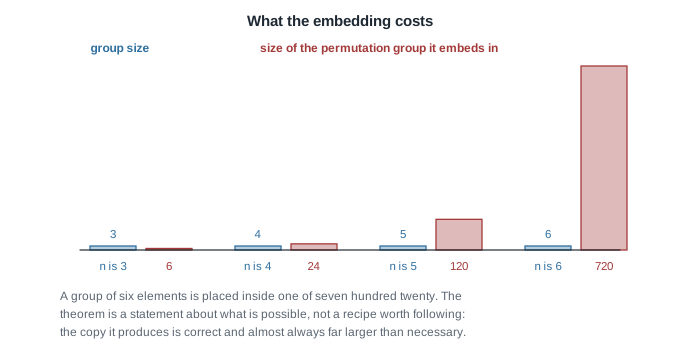
The week ends honestly. Cayley’s theorem classifies nothing, and the copy it produces is enormously larger than it needs to be — a group of six elements lands inside a group of seven hundred and twenty.
Why this matters beyond the definition
The theorem is often mis-stated as “every group is a permutation group”, which is false as written. A group of order six is not a set of permutations; it is isomorphic to a subgroup of \(S_6\), and the distinction is the entire content.
The point is easiest to see by asking what the theorem does not do. Both \(\mathbb{Z}_4\) and the Klein four-group embed in \(S_4\), and Week 11 proved they are not isomorphic. So embedding into a permutation group cannot collapse the distinction between two groups — it renders that distinction in permutations rather than erasing it.
What you will be able to do
- Prove that left multiplication by a fixed element is a bijection of the underlying set.
- Prove that \(g \mapsto \lambda_g\) is an injective homomorphism into the symmetric group on \(G\).
- State Cayley’s theorem precisely and explain why “subgroup of” cannot be dropped.
- Read the permutation \(\lambda_g\) directly off a row of a Cayley table.
- Construct the permutation representation of a small group and say what the embedding costs.
Terms and notation worth fixing
| Term | Meaning as used in this course |
|---|---|
| \(\operatorname{Sym}(X)\) | the group of all bijections of the set \(X\) onto itself, under composition |
| \(\lambda_g\) | the left translation by \(g\): the map \(x \mapsto gx\) from \(G\) to \(G\) |
| left regular representation | the homomorphism \(\lambda \colon G \to \operatorname{Sym}(G)\), \(g \mapsto \lambda_g\) |
| embedding | an injective homomorphism; its image is a copy of the domain |
| faithful | a representation with trivial kernel, so no information is lost |
| coset representation | the analogous map \(G \to \operatorname{Sym}(G/H)\) for a subgroup \(H\) |
When \(\lvert G \rvert = n\) we identify \(\operatorname{Sym}(G)\) with \(S_n\) by numbering the elements of \(G\) from \(1\) to \(n\); which numbering is used changes the picture and not the conclusion.
Left translation, and why it is a permutation
Fix \(g \in G\) and define \(\lambda_g \colon G \to G\) by \(\lambda_g(x) = gx\).
Note what \(\lambda_g\) is and is not. It is a map from the set \(G\) to itself. It is generally not a homomorphism: \(\lambda_g(xy) = gxy\), while \(\lambda_g(x)\lambda_g(y) = gxgy\), and these differ unless \(g = e\). Left translation is a rearrangement of the group, not a structure-preserving map of it, and that is exactly the role it plays here.
It is a bijection
Injective: if \(gx = gy\) then \(x = y\) by left cancellation, which Week 6 proved holds in every group.
Surjective: given \(y \in G\), take \(x = g^{-1}y\); then \(\lambda_g(x) = g(g^{-1}y) = y\).
So \(\lambda_g \in \operatorname{Sym}(G)\). Notice that both halves used a group axiom that fails in general algebraic systems: cancellation needs inverses, and solvability needs them too. In a system with only an associative operation, left translation need not be a bijection at all.
Reading it off the Cayley table
Here is the concrete form of the same statement. Write the Cayley table of \(G\) with the same ordering of elements down the side and along the top. The row headed \(g\) lists the values \(gx\) as \(x\) runs along the headings — which is exactly \(\lambda_g\). Every row of a group table is a rearrangement of the headings, which is the Latin square property Week 6 derived from cancellation, and now that property has a name.
The map \(g \mapsto \lambda_g\) is an injective homomorphism
The map \(\lambda \colon G \to \operatorname{Sym}(G)\) sending \(g \mapsto \lambda_g\) is a homomorphism with \(\ker\lambda = \{e\}\).
Proof. For the homomorphism property, evaluate both sides at an arbitrary \(x\). Recalling Week 2’s convention that the right factor is applied first, \[(\lambda_g \circ \lambda_h)(x) = \lambda_g(hx) = g(hx) = (gh)x = \lambda_{gh}(x).\] Since they agree at every \(x\), \(\lambda_g \circ \lambda_h = \lambda_{gh}\). Associativity in \(G\) is exactly what makes this work, which is worth noticing: the theorem is not available without it.
For the kernel, suppose \(\lambda_g\) is the identity permutation. Then \(gx = x\) for every \(x\), and taking \(x = e\) gives \(g = e\). So the kernel is trivial and \(\lambda\) is injective by Week 12’s criterion. \(\square\)
Cayley’s theorem
Every group \(G\) is isomorphic to a subgroup of \(\operatorname{Sym}(G)\). In particular, a group of order \(n\) is isomorphic to a subgroup of \(S_n\).
Proof. By the proposition, \(\lambda \colon G \to \operatorname{Sym}(G)\) is a homomorphism with trivial kernel. By Week 12, its image is a subgroup of \(\operatorname{Sym}(G)\), and the first isomorphism theorem gives \[G \;\cong\; G/\ker\lambda \;\cong\; \operatorname{im}\lambda \;\le\; \operatorname{Sym}(G).\] When \(\lvert G \rvert = n\), numbering the elements identifies \(\operatorname{Sym}(G)\) with \(S_n\). \(\square\)
The proof is four lines because Week 12 did the work. That is a reasonable illustration of what the isomorphism theorems are for: they turn “this map is injective” into “this is a copy” without further argument.
It is worth taking stock of how much of the course that four-line proof consumes. Cancellation, from Week 6, made the translations injective. The existence of inverses, from the axioms, made them surjective. Associativity made \(\lambda\) a homomorphism. The kernel criterion came from Week 12, and so did the first isomorphism theorem. And the object being landed in — the symmetric group — was built in Week 2. There is no step here that was not prepared, which is the sense in which the result is a closing theorem rather than a new departure.
There is also a small logical point that repays attention. The theorem is proved for every group, including infinite ones: \(\operatorname{Sym}(G)\) makes sense for any set \(G\), and nothing in the argument used finiteness. The statement about \(S_n\) is the finite specialisation, obtained by numbering the elements. So an infinite group such as \((\mathbb{R}, +)\) is isomorphic to a group of bijections of \(\mathbb{R}\) — a genuine and rather striking claim, and one that no amount of table inspection would have suggested.
What it does not say
It does not say \(G\) is a set of permutations. It says \(G\) is isomorphic to one, and the isomorphism is the content.
It does not classify anything. Knowing that a group of order eight embeds in \(S_8\) tells you nothing about which of the five groups of order eight you have.
It does not produce an efficient copy. The embedding sends a group of order \(n\) into a group of order \(n!\). For \(n = 6\) that is six elements inside seven hundred and twenty.
What the cycle structure of the image records
The embedding is faithful, so nothing is lost — but it is worth asking exactly how the group’s features reappear once everything has been turned into permutations.
Element orders become cycle structure. If \(\lvert g \rvert = m\) then \(\lambda_g\) has order \(m\), since \(\lambda\) is injective and preserves orders. More is true: \(\lambda_g\) has no fixed points whenever \(g \ne e\), because \(gx = x\) would force \(g = e\) by cancellation. A permutation of \(n\) symbols with order \(m\) and no fixed points must consist entirely of cycles of length \(m\), so \(m\) divides \(n\) — which is Lagrange’s theorem arriving from an unexpected direction. The image of an element of order \(m\) in a group of order \(n\) is always a product of exactly \(n/m\) disjoint \(m\)-cycles.
Check that against the two worked examples below. In \(\mathbb{Z}_4\) the element \(1\) has order four and its image is one four-cycle, since \(4/4 = 1\); the element \(2\) has order two and its image is \((1\,3)(2\,4)\), two disjoint transpositions, since \(4/2 = 2\). In the four-group every non-identity element has order two and every image is a product of two transpositions. The arithmetic works out every time, and it has to.
Abelianness becomes commuting permutations, and the centre becomes the permutations commuting with the whole image. Nothing is invisible in the copy; it is simply written in a different alphabet.
The coset representation
The same construction runs on the cosets of any subgroup. For \(H \le G\), let \(G\) act on the set of left cosets by \(g \cdot (aH) = (ga)H\). Each \(g\) gives a bijection of that set, and the resulting map \(G \to \operatorname{Sym}(G/H)\) is a homomorphism whose kernel sits inside \(H\) — taking \(a = e\) shows any \(g\) in the kernel satisfies \(gH = H\), so \(g \in H\).
Taking \(H = \{e\}\) recovers Cayley’s theorem exactly. Taking \(H\) larger gives a smaller and often much more efficient representation, into \(S_{[G:H]}\) instead of \(S_n\), at the cost of a kernel that may no longer be trivial. This is the standard route to a theorem of a later course: if \([G:H] = p\) is the smallest prime dividing \(\lvert G \rvert\), then \(H\) is normal.
Worked example — the cyclic group of order four inside the permutations of four symbols
Step 1 — number the elements. Take \(G = \mathbb{Z}_4 = \{0,1,2,3\}\) under addition, and call the element \(i\) the symbol \(i+1\). So \(0, 1, 2, 3\) are the symbols \(1, 2, 3, 4\).
Step 2 — compute \(\lambda_1\). Adding \(1\) sends \(0 \mapsto 1\), \(1 \mapsto 2\), \(2 \mapsto 3\), \(3 \mapsto 0\). In symbols that is \(1 \mapsto 2\), \(2 \mapsto 3\), \(3 \mapsto 4\), \(4 \mapsto 1\), so \[\lambda_1 = (1\,2\,3\,4).\]
Step 3 — compute the rest. Adding \(2\) sends \(0 \mapsto 2\), \(1 \mapsto 3\), \(2 \mapsto 0\), \(3 \mapsto 1\), giving \(\lambda_2 = (1\,3)(2\,4)\). Adding \(3\) gives \(\lambda_3 = (1\,4\,3\,2)\). And \(\lambda_0\) is the identity.
Step 4 — check it is a subgroup. The four permutations are the powers of \((1\,2\,3\,4)\), so the image is \(\langle (1\,2\,3\,4) \rangle\), a cyclic subgroup of order four inside \(S_4\), which has twenty-four elements.
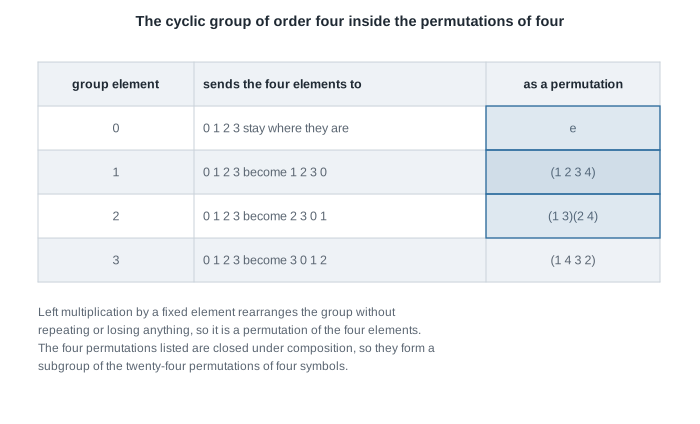
What this establishes. A concrete faithful copy of \(\mathbb{Z}_4\) inside \(S_4\), produced mechanically from the table.
What this does not establish. That \(S_4\) is the smallest permutation group containing a copy of \(\mathbb{Z}_4\). It is not — \(S_4\) is what Cayley’s construction happens to give.
The same reasoning, transferred
Run the construction on \(\mathbb{Z}_3 = \{0,1,2\}\), calling element \(i\) the symbol \(i+1\). Adding \(1\) sends \(0 \mapsto 1\), \(1 \mapsto 2\), \(2 \mapsto 0\), so \(\lambda_1 = (1\,2\,3)\), and \(\lambda_2 = (1\,3\,2)\). The image is \(\{\varepsilon, (1\,2\,3), (1\,3\,2)\} = A_3\) inside \(S_3\).
What stayed the same: the recipe. What changed: the efficiency. Here the ambient group \(S_3\) has six elements and the copy has three — an index of two, which is as tight as the construction ever gets. For \(\mathbb{Z}_4\) the copy sat inside a group six times its size, and for larger groups the ratio grows without bound. The recipe is uniform; its economy is not.
Second worked example — the four-group inside the permutations of four, and what distinguishes it
Step 1 — set up the table. Let \(V = \{e, a, b, c\}\) with \(a^2 = b^2 = c^2 = e\) and \(ab = c\), \(ac = b\), \(bc = a\). Number \(e, a, b, c\) as symbols \(1, 2, 3, 4\).
Step 2 — compute \(\lambda_a\). Left multiplication by \(a\) sends \(e \mapsto a\), \(a \mapsto e\), \(b \mapsto ab = c\), \(c \mapsto ac = b\). In symbols, \(1 \mapsto 2\), \(2 \mapsto 1\), \(3 \mapsto 4\), \(4 \mapsto 3\), so \[\lambda_a = (1\,2)(3\,4).\]
Step 3 — compute the others. By the same reading of the table, \(\lambda_b = (1\,3)(2\,4)\) and \(\lambda_c = (1\,4)(2\,3)\), with \(\lambda_e\) the identity.
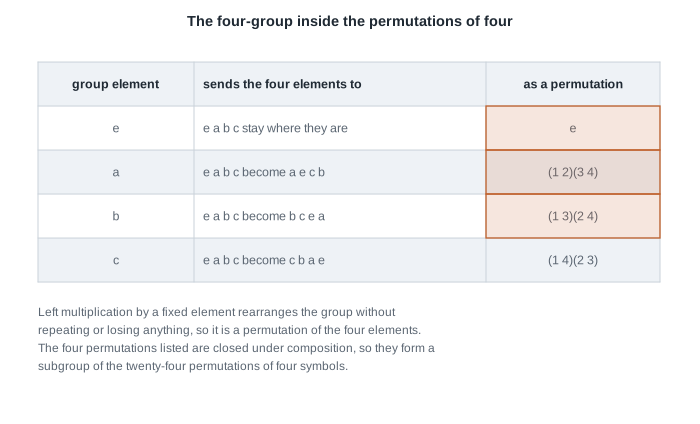
Step 4 — compare the two images. Both \(\mathbb{Z}_4\) and \(V\) have landed as subgroups of \(S_4\) of order four. But the first image is generated by a single four-cycle, and the second consists of three commuting products of two disjoint transpositions and contains no four-cycle at all. Two different subgroups of the same size in the same group.
Step 5 — draw the conclusion. Cayley’s theorem does not collapse the distinction Week 11 drew between \(\mathbb{Z}_4\) and \(V\). It renders that distinction in permutations: an element of order four becomes a four-cycle, and an element of order two becomes a product of disjoint transpositions. The order profile is visible in the cycle types.
What this establishes. That the embedding is faithful in the strong sense — non-isomorphic groups produce non-isomorphic images.
What this does not establish. That every order-four subgroup of \(S_4\) is one of these two. \(S_4\) has several, and cataloguing them is a different exercise.
The misreading to avoid
“Cayley’s theorem says every group is a permutation group.” It says every group is isomorphic to a subgroup of a permutation group, and both qualifications are load-bearing.
“Isomorphic to” rather than “is”: the elements of \(\mathbb{Z}_4\) are congruence classes, not permutations, and the theorem produces a copy rather than a re-description. “Subgroup of” rather than “equal to”: the image is a very small part of \(S_n\), and dropping the word would claim \(\lvert G \rvert = n!\) for a group of order \(n\), which is false for every \(n \ge 3\).
The habit worth building is to state the ambient object every time. “\(\mathbb{Z}_4\) is isomorphic to the subgroup \(\langle (1\,2\,3\,4) \rangle\) of \(S_4\)” is a complete and checkable sentence; “\(\mathbb{Z}_4\) is a permutation group” is not.
“So \(S_n\) is the biggest group.” There is no biggest group, and the theorem does not suggest one. What it says is that every group of order \(n\) embeds in \(S_n\) — a statement quantified over groups of a fixed order. \(S_n\) itself has order \(n!\), and by the theorem it embeds in \(S_{n!}\), which embeds in something larger still.
The related slip is to conclude that studying \(S_n\) is therefore enough. That is false in the way that matters: knowing every group sits inside some \(S_n\) tells you nothing about which subgroup, and the subgroups of \(S_n\) are exactly as varied as groups are. The theorem is a statement about what is possible in principle, not a strategy.
Practice on your own
These are for your own checking, not for submission.
Construct the left regular representation of \(\mathbb{Z}_6\) explicitly, numbering \(0, \dots, 5\) as symbols \(1, \dots, 6\). What is \(\lambda_1\) in cycle notation, and what are the cycle types of the other five?
Construct the left regular representation of \(S_3\) inside \(S_6\). How large is the image, how large is the ambient group, and how does that compare with the fact that \(S_3\) already sits inside \(S_3\)?
Prove that \(\lambda_g\) is a homomorphism if and only if \(g = e\), and explain why that does not damage the theorem.
Define \(\rho_g(x) = xg\), right multiplication. Show that \(g \mapsto \rho_g\) is generally not a homomorphism, and find the modification that repairs it.
Let \(H \le G\) with \([G:H] = 2\). Write down the coset representation \(G \to \operatorname{Sym}(G/H)\) explicitly and identify its kernel. What familiar homomorphism have you produced?
Where to read more
- The course text, Judson’s Abstract Algebra: Theory and Applications, is free to read at that address; Cayley’s theorem appears in its chapter on isomorphisms. Its worked embeddings of small groups are a good check on your own.
- MIT OpenCourseWare 18.703 Modern Algebra presents Cayley’s theorem as the first example of a group action, which is the framework a later course develops.
- Group Explorer will show a group’s multiplication table with rows highlighted, which makes the “each row is a permutation” reading immediate.
- Availability and licence terms are not confirmed for any of these sources.
- The schedule lists the units in order; the resources page collects the readings.
Where this goes next
Group theory is finished. The last two weeks add a second operation and ask the same four questions Week 1 asked about the first. A ring is an abelian group under addition with an associative multiplication that distributes over it, and almost everything you assume about multiplication turns out not to be an axiom: a ring need not be commutative, need not have a \(1\), and may contain non-zero elements whose product is zero. Week 14 builds the definitions and meets integral domains; Week 15 adds inverses for the second operation and reaches fields, closing the course on the same four properties it opened with. Continue to Week 14.
You can also return to the notes overview or the course home page.