Week 5 — Equivalence relations, partitions, and congruence classes
Where this week starts
You have already used this week’s central idea twice without naming it. In Week 2 the disjoint-cycle decomposition worked because the relation “\(y\) is reached from \(x\) by repeatedly applying \(\sigma\)” carves \(\{1, \dots, n\}\) into orbits with no overlap and no leftovers. In Weeks 3 and 4 you sorted integers by their remainder on division by \(n\) and treated all integers with the same remainder as interchangeable. Both are instances of a single construction: an equivalence relation and the partition it induces.
This week names it, proves the correspondence between the two, and then does something genuinely new with it. Taking \(\mathbb{Z}\) and the relation “\(a\) and \(b\) differ by a multiple of \(n\)” produces \(n\) classes, and one can try to add and multiply the classes themselves — not the integers inside them. That is the first time in this course a new algebraic system is built rather than found, and it is the prototype for two more constructions later: the quotient group in Week 10 and the field of fractions in Week 15.
Building it requires an argument you have probably never had to make. A class has many names — the class of \(2\) modulo \(5\) is also the class of \(7\), of \(12\), and of \(-3\) — and the recipe for multiplying classes says to multiply representatives. So the recipe involves a choice, and a definition that depends on an arbitrary choice is not a definition at all. Showing the choice does not matter is called checking that the operation is well defined, and it is the intellectual centre of the week. Do it slowly here and Weeks 10, 12, and 14 will each cost you an afternoon less.
Why this matters beyond the definition
Here is an equation students solve wrongly every year. Modulo \(6\), we have \(2 \cdot 1 = 2\) and \(2 \cdot 4 = 8 \equiv 2\). So \(2 \cdot 1 \equiv 2 \cdot 4 \pmod 6\) with the factor \(2\) on both sides — and yet \(1 \not\equiv 4 \pmod 6\). Cancellation fails.
That is not a curiosity. It is the reason \(\mathbb{Z}_n\) is a genuinely different arithmetic rather than the integers with smaller numbers, and it is the reason the linear congruence \(ax \equiv b\) can have no solutions at all, or several, where the equation \(ax = b\) over the rationals always has exactly one. By the end of the week you should be able to say precisely which classes can be cancelled, and Bézout’s identity from Week 4 will be what tells you.
What you will be able to do
- Verify that a given relation is or is not an equivalence relation, exhibiting the failing property by counterexample when it fails.
- Prove that the classes of an equivalence relation partition the set, and that every partition arises from exactly one equivalence relation.
- Prove that addition and multiplication of congruence classes are well defined, and say exactly what the proof rules out.
- Decide which classes are invertible modulo \(n\), using Bézout’s identity.
- Solve a linear congruence \(ax \equiv b \pmod n\) completely, including the count of solutions.
Terms and notation worth fixing
| Term | Meaning as used in this course |
|---|---|
| relation on \(X\) | a rule that, for each ordered pair from \(X\), either holds or does not; written \(a \sim b\) |
| reflexive | \(a \sim a\) for every \(a \in X\) |
| symmetric | \(a \sim b\) implies \(b \sim a\) |
| transitive | \(a \sim b\) and \(b \sim c\) imply \(a \sim c\) |
| equivalence relation | a relation that is reflexive, symmetric, and transitive |
| class of \(a\) | \([a] = \{\, x \in X : x \sim a \,\}\); any element of \([a]\) is a representative |
| partition of \(X\) | a collection of non-empty, pairwise disjoint subsets whose union is \(X\) |
| \(a \equiv b \pmod n\) | \(n \mid a - b\); read “\(a\) is congruent to \(b\) modulo \(n\)” |
| \(\mathbb{Z}_n\) | the set of congruence classes modulo \(n\), that is \(\mathbb{Z}/n\mathbb{Z}\) |
| \(U(n)\) | the classes in \(\mathbb{Z}_n\) that have a multiplicative inverse |
Products of classes are written with an explicit dot, as \([a] \cdot [b]\), throughout this course.
Equivalence relations and the partitions they induce
An equivalence relation is what you use when you want to treat different objects as the same for a particular purpose, without pretending they are literally equal.
The three properties, and one that is not implied
Reflexivity, symmetry, and transitivity are independent: no two of them imply the third. It is worth holding a counterexample for each in mind.
- On \(\mathbb{Z}\), the relation \(a \le b\) is reflexive and transitive but not symmetric.
- On \(\mathbb{Z}\), the relation \(a \ne b\) is symmetric but neither reflexive nor transitive.
- On \(\mathbb{Z}\), the relation \(\lvert a - b \rvert \le 1\) is reflexive and symmetric but not transitive, since \(1 \sim 2\) and \(2 \sim 3\) while \(1 \not\sim 3\).
A tempting false argument claims reflexivity follows from the other two: given \(a \sim b\), symmetry gives \(b \sim a\), and transitivity then gives \(a \sim a\). The gap is the words “given \(a \sim b\)”. If some element is related to nothing at all, the argument never starts, and reflexivity genuinely fails while symmetry and transitivity hold vacuously.
The correspondence with partitions
Let \(\sim\) be an equivalence relation on a set \(X\). Then the classes of \(\sim\) form a partition of \(X\). Conversely, every partition of \(X\) arises from exactly one equivalence relation.
Proof, first direction. Each class is non-empty, since \(a \in [a]\) by reflexivity, and the classes cover \(X\) for the same reason. It remains to show that two classes are either equal or disjoint.
Suppose \([a] \cap [b] \ne \varnothing\), say \(c\) lies in both. Then \(c \sim a\) and \(c \sim b\). Take any \(x \in [a]\), so \(x \sim a\). By symmetry \(a \sim c\), and by transitivity \(x \sim c\); then \(c \sim b\) and transitivity again give \(x \sim b\), so \(x \in [b]\). Hence \([a] \subseteq [b]\), and the same argument with \(a\) and \(b\) exchanged gives \([b] \subseteq [a]\). So \([a] = [b]\). \(\square\)
Proof, second direction. Given a partition, define \(a \sim b\) to mean that \(a\) and \(b\) lie in the same part. Reflexivity holds because every element lies in some part; symmetry is immediate; and transitivity holds because the parts are disjoint, so if \(a\) and \(b\) share a part and \(b\) and \(c\) share a part, those parts both contain \(b\) and are therefore the same part. That the relation is the only one with these classes follows because \(\sim\) is completely determined by which elements share a class. \(\square\)
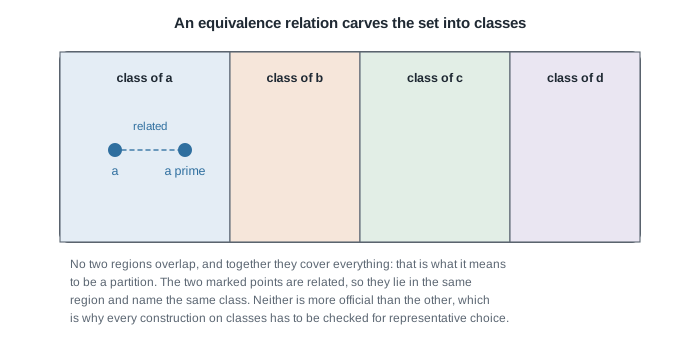
The consequence worth stating loudly: \([a] = [b]\) if and only if \(a \sim b\). A class is a set, not a favoured element, and it carries as many names as it has members. That is the whole source of the difficulty in the next section.
Congruence modulo \(n\), and building an arithmetic on the classes
Fix an integer \(n \ge 1\) and define \(a \equiv b \pmod n\) to mean \(n \mid a - b\).
It is an equivalence relation, with exactly \(n\) classes
Reflexive: \(n \mid a - a = 0\), and every integer divides \(0\). Symmetric: if \(n \mid a - b\) then \(a - b = nk\), so \(b - a = n(-k)\) and \(n \mid b - a\). Transitive: if \(n \mid a-b\) and \(n \mid b-c\) then \(n\) divides the sum \((a-b) + (b-c) = a-c\), by Week 3’s linearity property.
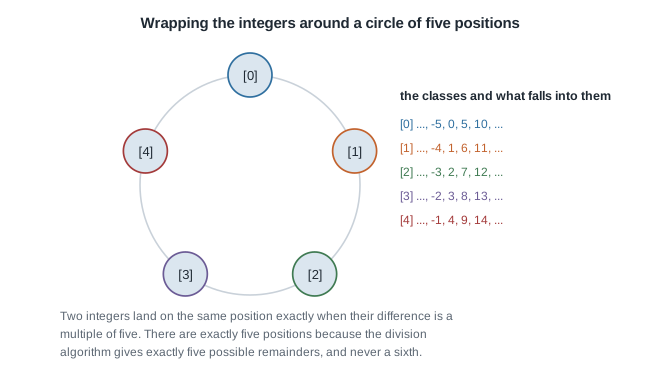
There are exactly \(n\) classes. By the division algorithm, every integer \(a\) has a unique remainder \(r\) with \(0 \le r < n\), and \(a \equiv r \pmod n\) because \(a - r = nq\). So every class contains one of \(0, 1, \dots, n-1\). And no two of those are congruent: if \(0 \le r < s < n\) then \(0 < s - r < n\), so \(n \nmid s - r\). The count is exactly the uniqueness clause of the division algorithm, which is why Week 3 insisted on it.
Well-definedness, done slowly
We want to define \([a] + [b] = [a+b]\) and \([a] \cdot [b] = [ab]\). The difficulty is that the right-hand sides are computed from \(a\) and \(b\), which are choices: nothing distinguishes \([2]\) from \([7]\) modulo \(5\) as names for the same class.
If \(a \equiv a' \pmod n\) and \(b \equiv b' \pmod n\), then \(a + b \equiv a' + b' \pmod n\) and \(ab \equiv a'b' \pmod n\).
Proof. By hypothesis there are integers \(s\) and \(t\) with \(a' = a + sn\) and \(b' = b + tn\).
For the sum, \(a' + b' = (a + b) + (s + t)n\), so \(n\) divides \((a'+b') - (a+b)\) and the two sums are congruent.
For the product, expand: \[a'b' = (a + sn)(b + tn) = ab + atn + bsn + stn^2 = ab + n(at + bs + stn).\] The bracket is an integer, so \(n \mid a'b' - ab\) and the two products are congruent. \(\square\)
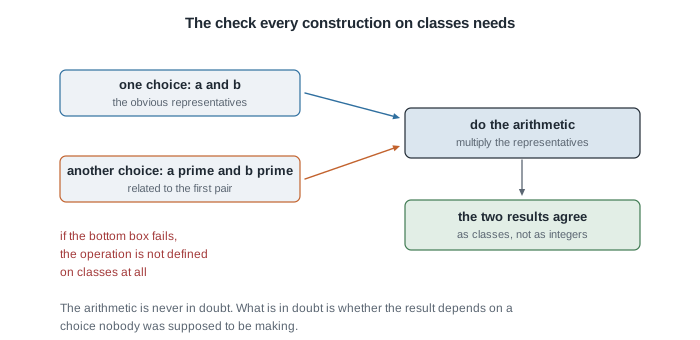
That is the argument, and it is worth naming what it rules out. It does not say the two products \(ab\) and \(a'b'\) are equal as integers — modulo \(5\), taking \(a = 2, b = 3\) and \(a' = 7, b' = 8\) gives \(6\) and \(56\), which are wildly different integers. It says they land in the same class, which is all the definition needs. Every well-definedness proof in this course has that shape: two choices, one computation each, and a demonstration that the outputs are identified even though they are not identical.
Which classes are invertible
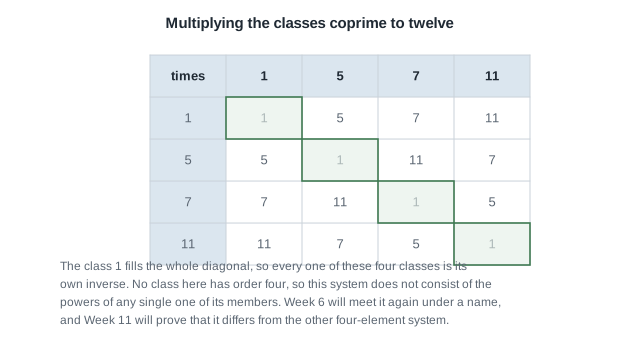
A class \([a]\) is a unit modulo \(n\) if there is a class \([x]\) with \([a] \cdot [x] = [1]\).
\([a]\) is a unit modulo \(n\) if and only if \(\gcd(a, n) = 1\).
Proof. Suppose \(\gcd(a,n) = 1\). By Bézout there are integers \(x, y\) with \(ax + ny = 1\). Then \(ax - 1 = -ny\) is a multiple of \(n\), so \(ax \equiv 1 \pmod n\) and \([x]\) is the inverse.
Conversely suppose \(ax \equiv 1 \pmod n\) for some \(x\). Then \(ax - 1 = nk\) for some \(k\), so \(ax - nk = 1\). Any common divisor of \(a\) and \(n\) divides the left side by linearity, so it divides \(1\) and equals \(\pm 1\). Hence \(\gcd(a,n) = 1\). \(\square\)
Cancellation, stated precisely
The units are exactly the classes you are allowed to cancel, and it is worth having that as a proposition rather than as a warning.
Let \([c]\) be a unit modulo \(n\). If \([c] \cdot [x] = [c] \cdot [y]\), then \([x] = [y]\).
Proof. Let \([d]\) be the inverse of \([c]\), so \([d] \cdot [c] = [1]\). Multiply both sides of the hypothesis on the left by \([d]\) and use associativity, which \(\mathbb{Z}_n\) inherits from \(\mathbb{Z}\): \[[x] = [1] \cdot [x] = ([d] \cdot [c]) \cdot [x] = [d] \cdot ([c] \cdot [x]) = [d] \cdot ([c] \cdot [y]) = ([d] \cdot [c]) \cdot [y] = [y]. \qquad \square\]
Read the proof again and notice that no division happened anywhere. What looks like cancelling a common factor is multiplication by an inverse, and it works exactly when that inverse exists. When \(\gcd(c, n) > 1\) there is no inverse, the argument has no first step, and the conclusion genuinely fails — as the pair \([1]\) and \([4]\) modulo \(6\) shows against \([c] = [2]\).
The set of units is written \(U(n)\), and it has \(\phi(n)\) elements, where \(\phi\) counts the integers in \(\{1, \dots, n\}\) coprime to \(n\). When \(n = p\) is prime, every one of \(1, \dots, p-1\) is coprime to \(p\), so \(U(p)\) has \(p - 1\) elements and every non-zero class is invertible — which Week 15 will recognise as the statement that \(\mathbb{Z}_p\) is a field.
Worked example — solving \(6x \equiv 9 \pmod{15}\)
Over the rationals, \(6x = 9\) has the single solution \(x = 3/2\). Modulo \(15\) the situation is different in both directions: there is no division available, and there turn out to be several solutions.
Step 1 — decide whether any solution exists. A solution means \(15 \mid 6x - 9\), that is \(6x - 15k = 9\) for some integer \(k\). Every integer combination of \(6\) and \(15\) is a multiple of \(\gcd(6,15) = 3\), by Week 3’s linearity property. So a solution can exist only if \(3 \mid 9\), which it does. Conversely, Bézout gives integers with \(6u + 15v = 3\), and multiplying by \(3\) produces a combination equal to \(9\). So solutions exist.
Step 2 — reduce the congruence. Since \(3\) divides \(6\), \(9\), and \(15\), divide the whole congruence through by \(3\) — including the modulus: \[2x \equiv 3 \pmod 5.\] Dividing the modulus is the step people forget. It is legitimate because \(6x - 9 = 15m\) is equivalent to \(2x - 3 = 5m\).
Step 3 — solve the reduced congruence. Now \(\gcd(2,5) = 1\), so \([2]\) is a unit modulo \(5\). Its inverse is \([3]\), since \(2 \cdot 3 = 6 \equiv 1 \pmod 5\). Multiply both sides: \[x \equiv 3 \cdot 3 = 9 \equiv 4 \pmod 5.\]
Step 4 — lift back to modulus \(15\). The classes modulo \(5\) that reduce from modulus \(15\) are \(x \equiv 4, 9, 14 \pmod{15}\) — three of them, one for each multiple of \(5\) we can add without leaving the original modulus.
Step 5 — verify all three. \(6 \cdot 4 = 24 = 15 + 9 \equiv 9\); \(6 \cdot 9 = 54 = 45 + 9 \equiv 9\); \(6 \cdot 14 = 84 = 75 + 9 \equiv 9\). All three check.
What this establishes. The general pattern: \(ax \equiv b \pmod n\) has a solution exactly when \(d = \gcd(a,n)\) divides \(b\), and then it has exactly \(d\) solutions modulo \(n\), obtained by solving the reduced congruence and adding multiples of \(n/d\).
What this does not establish. Anything about congruences with more than one unknown, or about \(x^2 \equiv b\), both of which behave quite differently.
The same reasoning, transferred
Solve \(4x \equiv 6 \pmod{10}\).
Here \(d = \gcd(4,10) = 2\), and \(2 \mid 6\), so solutions exist and there will be exactly two. Divide through by \(2\), modulus included: \(2x \equiv 3 \pmod 5\). That is the same reduced congruence as before, so \(x \equiv 4 \pmod 5\), and lifting to modulus \(10\) gives \(x \equiv 4, 9 \pmod{10}\).
Verify: \(4 \cdot 4 = 16 = 10 + 6 \equiv 6\), and \(4 \cdot 9 = 36 = 30 + 6 \equiv 6\). Both check.
What stayed the same: every step, and even the reduced congruence. What changed: the count of solutions, which is \(d = 2\) here rather than \(3\), because the count is exactly \(\gcd(a,n)\). Two different starting problems collapsing to the same reduced one is worth noticing — it says the reduced congruence is where the actual content lives.
Second worked example — a relation that is not an equivalence relation
On \(\mathbb{Z}\), define \(a \sim b\) to mean \(\lvert a - b \rvert \le 1\).
Step 1 — check reflexivity. \(\lvert a - a \rvert = 0 \le 1\), so \(a \sim a\) for every \(a\). Passes.
Step 2 — check symmetry. \(\lvert a - b \rvert = \lvert b - a \rvert\), so \(a \sim b\) gives \(b \sim a\). Passes.
Step 3 — check transitivity. Take \(a = 1\), \(b = 2\), \(c = 3\). Then \(\lvert 1 - 2 \rvert = 1 \le 1\) and \(\lvert 2 - 3 \rvert = 1 \le 1\), so \(1 \sim 2\) and \(2 \sim 3\). But \(\lvert 1 - 3 \rvert = 2 > 1\), so \(1 \not\sim 3\). Fails.
Step 4 — see what breaks downstream. Form the sets \([a] = \{a - 1, a, a + 1\}\) that the class notation would name. Then \([1] = \{0,1,2\}\) and \([2] = \{1,2,3\}\). These are neither equal nor disjoint: they share \(1\) and \(2\) and differ elsewhere. So they are not a partition, and the correspondence theorem’s conclusion visibly fails.
Step 5 — see what breaks in the notation. Since \(1 \sim 2\), the notation \([1] = [2]\) ought to hold; but \([1] \ne [2]\) as sets. So the symbol \([a]\) does not even name a well-defined object. Every statement of the form “let \([a]\) be the class of \(a\)” silently uses transitivity.
What this establishes. That transitivity is doing specific work — it is exactly the hypothesis that makes overlapping classes coincide, which is the step in the correspondence proof where \(c \sim a\) and \(c \sim b\) were chained together.
What this does not establish. That the relation is useless. It is a perfectly good notion of “close”, and relations like it are studied. It simply cannot be used to build classes.
The misreading to avoid
“\([a]\) is basically just \(a\).” It is not: \([a]\) is a set with infinitely many members, and \([2] = [7] = [12] = [-3]\) modulo \(5\) are four names for one object. The habit of writing \([a]\) and thinking \(a\) produces two specific errors.
The first is skipping well-definedness. If you think of \([a]\) as \(a\) then \([a] \cdot [b] = [ab]\) looks like a notation, not a construction needing proof, and you will skip the check every time it matters — including in Week 10, where for a non-normal subgroup the analogous check genuinely fails and the construction does not exist. Getting into the habit now, while the proof is three lines, is much cheaper than acquiring it under pressure later.
The second is importing cancellation. Over the integers, \(2x = 2y\) gives \(x = y\). Modulo \(6\) it does not: \(2 \cdot 1 \equiv 2 \equiv 2 \cdot 4\), and \(1 \not\equiv 4\). The precise statement is that you may cancel \([c]\) exactly when \([c]\) is a unit, that is when \(\gcd(c,n) = 1\) — and then the cancellation is really multiplication by \([c]^{-1}\), which is a legitimate operation, rather than division, which does not exist. Modulo \(6\), the class \([2]\) is not a unit since \(\gcd(2,6) = 2\), and that is precisely why the cancellation failed.
A useful way to hold this: \(\mathbb{Z}_n\) inherits addition, subtraction, and multiplication from \(\mathbb{Z}\), and inherits no division at all. Which classes happen to have inverses is a fact about \(n\), computed by Bézout, and Week 14 will name the classes that fail as zero divisors.
Practice on your own
These are for your own checking, not for submission.
For each relation on \(\mathbb{Z}\), decide which of the three properties hold: \(a \sim b\) iff \(a + b\) is even; \(a \sim b\) iff \(ab > 0\); \(a \sim b\) iff \(a^2 = b^2\). Describe the classes for whichever ones are equivalence relations.
Prove that congruence modulo \(1\) has exactly one class, and that congruence modulo \(n\) for \(n \ge 1\) has exactly \(n\). Which step of your argument uses the uniqueness half of the division algorithm?
Find every unit in \(\mathbb{Z}_{18}\) and give the inverse of each. Then verify that the number of units is \(\phi(18)\).
Solve each completely, or show that nothing satisfies it. \(8x \equiv 12 \pmod{20}\); \(9x \equiv 4 \pmod{15}\); \(5x \equiv 3 \pmod{11}\). Give the number of solutions in each case and check every one.
Prove that if \([c]\) is a unit modulo \(n\) and \([c] \cdot [x] = [c] \cdot [y]\), then \([x] = [y]\). Then exhibit a modulus and a non-unit class for which the conclusion fails.
Where to read more
- The course text, Judson’s Abstract Algebra: Theory and Applications, is free to read at that address; equivalence relations sit in its chapter on preliminaries and the arithmetic of congruence classes in its chapter on the integers. Its exercises on equivalence relations are worth doing in bulk, because the same verification recurs all term.
- MIT OpenCourseWare 18.703 Modern Algebra treats congruence classes as a first example of a quotient construction, which is exactly the framing Week 10 will need.
- Availability and licence terms are not confirmed for either source.
- The schedule lists the units in order; the resources page collects the readings.
Where this goes next
Everything is now in place for the definition the course has been circling since Week 1. Next week we name a set with an associative operation, an identity, and inverses a group, and immediately have a stock of examples: \(\mathbb{Z}\) under addition, \(\mathbb{Z}_n\) under addition, \(U(n)\) under multiplication, \(S_n\) under composition, the symmetries of a regular polygon, and the invertible matrices. The four-property audit of Week 1 becomes the definition, the permutations of Week 2 become the standard non-commutative example, and the units of this week become an infinite family of finite commutative ones. Continue to Week 6.
You can also return to the notes overview or the course home page.