Week 2 — Permutations and the symmetric group
Where this week starts
Last week ended with a promise: the first system to pass the whole four-property audit would be built out of functions, and it would pass without being commutative. This week builds it.
The objects are permutations — bijections of a finite set onto itself — and the operation is composition. Three of the four properties come free from facts about functions you already have. Composition of bijections is a bijection, so the set is closed. Composition of functions is always associative, so no triples need checking. The identity function is a bijection, so there is an identity. And a bijection has an inverse function that is itself a bijection, so every element has an inverse. The audit is over before it starts.
What makes this the most valuable example in the course is what it fails: commutativity. Composing two rearrangements in the other order generally produces a different rearrangement, and that failure is not a defect to be repaired. It is the source of nearly everything interesting later. When Week 10 asks why some subgroups admit a quotient and others do not, when Week 11 needs two four-element systems that are genuinely different, when Week 13 proves that every group hides inside a permutation group — the answer each time traces back to this week.
Two pieces of machinery have to be set up carefully before any of that. The first is notation: cycle notation is compact and readable, but only if you are fluent, and fluency takes deliberate practice this week rather than improvisation in Week 8. The second is a convention. Composition can be read in two directions, textbooks split roughly evenly, and a course that leaves it ambiguous produces students who get every second computation wrong. We fix it here and restate it every time it matters.
Why this matters beyond the definition
Ask a class for the order of the permutation \((1\,2\,3)(4\,5)\) — the least positive \(k\) with \(\sigma^k\) the identity — and a large fraction will say five, because there are five symbols, or six, because \(3 \times 2 = 6\). The second group has the right number for the wrong reason, and the distinction matters the moment the cycles are longer: the order of \((1\,2\,3\,4)(5\,6)\) is four, not eight, because the two cycles come back to rest together after four steps.
The correct rule is the least common multiple of the cycle lengths, and it is the first place in this course where Week 3’s arithmetic of divisibility does real work inside group theory. Getting it right depends on seeing a permutation as a set of independent loops turning at their own speeds rather than as a single string of symbols.
What you will be able to do
- Write a permutation in two-row form and in cycle notation, and convert between them.
- Compose two permutations correctly under the course’s stated convention, and demonstrate that the two orders generally give different results.
- Decompose a permutation into disjoint cycles and read its order off the cycle lengths.
- Express a permutation as a product of transpositions and determine its parity.
- Describe the symmetric group \(S_n\) and the alternating group \(A_n\), state their sizes, and write out \(S_3\) completely.
Terms and notation worth fixing
| Term | Meaning as used in this course |
|---|---|
| permutation of \(X\) | a bijection \(\sigma \colon X \to X\); here \(X = \{1, 2, \dots, n\}\) |
| \(S_n\) | the set of all permutations of \(\{1, \dots, n\}\) under composition, the symmetric group |
| \(\sigma\tau\) | the composite “apply \(\tau\) first, then \(\sigma\)”, so \((\sigma\tau)(x) = \sigma(\tau(x))\) |
| cycle \((a_1\,a_2\,\dots\,a_k)\) | the permutation sending \(a_1 \mapsto a_2 \mapsto \dots \mapsto a_k \mapsto a_1\) and fixing everything else |
| disjoint cycles | cycles with no symbol in common; disjoint cycles commute |
| transposition | a cycle of length two, \((a\,b)\) |
| \(\lvert \sigma \rvert\) | the order of \(\sigma\): the least \(k \ge 1\) with \(\sigma^k = \varepsilon\) |
| \(A_n\) | the set of even permutations in \(S_n\), the alternating group |
We write \(\varepsilon\) for the identity permutation on the page and \(e\) for a general group identity from Week 6 onward.
\(\sigma\tau\) means apply \(\tau\) first, then \(\sigma\) — the same order you read \(f(g(x))\), and the same order function composition uses everywhere else in mathematics. Some textbooks, including some you may consult, apply the left factor first. Neither is wrong; they simply disagree, and every computation you meet must be read under one of them. In this course the later map is written on the left, and every later unit that composes permutations restates this in a clause.
Permutations, and why the audit passes immediately
A permutation of \(\{1, \dots, n\}\) is a bijection of that set onto itself. It rearranges the symbols without losing or duplicating any.
Two-row notation and cycle notation
The most literal way to record a permutation is a two-row array: the symbols on top, their images underneath. So \[\sigma = \begin{pmatrix} 1 & 2 & 3 & 4 & 5 & 6 \\ 3 & 6 & 5 & 4 & 1 & 2 \end{pmatrix}\] means \(\sigma(1) = 3\), \(\sigma(2) = 6\), \(\sigma(3) = 5\), \(\sigma(4) = 4\), \(\sigma(5) = 1\), \(\sigma(6) = 2\). It is unambiguous and unbearably bulky.
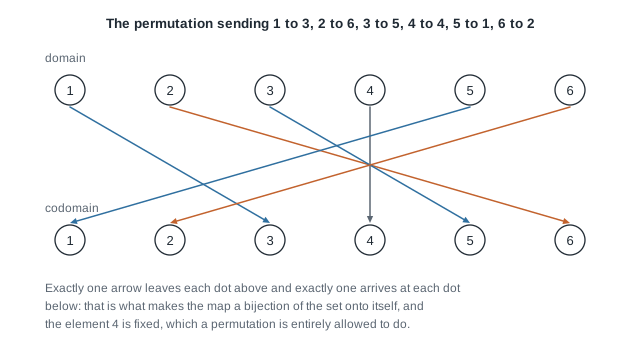
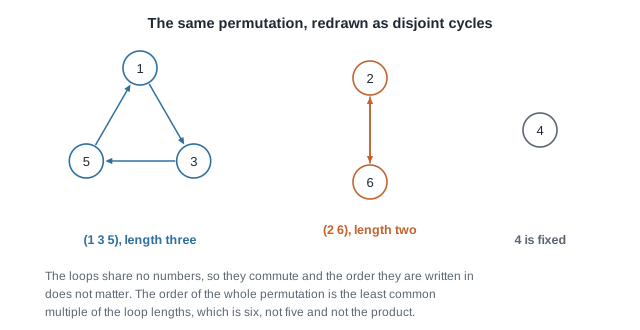
Cycle notation records the same information by following where a symbol goes and coming back. Start at \(1\): it goes to \(3\), which goes to \(5\), which goes back to \(1\). That closes a loop, written \((1\,3\,5)\). Now start at the smallest symbol not yet used, namely \(2\): it goes to \(6\), which goes back to \(2\), giving \((2\,6)\). The only symbol left is \(4\), which is fixed, and fixed symbols are conventionally omitted. So \[\sigma = (1\,3\,5)(2\,6).\]
Read a cycle as an instruction: each entry goes to the next, and the last goes back to the first.
Disjoint cycles, and what they buy
Two cycles are disjoint when they share no symbol. The decomposition above produced disjoint cycles, and that is not an accident.
Every permutation of a finite set is a product of disjoint cycles, and the decomposition is unique apart from the order in which the cycles are written and the choice of starting symbol within each cycle.
Proof sketch, with the compressed step named. The relation \(x \sim y\) when \(y = \sigma^k(x)\) for some integer \(k\) is an equivalence relation on \(\{1, \dots, n\}\) — a fact Week 5 will prove properly once equivalence relations are in place. Its classes are called the orbits of \(\sigma\). On each orbit, \(\sigma\) acts as a single cycle, because repeatedly applying \(\sigma\) to a point of a finite orbit must eventually return to it. Distinct orbits are disjoint, and every symbol lies in exactly one. Uniqueness follows because the orbits are determined by \(\sigma\) alone, not by any choice made during the construction. \(\square\)
Disjoint cycles commute with one another: if \(\alpha\) and \(\beta\) move no symbol in common, then each leaves the other’s symbols alone, so \(\alpha\beta\) and \(\beta\alpha\) have the same effect on every symbol. This is worth stating precisely because it is the source of a standard error. Disjoint cycles commute. Cycles in general do not: \((1\,2)(1\,3)\) and \((1\,3)(1\,2)\) are different permutations, as you should check.
The order of a permutation
Because disjoint cycles act independently, a cycle of length \(k\) returns every one of its symbols to where they started after exactly \(k\) applications, and after no fewer. A product of disjoint cycles is therefore the identity exactly when every cycle has completed a whole number of turns.
If \(\sigma\) decomposes into disjoint cycles of lengths \(k_1, \dots, k_m\), then \(\lvert \sigma \rvert = \operatorname{lcm}(k_1, \dots, k_m)\).
Proof. Write \(\sigma = \alpha_1 \cdots \alpha_m\) with the \(\alpha_i\) disjoint. Since disjoint cycles commute, \(\sigma^t = \alpha_1^t \cdots \alpha_m^t\), and because the \(\alpha_i\) move disjoint symbols, \(\sigma^t = \varepsilon\) forces \(\alpha_i^t = \varepsilon\) for each \(i\) separately. A cycle of length \(k_i\) satisfies \(\alpha_i^t = \varepsilon\) exactly when \(k_i \mid t\). So \(\sigma^t = \varepsilon\) exactly when every \(k_i\) divides \(t\), and the least such positive \(t\) is the least common multiple. \(\square\)
For \(\sigma = (1\,3\,5)(2\,6)\) the lengths are three and two, so \(\lvert \sigma \rvert = 6\). Not five, and not — as a coincidence of this example — distinguishable from the product \(3 \times 2\) until you look at a case where the lengths share a factor. For \((1\,2\,3\,4)(5\,6)\) the lengths are four and two, the least common multiple is four, and the product is eight; the order is four.
Transpositions, parity, and the alternating group
A transposition \((a\,b)\) swaps two symbols and fixes everything else. It is the simplest non-identity permutation, and every permutation is built from them.
Every permutation is a product of transpositions
A single cycle decomposes directly: \[(a_1\,a_2\,\dots\,a_k) = (a_1\,a_k)(a_1\,a_{k-1}) \cdots (a_1\,a_3)(a_1\,a_2),\] a product of \(k - 1\) transpositions. Check the case \(k = 5\) against the figure below, applying the rightmost swap first: starting from \(1\,2\,3\,4\,5\), the four swaps produce \(2\,3\,4\,5\,1\), which is exactly what \((1\,2\,3\,4\,5)\) does. Since every permutation is a product of disjoint cycles, and every cycle is a product of transpositions, every permutation is a product of transpositions. The identity is the empty product, or if you prefer, \((1\,2)(1\,2)\).
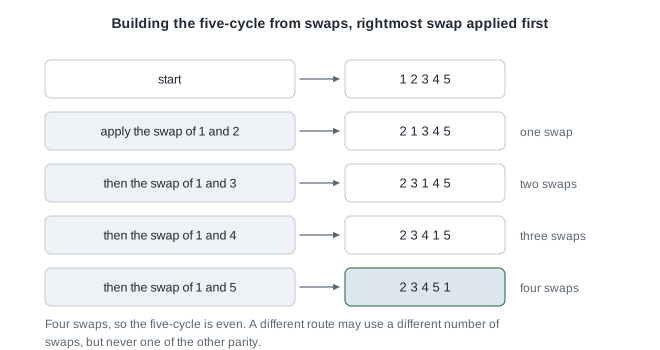
The decomposition is emphatically not unique. The same five-cycle can be written with six transpositions, or with eight, by inserting a swap and immediately undoing it. What is remarkable — and what makes the next definition possible — is that the number of transpositions is not free to vary however it likes.
Parity is well defined
No permutation can be written both as a product of an even number of transpositions and as a product of an odd number of transpositions.
Proof sketch, with the compressed step named. Consider the polynomial in \(n\) variables \[\Delta = \prod_{i < j} (x_i - x_j),\] the product over all index pairs with \(i < j\). Let a permutation \(\sigma\) act on \(\Delta\) by relabelling the variables, sending \(x_i\) to \(x_{\sigma(i)}\). The result is \(\pm \Delta\), because every factor is carried to \(\pm\) another factor and every pair is hit exactly once. The compressed step is a direct count showing that a single transposition produces the sign \(-1\): it reverses the factor \((x_a - x_b)\), and the remaining sign changes among the factors involving \(a\) or \(b\) pair off. Given that, writing \(\sigma\) as a product of \(t\) transpositions gives sign \((-1)^t\), and since the sign depends only on \(\sigma\), the parity of \(t\) does too. \(\square\)
So each permutation is even or odd, and the classification is unambiguous. A cycle of length \(k\) needs \(k - 1\) transpositions, so a cycle is even exactly when its length is odd — the five-cycle above is even, and a transposition itself is odd. This inversion trips people up every year: read the number of transpositions, not the length.
The symmetric and alternating groups
The set of all permutations of \(\{1, \dots, n\}\) is written \(S_n\) and has \(n!\) elements: there are \(n\) choices for the image of \(1\), then \(n-1\) for the image of \(2\), and so on. Under composition it passes the whole audit from Week 1, and it is non-commutative as soon as \(n \ge 3\).
The even permutations form a subset written \(A_n\). It is closed under composition, since even plus even is even; it contains \(\varepsilon\); and it is closed under inverses, since reversing a product of \(t\) transpositions gives another product of \(t\) transpositions. For \(n \ge 2\) exactly half of \(S_n\) is even, so \(\lvert A_n \rvert = n!/2\). The counting argument is worth seeing: pairing each even \(\sigma\) with \((1\,2)\sigma\) is a bijection from the even permutations to the odd ones.
Worked example — a product in \(S_6\), computed both ways
Let \(\sigma = (1\,3\,5)(2\,6)\) and \(\tau = (1\,4)(3\,6\,5)\) in \(S_6\). Compute \(\sigma\tau\) and \(\tau\sigma\).
Step 1 — write down what each does. From the cycle notation, \(\sigma\) sends \(1 \mapsto 3\), \(2 \mapsto 6\), \(3 \mapsto 5\), \(4 \mapsto 4\), \(5 \mapsto 1\), \(6 \mapsto 2\); and \(\tau\) sends \(1 \mapsto 4\), \(2 \mapsto 2\), \(3 \mapsto 6\), \(4 \mapsto 1\), \(5 \mapsto 3\), \(6 \mapsto 5\).
Step 2 — compute \(\sigma\tau\), applying \(\tau\) first. Take each symbol through \(\tau\) and then through \(\sigma\):
\[\begin{aligned} 1 &\xrightarrow{\ \tau\ } 4 \xrightarrow{\ \sigma\ } 4, &\qquad 2 &\xrightarrow{\ \tau\ } 2 \xrightarrow{\ \sigma\ } 6, \\ 3 &\xrightarrow{\ \tau\ } 6 \xrightarrow{\ \sigma\ } 2, &\qquad 4 &\xrightarrow{\ \tau\ } 1 \xrightarrow{\ \sigma\ } 3, \\ 5 &\xrightarrow{\ \tau\ } 3 \xrightarrow{\ \sigma\ } 5, &\qquad 6 &\xrightarrow{\ \tau\ } 5 \xrightarrow{\ \sigma\ } 1. \end{aligned}\]
Step 3 — read off the cycles. Start at \(1\): \(1 \mapsto 4 \mapsto 3 \mapsto 2 \mapsto 6 \mapsto 1\). That is a single five-cycle, and \(5\) is fixed. So \[\sigma\tau = (1\,4\,3\,2\,6).\]
Step 4 — order and parity. One cycle of length five, so \(\lvert \sigma\tau \rvert = 5\). A five-cycle is a product of four transpositions, so \(\sigma\tau\) is even and lies in \(A_6\).
Step 5 — now the other order. Take each symbol through \(\sigma\) first, then \(\tau\): \(1 \mapsto 3 \mapsto 6\), \(2 \mapsto 6 \mapsto 5\), \(3 \mapsto 5 \mapsto 3\), \(4 \mapsto 4 \mapsto 1\), \(5 \mapsto 1 \mapsto 4\), \(6 \mapsto 2 \mapsto 2\). Following from \(1\): \(1 \mapsto 6 \mapsto 2 \mapsto 5 \mapsto 4 \mapsto 1\), with \(3\) fixed. So \[\tau\sigma = (1\,6\,2\,5\,4).\]
What this establishes. Both products are five-cycles of order five, so they agree on every invariant we currently have — and they are different permutations, since \(\sigma\tau\) sends \(1\) to \(4\) while \(\tau\sigma\) sends \(1\) to \(6\). Composition in \(S_6\) does not commute, and no amount of agreement on cycle type implies equality.
What this does not establish. That \(\sigma\) and \(\tau\) never commute with anything. They commute with their own powers, with \(\varepsilon\), and with any permutation moving only symbols they fix. Non-commutativity is a statement about the operation, not about every individual pair.
The same reasoning, transferred
Run the identical procedure in \(S_5\) on \(\alpha = (1\,2\,3)\) and \(\beta = (3\,4\,5)\), which share the symbol \(3\) and so are not disjoint.
Applying \(\beta\) first: \(1 \mapsto 1 \mapsto 2\), \(2 \mapsto 2 \mapsto 3\), \(3 \mapsto 4 \mapsto 4\), \(4 \mapsto 5 \mapsto 5\), \(5 \mapsto 3 \mapsto 1\). So \(\alpha\beta = (1\,2\,3\,4\,5)\).
Applying \(\alpha\) first: \(1 \mapsto 2 \mapsto 2\), \(2 \mapsto 3 \mapsto 4\), \(3 \mapsto 1 \mapsto 1\), \(4 \mapsto 4 \mapsto 5\), \(5 \mapsto 5 \mapsto 3\). So \(\beta\alpha = (1\,2\,4\,5\,3)\).
What stayed the same: the procedure, and the conclusion that the two orders differ. What changed: these two cycles overlap in exactly one symbol, and the failure to commute is traceable to that single shared symbol. Had they been disjoint, both products would have been the same permutation. Two three-cycles composing to a five-cycle is also worth noticing — cycle lengths do not add or multiply in any simple way.
Second worked example — the symmetric group on three letters, in full
\(S_3\) has \(3! = 6\) elements: the identity \(\varepsilon\), the three transpositions \((1\,2)\), \((1\,3)\), \((2\,3)\), and the two three-cycles \((1\,2\,3)\) and \((1\,3\,2)\). It is the smallest non-commutative group, and it will reappear in Weeks 8, 10, and 11 as the standard counterexample to almost everything.
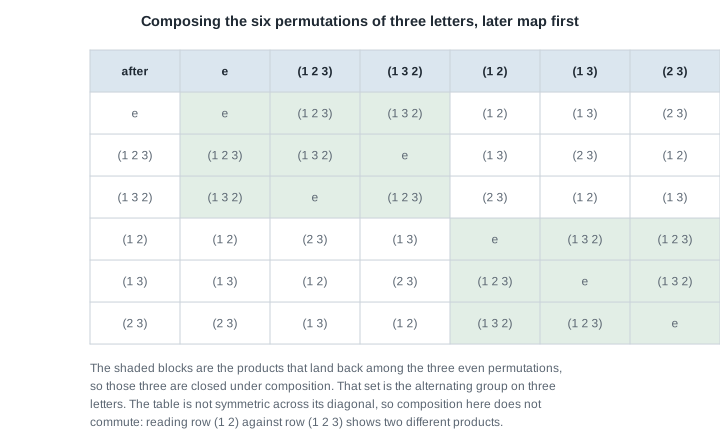
Here is the complete composition table, under the convention that the row element is applied after the column element.
| after \(\backslash\) first | \(\varepsilon\) | \((1\,2\,3)\) | \((1\,3\,2)\) | \((1\,2)\) | \((1\,3)\) | \((2\,3)\) |
|---|---|---|---|---|---|---|
| \(\varepsilon\) | \(\varepsilon\) | \((1\,2\,3)\) | \((1\,3\,2)\) | \((1\,2)\) | \((1\,3)\) | \((2\,3)\) |
| \((1\,2\,3)\) | \((1\,2\,3)\) | \((1\,3\,2)\) | \(\varepsilon\) | \((1\,3)\) | \((2\,3)\) | \((1\,2)\) |
| \((1\,3\,2)\) | \((1\,3\,2)\) | \(\varepsilon\) | \((1\,2\,3)\) | \((2\,3)\) | \((1\,2)\) | \((1\,3)\) |
| \((1\,2)\) | \((1\,2)\) | \((2\,3)\) | \((1\,3)\) | \(\varepsilon\) | \((1\,3\,2)\) | \((1\,2\,3)\) |
| \((1\,3)\) | \((1\,3)\) | \((1\,2)\) | \((2\,3)\) | \((1\,2\,3)\) | \(\varepsilon\) | \((1\,3\,2)\) |
| \((2\,3)\) | \((2\,3)\) | \((1\,3)\) | \((1\,2)\) | \((1\,3\,2)\) | \((1\,2\,3)\) | \(\varepsilon\) |
Three things to read off it. It is not symmetric across the diagonal: row \((1\,2)\) against column \((1\,2\,3)\) gives \((2\,3)\), while row \((1\,2\,3)\) against column \((1\,2)\) gives \((1\,3)\). Orders are visible: \(\varepsilon\) has order one, each transposition has order two since its square is \(\varepsilon\), and each three-cycle has order three. The even permutations close up: \(\{\varepsilon, (1\,2\,3), (1\,3\,2)\}\) is \(A_3\), and every product of two of them lands back inside — the shaded block in the figure.
\(S_3\) is also the full symmetry group of an equilateral triangle with labelled corners: the two three-cycles are the rotations through a third and two thirds of a turn, and the three transpositions are the reflections in the three axes. Every symmetry of the triangle permutes the corners, and every permutation of the corners is realised by a symmetry — which is why the two descriptions agree exactly here. That coincidence does not survive to the square, where the eight symmetries realise only eight of the twenty-four permutations of four corners.
The misreading to avoid
The misreading is about order, and it arrives in two forms.
“The order of \((1\,2\,3)(4\,5)\) is five, because five symbols are involved.” Symbols moved and order have nothing to do with each other. The order counts how many times you must apply the whole permutation before every symbol is home, and the three-cycle and the two-cycle come home on different schedules — the three-cycle after \(3, 6, 9, \dots\) steps, the two-cycle after \(2, 4, 6, \dots\). They coincide first at six. In general the order is \(\operatorname{lcm}\) of the cycle lengths, which is never larger than the product and is often strictly smaller: for \((1\,2\,3\,4)(5\,6)\) the order is four, not eight, because the two-cycle is home after two steps and again after four.
The remedy is to stop reading a permutation as a string and start reading it as independent loops turning at their own speeds. The figure of disjoint loops above is the right mental picture, and if you hold it, the least common multiple is not a formula to remember but the obvious statement that several wheels of different sizes return to their starting positions together at the least common multiple of their periods.
“Cycles commute.” Only disjoint ones do. The transfer example above is the standard refutation: \((1\,2\,3)\) and \((3\,4\,5)\) overlap in one symbol, and the two orders give two different five-cycles. The general principle worth carrying forward is that in any non-commutative system, writing \(ab\) when you meant \(ba\) is not a typographical slip but a different element, and this course will punish it repeatedly — most sharply in Week 8, where left and right cosets of the same subgroup turn out to be different sets.
Practice on your own
These are for your own checking, not for submission.
In \(S_7\), let \(\sigma = (1\,4\,2)(3\,7\,6\,5)\) and \(\tau = (2\,5)(1\,3\,4)\). Compute \(\sigma\tau\) and \(\tau\sigma\) in cycle notation, and give the order and parity of each.
Find all permutations in \(S_4\) of order four, and all of order three. How many are there of each, and what does that tell you about \(\lvert A_4 \rvert\)?
Prove that a cycle of length \(k\) has order \(k\), directly from the definition of a cycle, without quoting the least common multiple rule.
Show that \((1\,2)(1\,3) \ne (1\,3)(1\,2)\) by computing both, and then find two distinct non-disjoint permutations in \(S_4\) that do commute. What is special about your pair?
Prove that for \(n \ge 2\) the map \(\sigma \mapsto (1\,2)\sigma\) is a bijection from the even permutations of \(S_n\) to the odd ones, and deduce \(\lvert A_n \rvert = n!/2\). Where does the argument need \(n \ge 2\)?
Where to read more
- The course text, Judson’s Abstract Algebra: Theory and Applications, is free to read at that address; this week aligns with its chapter on permutation groups. Note when you open it that its composition convention may differ from ours — check which one it uses before working its exercises, and translate rather than mixing them.
- MIT OpenCourseWare 18.703 Modern Algebra develops the symmetric group and the sign of a permutation in its lecture notes, with a different route to the parity theorem.
- Group Explorer runs in a browser at no cost and will draw the multiplication table and the cycle graph of \(S_3\) for you. Comparing its table with the one above is a good way to discover which convention it uses.
- Availability and licence terms are not confirmed for any of these sources.
Where this goes next
The next two weeks step away from permutations and rebuild the integers. That looks like a detour and is not one. Two facts from this week already depend on divisibility: the order of a permutation is a least common multiple, and a cycle of length \(k\) returns to rest exactly when \(k\) divides the number of steps. Week 3 proves the division algorithm those statements quietly assumed, and Week 4 builds the Euclidean algorithm and unique factorization on top of it. When groups arrive in Week 6, that arithmetic will be waiting: Lagrange’s theorem in Week 8 is a divisibility statement, and the subgroup structure of a cyclic group in Week 7 is the divisor structure of an integer wearing a different hat. Continue to Week 3.
You can also return to the notes overview or the course home page.