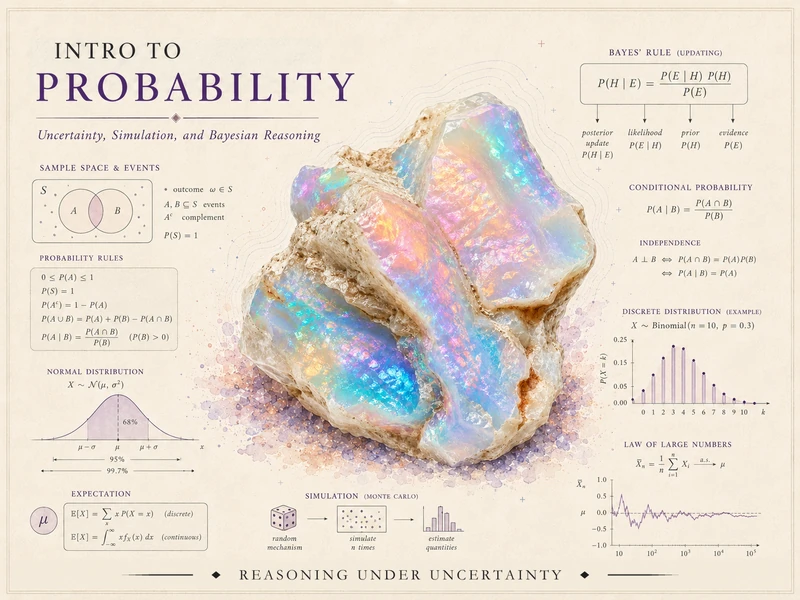
Introduction to Probability
Uncertainty, simulation, and Bayesian reasoning
Probability is the language we use to reason carefully when we do not — and cannot — know what will happen next. This course teaches you to speak it: to turn vague hunches about chance into precise statements, to update those statements as evidence arrives, and to check your reasoning by simulating the world on a computer.
What this course is
This is a first course in probability, built around a simple promise: by the end, uncertainty will feel less like a fog and more like a thing you can describe, compute with, and argue about. We start from the classical foundations — sample spaces, events, and the rules that govern them — and build steadily toward random variables, the standard distributions, and the limit behavior that makes large-sample reasoning possible.
The course is deliberately Bayesian-friendly. Conditional probability and updating are not a side topic tucked into one week; they sit near the center of how we think. When new information arrives, a well-posed probability changes in a disciplined way, and learning that discipline is one of the main things you will carry out of this course.
Throughout, we follow one small synthetic world — a commuter student’s morning, with an unreliable shuttle, the weather, a true/false quiz, and a stack of arriving buses. The same characters return week after week as the machinery grows, so that each new idea attaches to something you already understand rather than starting from scratch.
What you will be able to do
By the end of the term, you should be able to:
- Set up a sample space and assign probabilities to events, and use the complement, addition, and multiplication rules without second-guessing them.
- Compute and interpret conditional probabilities, and decide whether two events are independent.
- Apply Bayes’ rule to update a belief from a prior and evidence — and explain why a positive screening test can still leave a low probability of disease.
- Work with discrete and continuous random variables: their distributions, expectations, and variances, and the standard models (binomial, Poisson, exponential, normal).
- Describe how sums and averages behave — the law of large numbers and the central limit theorem — and see that behavior emerge in simulation.
- Build a small probability model of a real situation and defend the choices you made.
How the site is organized
This public site has three working areas, reachable from the sidebar:
- Notes — the weekly instructional spine. Each week poses a question, develops the concept, works examples (including the recurring commuter case), names a common mistake, and offers ungraded self-checks. Start here.
- Labs — the simulation strand. Four short labs in R and Quarto let you confirm the theory by generating data and watching the patterns appear. Code is shown for study; you run it locally.
- Resources — a notation glossary, a one-page distribution reference, and setup instructions for R and Quarto. Keep these open while you read.
Software
We use R (via RStudio or Posit Cloud) together with Quarto for the simulation work. The software is a support for probability reasoning, not the center of the course: simulation lets you check an answer you derived by hand, and build intuition for results that are hard to picture. No prior coding experience is assumed — every lab is scaffolded, and the code is explained as it goes. In the notes and labs on this site, R chunks are shown as teaching examples and are not executed in place; you run them in your own session. No paid homework platform is used in this course.
Source and attribution
These notes are the course’s own synthesis, grounded in but not copied from established sources. The course uses two free, openly licensed texts, and you are pointed to both:
- Primary text — Introduction to Probability by Charles M. Grinstead and J. Laurie Snell, a free text released under the GNU Free Documentation License. It grounds our scope, sequence, and notation level, and is named as a reading in every spine week.
- Supplementary text — MIT OpenCourseWare 18.05, Introduction to Probability and Statistics (CC BY-NC-SA 4.0, free). It is used selectively but genuinely — the notes link it alongside Grinstead & Snell for Bayesian reasoning, the standard models, simulation, and review.
- Optional orientation — E. T. Jaynes, Probability Theory: The Logic of Science, cited only for the one-line idea that probability can be read as extended logic — quantified reasoning under uncertainty. It is not a course text, and nothing from it is reproduced.
All examples use synthetic data with seeds set. The prose here is original.
A note on what is public here
Everything on this site is public and ungraded — study material only. You will not find graded prompts, answer keys, point values, or due dates here. The operational side of the course — graded checkpoints, quizzes, homework, labs, the midterm, the project, and the final, along with all dates and submissions — lives in Blackboard (the LMS), which is authoritative. If this site and Blackboard ever disagree, follow Blackboard.