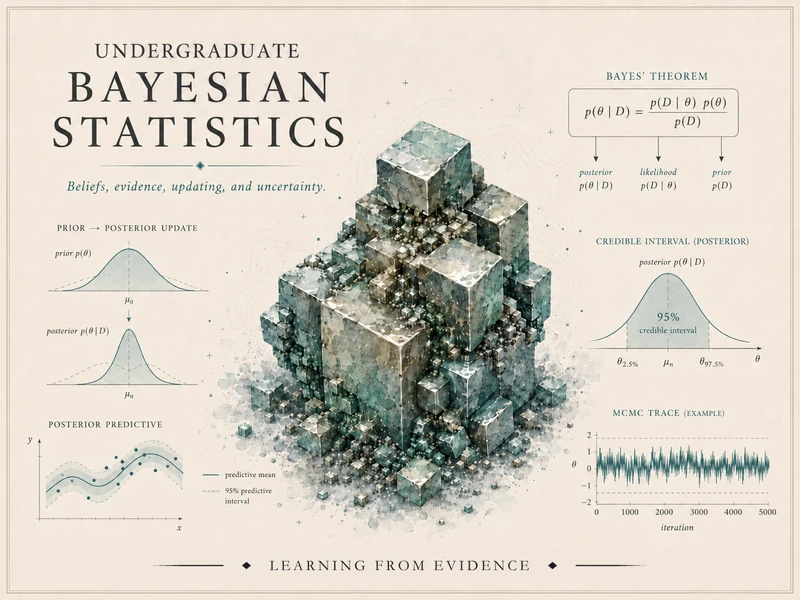
Bayesian Statistics
Probability, modeling, computation, and evidence
A first course in reasoning with uncertainty. We treat probability as the language of uncertainty: before data we describe what is plausible, after data we update that plausibility through a likelihood, and then we check whether the resulting model can generate data that look like the world. This public site carries the course’s instructional notes, labs, and resources.
What this course is
Bayesian statistics is a coherent framework for reasoning under uncertainty, updating belief with data, and using models to predict and decide. The course is applied and computational but it is not a software-training course and not a formula-memorization course. Building on introductory statistics and undergraduate probability, we move from discrete Bayes’ rule and diagnostic reasoning to priors, likelihoods, posteriors, posterior prediction, simple conjugate models, simulation-based summaries, Bayesian regression, model checking, and introductory hierarchical ideas.
Classical inference appears throughout as a point of comparison — confidence intervals, p-values, hypothesis tests, regression output — not as a foil, but so you can say clearly what each kind of statistical statement means and what it assumes.
What you will be able to do
By the end of the term, a student who has done the work should be able to:
- explain Bayesian reasoning as updating uncertainty in light of evidence, and use Bayes’ rule in discrete settings;
- identify, write, and interpret the prior, likelihood, posterior, and posterior predictive distributions of an applied model;
- work with simple models — Beta-Binomial, Gamma-Poisson, Normal — and summarize posterior uncertainty with credible and predictive intervals;
- reason about prior sensitivity, check models with posterior predictive thinking, and fit and interpret basic Bayesian regression;
- describe introductory hierarchical ideas (partial pooling, shrinkage), compare Bayesian and classical summaries responsibly, and communicate results to a non-technical audience;
- produce reproducible statistical work with local R, VS Code, and Quarto.
How the site is organized
- Notes — the weekly instructional spine, grouped into five parts across the 15-week term. Each week develops the ideas, works examples, names the common mistakes, and points to its reading.
- Labs — the hands-on, reproducible computation strand (R + Quarto): posterior simulation, grid approximation, regression, and partial pooling.
- Resources — the software setup, a running notation glossary, and a Bayes-vs-classical reference.
Software
The default workflow is a local install on your own machine: R for computation, VS Code as the editor, and Quarto for reproducible reports that combine code, output, graphics, and written interpretation. No paid platform is required. A limited number of MAC laptops may be available as a fallback. Setup help lives on the setup page.
Source and attribution
The primary open text is Bayes Rules! An Introduction to Applied Bayesian Modeling by Johnson, Ott, and Dogucu, which is readable online at no cost. Its licence and redistribution terms have not been confirmed for this site, so nothing here depends on them. These notes are the course’s own synthesis: they are organized around, and point you to, Bayes Rules! and other readings, but every explanation, example, and practice item here is written for this course. No exercise, example, dataset, figure, or passage from a source is reproduced.
A note on what is public here
This site is public, ungraded course material. Graded prompts, rubrics, point values, due dates, submission instructions, and answer keys are not posted here — those live in, and are governed by, Blackboard (the LMS), which is authoritative for everything graded and operational.
Draft course site. Topic flow is in place; dates, weights, and final policies are not sealed and are authoritative in the LMS.